The word yes is one of the most common words in English. It means agreement, approval, permission, or acceptance. People use it every day in conversations, meetings, classrooms, and online messages. Imagine your friend asks, “Would you like to join us for dinner?” You smile and reply, “Yes!” That single word quickly shows your agreement and positive response.
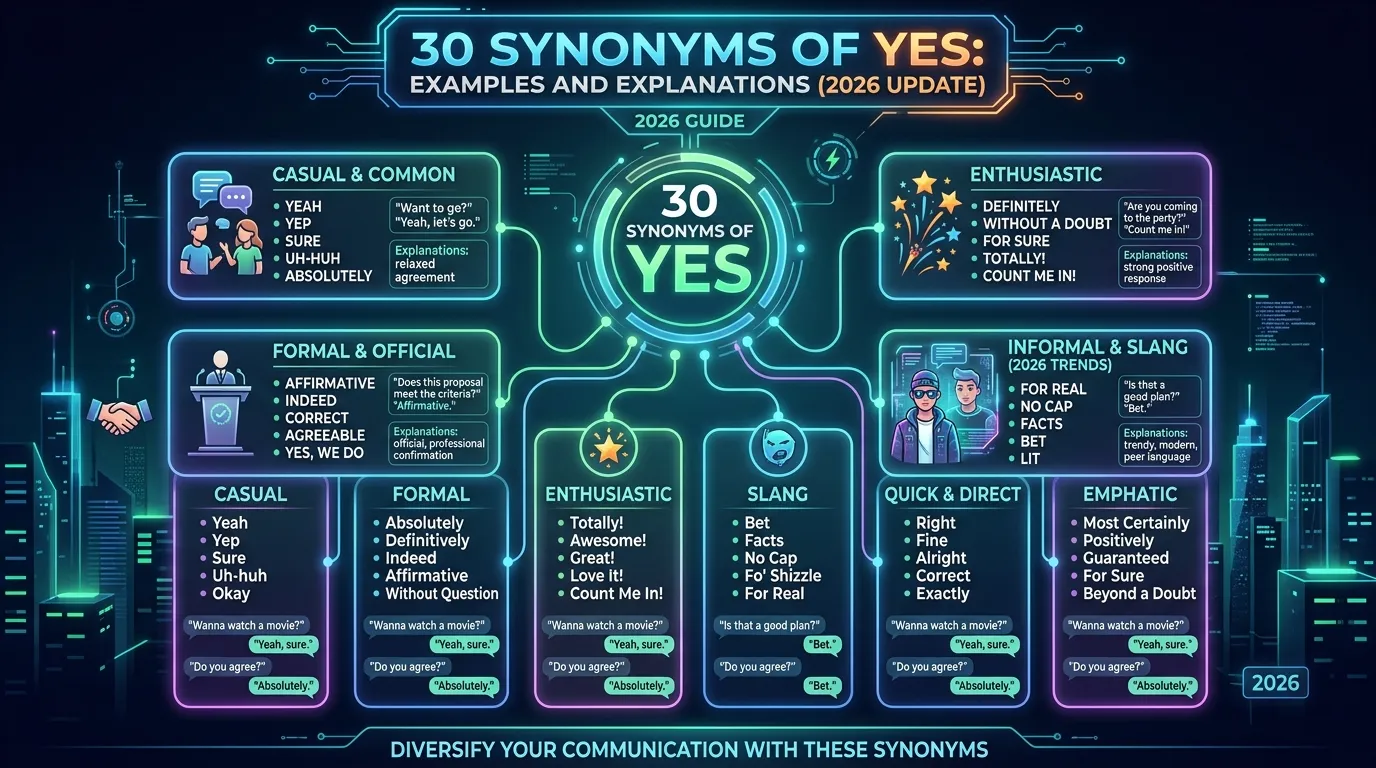
Although yes is simple, using different synonyms can make your speaking and writing more interesting. English learners, students, and content writers can improve their vocabulary by learning words that express agreement in different situations. Some synonyms sound formal, while others are casual or enthusiastic. In this article, you will learn the meaning of yes, its pronunciation, history, grammar, connotation, and 30 useful synonyms with examples. You will also discover when each synonym works best so you can communicate more naturally and confidently.
Meaning of Yes
Definition
Yes (Interjection):
A word used to express agreement, approval, permission, confirmation, or a positive answer.
Examples
- Yes, I would love to help you.
- She smiled and said yes to the invitation.
Connotative Meaning
- Positive tone: Shows agreement, support, willingness, happiness, or approval.
- Negative tone: Rarely negative, but it may sound unwilling or sarcastic depending on voice and context.
- Neutral tone: Simply answers a question or confirms information.
Etymology
- Origin: Old English
- Original form: gēse or gēa
- Original meaning: “So be it,” “indeed,” or “certainly.”
- It developed from early Germanic words expressing agreement.
Short History of the Keyword
- Old English (450–1100): Used as gēa and gēse to express agreement.
- Middle English (1100–1500): The spelling gradually became yes, replacing earlier forms.
- Modern English (1500–Present): Became the standard word for answering positively in spoken and written English.
Pronunciation (US & UK – IPA)
US: /jɛs/
UK: /jes/
Syllables
yes
Affixation Pattern of Yes
Root: yes
Prefix: None
Suffix: None
Word Formation of Yes
- Yes – interjection
- Yeses – noun (plural)
- Yes-man – noun
- Yes-woman – noun
- Yesmanship – noun
- Yes-like – adjective (rare)
30 Synonyms of Yes
1. Certainly (Adverb)
US: /ˈsɝːtənli/ | UK: /ˈsɜːtənli/
Meaning: Used to express confident agreement.
Examples:
- Certainly, I can help you.
- You may certainly use my notes.
2. Absolutely (Adverb)
US: /ˌæbsəˈluːtli/ | UK: /ˌæbsəˈluːtli/
Meaning: Expresses complete agreement.
Examples:
- Absolutely, that’s the right answer.
- I absolutely agree with you.
3. Definitely (Adverb)
US: /ˈdefɪnətli/ | UK: /ˈdefɪnətli/
Meaning: Shows strong certainty.
Examples:
- I will definitely come tomorrow.
- Definitely, that’s a great idea.
4. Indeed (Adverb)
US: /ɪnˈdiːd/ | UK: /ɪnˈdiːd/
Meaning: Used to confirm or emphasize agreement.
Examples:
- Indeed, it was an amazing trip.
- Yes, indeed, you are correct.
5. Surely (Adverb)
US: /ˈʃʊrli/ | UK: /ˈʃɔːli/
Meaning: Expresses confidence or certainty.
Examples:
- Surely, we can solve this problem.
- You can surely trust her.
6. Certainly So (Phrase)
US: /ˈsɝːtənli soʊ/ | UK: /ˈsɜːtənli səʊ/
Meaning: Means “yes, that is correct.”
Examples:
- Is this your book? Certainly so.
- Are you joining us? Certainly so.
7. Of Course (Phrase)
US: /əv kɔːrs/ | UK: /əv kɔːs/
Meaning: Shows willing agreement.
Examples:
- Of course, I’ll help you.
- You may borrow my pen, of course.
8. Affirmative (Adjective/Interjection)
US: /əˈfɝːmətɪv/ | UK: /əˈfɜːmətɪv/
Meaning: A formal word meaning “yes.”
Examples:
- The officer replied, “Affirmative.”
- The answer was affirmative.
9. Agreed (Adjective/Interjection)
US: /əˈɡriːd/ | UK: /əˈɡriːd/
Meaning: Shows acceptance of an idea.
Examples:
- Agreed, let’s start now.
- We all agreed to the plan.
10. Okay (Interjection)
US: /oʊˈkeɪ/ | UK: /əʊˈkeɪ/
Meaning: Accepts or agrees with something.
Examples:
- Okay, I’ll do it.
- Okay, let’s begin.
11. Alright (Interjection)
US: /ɔːlˈraɪt/ | UK: /ɔːlˈraɪt/
Meaning: Used to accept or agree with something.
Examples:
- Alright, I’ll join the meeting.
- Everything is alright now.
12. Fine (Adjective/Interjection)
US: /faɪn/ | UK: /faɪn/
Meaning: Shows acceptance or willingness.
Examples:
- Fine, let’s leave now.
- Fine, I agree with your idea.
13. Surely (Interjection/Adverb)
US: /ˈʃʊrli/ | UK: /ˈʃɔːli/
Meaning: Used to express confident agreement.
Examples:
- Surely, we can finish today.
- Surely, that’s true.
14. Right (Adjective/Interjection)
US: /raɪt/ | UK: /raɪt/
Meaning: Used to confirm agreement.
Examples:
- Right, let’s begin.
- You’re right.
15. Exactly (Adverb)
US: /ɪɡˈzæktli/ | UK: /ɪɡˈzæktli/
Meaning: Shows complete agreement.
Examples:
- Exactly! That’s my point.
- You understood exactly.
16. Correct (Adjective)
US: /kəˈrekt/ | UK: /kəˈrekt/
Meaning: True or accurate.
Examples:
- That answer is correct.
- Yes, you’re correct.
17. True (Adjective)
US: /truː/ | UK: /truː/
Meaning: Something that is real or accurate.
Examples:
- That’s true.
- Everything you said is true.
18. Accepted (Adjective)
US: /əkˈseptɪd/ | UK: /əkˈseptɪd/
Meaning: Approved or agreed upon.
Examples:
- Your proposal is accepted.
- The offer was accepted.
19. Granted (Verb/Adjective)
US: /ˈɡræntɪd/ | UK: /ˈɡrɑːntɪd/
Meaning: Permission or agreement has been given.
Examples:
- Permission granted.
- Granted, the task was difficult.
20. Very Well (Phrase)
US: /ˈveri wel/ | UK: /ˈveri wel/
Meaning: A polite way to agree.
Examples:
- Very well, we shall continue.
- Very well, I understand.
21. Roger (Interjection)
US: /ˈrɑːdʒər/ | UK: /ˈrɒdʒə/
Meaning: A radio communication term meaning “message received.”
Examples:
- Roger, I’ll move now.
- Roger, command understood.
22. Aye (Interjection)
US: /aɪ/ | UK: /aɪ/
Meaning: A formal or traditional word meaning “yes.”
Examples:
- Aye, captain.
- The members voted aye.
23. Yup (Interjection)
US: /jʌp/ | UK: /jʌp/
Meaning: An informal way to say “yes.”
Examples:
- Yup, I’m ready.
- Yup, that’s correct.
24. Yeah (Interjection)
US: /jæ/ | UK: /jeə/
Meaning: A very common informal form of “yes.”
Examples:
- Yeah, I know.
- Yeah, let’s go.
25. Yep (Interjection)
US: /jep/ | UK: /jep/
Meaning: A casual way to say “yes.”
Examples:
- Yep, that’s mine.
- Yep, I’ll come.
26. Uh-huh (Interjection)
US: /ˌʌˈhʌ/ | UK: /ˌʌˈhʌ/
Meaning: Shows agreement while listening.
Examples:
- Uh-huh, I understand.
- Uh-huh, continue please.
27. By All Means (Phrase)
US: /baɪ ɔːl miːnz/ | UK: /baɪ ɔːl miːnz/
Meaning: Gives willing permission.
Examples:
- By all means, have a seat.
- By all means, ask questions.
28. Willingly (Adverb)
US: /ˈwɪlɪŋli/ | UK: /ˈwɪlɪŋli/
Meaning: With readiness and agreement.
Examples:
- She willingly helped us.
- I willingly accepted the offer.
29. Positively (Adverb)
US: /ˈpɑːzətɪvli/ | UK: /ˈpɒzətɪvli/
Meaning: With certainty or approval.
Examples:
- I can positively confirm it.
- She answered positively.
30. Undoubtedly (Adverb)
US: /ʌnˈdaʊtɪdli/ | UK: /ʌnˈdaʊtɪdli/
Meaning: Without any doubt.
Examples:
- Undoubtedly, he is talented.
- This is undoubtedly true.
Prototype Meaning
When people hear the word yes, they usually think of a simple positive answer. It expresses agreement, acceptance, approval, permission, or confirmation. It is one of the first English words that learners study because it is useful in almost every conversation. Whether someone accepts an invitation, answers a question, or agrees with an idea, yes is the natural response.
Prototype Categorization
- Formal agreement: affirmative, certainly, indeed, very well
- Strong agreement: absolutely, definitely, exactly, undoubtedly
- Casual conversation: yeah, yep, yup, okay, alright, uh-huh
- Permission: by all means, granted, of course
- Confirmation: correct, true, right, positively
- Military or radio communication: roger
- Traditional or parliamentary use: aye
Antonyms of Yes
- No (Interjection): A negative answer or refusal.
- Never (Adverb): Not at any time.
- Not (Adverb): Used to make a statement negative.
- Refuse (Verb): To say no to something.
- Reject (Verb): To refuse to accept something.
- Decline (Verb): To politely refuse.
- Deny (Verb): To state that something is not true.
- Disagree (Verb): To have a different opinion.
- Oppose (Verb): To be against something.
- Object (Verb): To express disagreement.
Short Questions and Answers
- What does yes mean? It means agreement, approval, acceptance, permission, or a positive answer.
- When should yes be used? Use it when answering positively, agreeing with someone, accepting an offer, or giving permission.
- Is yes positive or negative? It is usually positive because it shows agreement or acceptance. However, tone and context may change its emotional meaning.
- How is it different from similar words? Yes is the most common positive response. Words like absolutely, certainly, and indeed express stronger, more formal, or more enthusiastic agreement.
Conclusion
Learning the Synonyms of Yes and Synonyms of Yes synonyms helps you become a stronger English speaker and writer. Instead of repeating the same word, you can choose expressions that match the situation, tone, and audience. Formal words such as affirmative and certainly work well in professional writing, while casual words like yeah, yep, and okay fit everyday conversations. Building your vocabulary improves communication, makes your writing more engaging, and increases your confidence in speaking English. Practice using a new synonym every day, and you will soon express agreement more naturally and effectively.

I’m Zahid Abbas, an educator, researcher, and digital publishing strategist with a passion for linguistics, grammar, and clear communication. As a content creator and SEO specialist, I craft research-driven, reader-focused content that empowers learners and makes knowledge accessible worldwide.