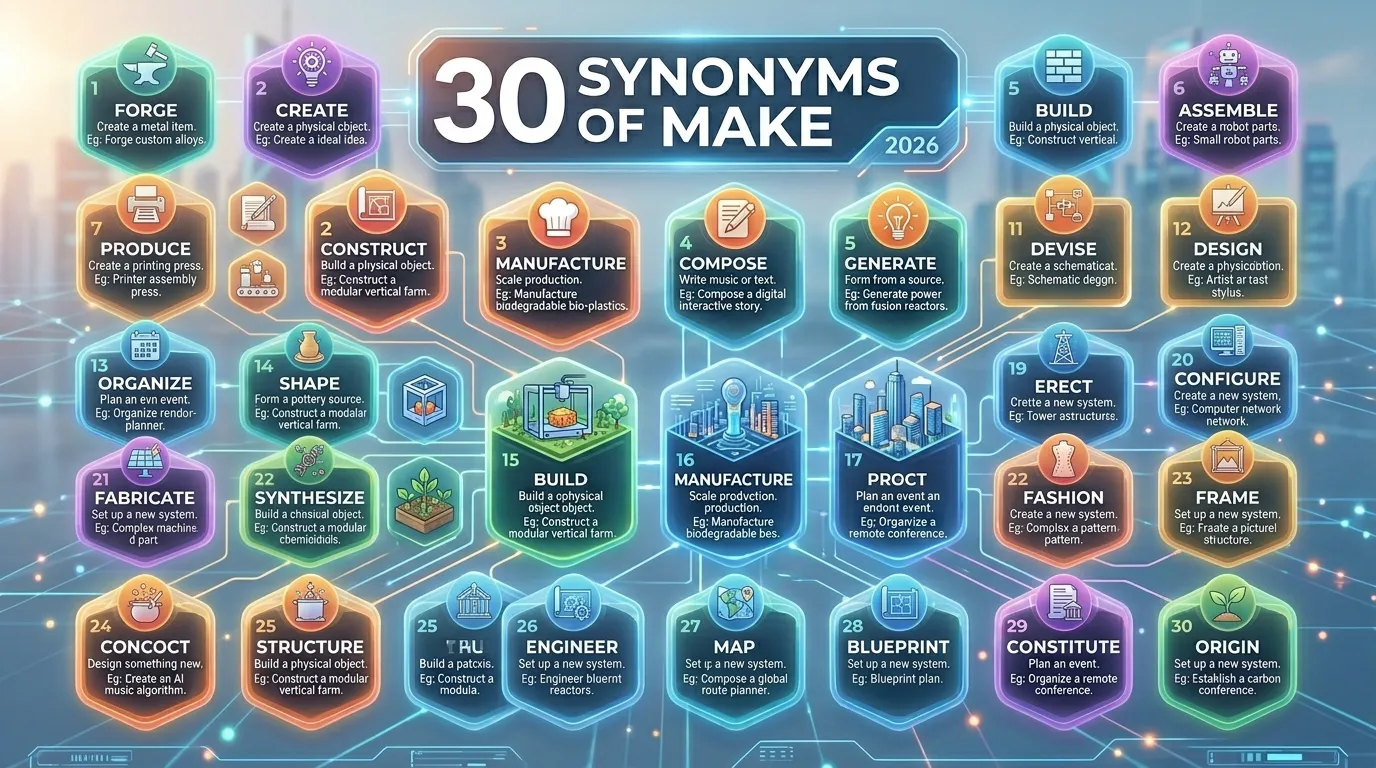
The word make is one of the most common verbs in English. It means to create, build, produce, or cause something to happen. Imagine a student making a science project for school or a chef making a delicious meal for customers. In both situations, the word make naturally describes the action of creating something.
People use make every day in speaking and writing because it fits many situations. However, using the same word repeatedly can make writing sound boring. Learning synonyms helps English learners express ideas more clearly and accurately. It also helps content writers improve readability and avoid repetition.
In this article, you will learn the meaning of make, its pronunciation, history, grammar, connotation, and 30 useful synonyms. You will also see examples and categories that help you choose the best word for different situations.
Meaning of Make
Make (Verb):
To create, build, produce, prepare, or cause something to happen.
Examples
- She can make beautiful greeting cards.
- Hard work can make a big difference in life.
Connotative Meaning
- Positive tone: create success, build relationships, make progress.
- Negative tone: make mistakes, make trouble, make problems.
- Neutral tone: make a list, make a decision, make a plan.
Etymology
- Origin: Old English macian
- Original meaning: to build, prepare, arrange, or form.
Short History of Make
- Old English (450–1100): Macian meant to build or construct.
- Middle English (1100–1500): The word expanded to include creating, causing, and producing.
- Modern English (1500–Present): Make became one of the most widely used English verbs with many meanings.
Pronunciation (US & UK – IPA)
US: /meɪk/
UK: /meɪk/
Syllables
make
Affixation Pattern of Make
Root: make
Prefix: None
Suffix: None
Word Formation of Make
- Make (Verb)
- Maker (Noun)
- Making (Noun/Verb)
- Made (Verb – past tense)
- Homemade (Adjective)
- Makeup (Noun)
- Moneymaker (Noun)
- Peacemaker (Noun)
30 Synonyms of Make
1. Create (Verb)
US: /kriˈeɪt/ | UK: /kriˈeɪt/
Meaning: To bring something new into existence.
Examples:
- The artist created a beautiful painting.
- They created a new website.
2. Produce (Verb)
US: /prəˈduːs/ | UK: /prəˈdjuːs/
Meaning: To make or manufacture something.
Examples:
- The factory produces cars.
- Farmers produce fresh vegetables.
3. Build (Verb)
US: /bɪld/ | UK: /bɪld/
Meaning: To construct something.
Examples:
- Workers built a bridge.
- We plan to build a new house.
4. Construct (Verb)
US: /kənˈstrʌkt/ | UK: /kənˈstrʌkt/
Meaning: To build carefully according to a plan.
Examples:
- Engineers constructed the tower.
- They constructed a strong fence.
5. Form (Verb)
US: /fɔːrm/ | UK: /fɔːm/
Meaning: To shape or create something.
Examples:
- Clouds formed in the sky.
- Students formed a group.
6. Generate (Verb)
US: /ˈdʒenəreɪt/ | UK: /ˈdʒenəreɪt/
Meaning: To produce or create.
Examples:
- Solar panels generate electricity.
- The campaign generated interest.
7. Develop (Verb)
US: /dɪˈveləp/ | UK: /dɪˈveləp/
Meaning: To create gradually over time.
Examples:
- The company developed new software.
- She developed useful skills.
8. Craft (Verb)
US: /kræft/ | UK: /krɑːft/
Meaning: To make skillfully.
Examples:
- He crafted a wooden chair.
- She crafted a thoughtful speech.
9. Manufacture (Verb)
US: /ˌmænjuˈfæktʃər/ | UK: /ˌmænjʊˈfæktʃə/
Meaning: To make goods in large quantities.
Examples:
- The company manufactures phones.
- They manufacture clothing.
10. Fabricate (Verb)
US: /ˈfæbrɪkeɪt/ | UK: /ˈfæbrɪkeɪt/
Meaning: To construct or assemble.
Examples:
- Workers fabricated metal parts.
- The factory fabricated components.
11. Compose (Verb)
US: /kəmˈpoʊz/ | UK: /kəmˈpəʊz/
Meaning: To create music or writing.
Examples:
- Mozart composed music.
- She composed a poem.
12. Design (Verb)
US: /dɪˈzaɪn/ | UK: /dɪˈzaɪn/
Meaning: To plan and create.
Examples:
- She designed a logo.
- Architects design buildings.
13. Invent (Verb)
US: /ɪnˈvent/ | UK: /ɪnˈvent/
Meaning: To create something new.
Examples:
- Edison invented many devices.
- Scientists invented a new method.
14. Establish (Verb)
US: /ɪˈstæblɪʃ/ | UK: /ɪˈstæblɪʃ/
Meaning: To set up or create.
Examples:
- They established a business.
- The school was established in 1990.
15. Found (Verb)
US: /faʊnd/ | UK: /faʊnd/
Meaning: To start an organization.
Examples:
- She founded a charity.
- They founded the company together.
16. Assemble (Verb)
US: /əˈsembəl/ | UK: /əˈsembəl/
Meaning: To put parts together.
Examples:
- He assembled the furniture.
- Workers assembled the machine.
17. Prepare (Verb)
US: /prɪˈper/ | UK: /prɪˈpeə/
Meaning: To get something ready.
Examples:
- She prepared dinner.
- Students prepared presentations.
18. Cook (Verb)
US: /kʊk/ | UK: /kʊk/
Meaning: To make food.
Examples:
- My mother cooks delicious meals.
- He cooked breakfast.
19. Produce (Verb)
US: /prəˈduːs/ | UK: /prəˈdjuːs/
Meaning: To bring into existence.
Examples:
- The machine produced parts.
- The event produced good results.
20. Shape (Verb)
US: /ʃeɪp/ | UK: /ʃeɪp/
Meaning: To give form to something.
Examples:
- The potter shaped the clay.
- Experience shaped her character.
21. Forge (Verb)
US: /fɔːrdʒ/ | UK: /fɔːdʒ/
Meaning: To create through effort.
Examples:
- They forged a strong partnership.
- Blacksmiths forge metal tools.
22. Mold (Verb)
US: /moʊld/ | UK: /məʊld/
Meaning: To form into a particular shape.
Examples:
- The artist molded the clay.
- Parents help mold character.
23. Devise (Verb)
US: /dɪˈvaɪz/ | UK: /dɪˈvaɪz/
Meaning: To invent or plan.
Examples:
- She devised a solution.
- They devised a strategy.
24. Initiate (Verb)
US: /ɪˈnɪʃieɪt/ | UK: /ɪˈnɪʃieɪt/
Meaning: To start something.
Examples:
- The company initiated changes.
- He initiated the project.
25. Cause (Verb)
US: /kɔːz/ | UK: /kɔːz/
Meaning: To make something happen.
Examples:
- Heavy rain caused flooding.
- Stress can cause problems.
26. Perform (Verb)
US: /pərˈfɔːrm/ | UK: /pəˈfɔːm/
Meaning: To carry out an action.
Examples:
- The surgeon performed the operation.
- Employees perform tasks daily.
27. Execute (Verb)
US: /ˈeksɪkjuːt/ | UK: /ˈeksɪkjuːt/
Meaning: To carry out a plan.
Examples:
- The team executed the strategy.
- He executed the task perfectly.
28. Produce (Verb)
US: /prəˈduːs/ | UK: /prəˈdjuːs/
Meaning: To create or yield.
Examples:
- Trees produce oxygen.
- The farm produces wheat.
29. Generate (Verb)
US: /ˈdʒenəreɪt/ | UK: /ˈdʒenəreɪt/
Meaning: To bring about.
Examples:
- The advertisement generated sales.
- Wind turbines generate power.
30. Bring About (Phrasal Verb)
US: /brɪŋ əˈbaʊt/ | UK: /brɪŋ əˈbaʊt/
Meaning: To cause something to happen.
Examples:
- The reform brought about change.
- Technology brought about progress.
Prototype Meaning
The most typical meaning of make is to create or produce something that did not exist before. When people hear the word, they often imagine someone making a product, meal, object, plan, or result through effort and action.
Prototype Categorization
- Creating Something New: create, invent, devise, generate, develop
- Building and Construction: build, construct, fabricate, assemble
- Artistic Creation: craft, compose, design
- Business and Organizations: establish, found, initiate
- Food Preparation: prepare, cook
- Shaping and Forming: shape, mold, form, forge
- Causing Results: cause, bring about, generate
- Carrying Out Actions: perform, execute
Antonyms of Make
- Destroy (Verb): To ruin completely.
- Demolish (Verb): To tear down a structure.
- Break (Verb): To damage something.
- Ruin (Verb): To spoil completely.
- Undo (Verb): To reverse an action.
- Dismantle (Verb): To take apart.
- Eliminate (Verb): To remove completely.
- Erase (Verb): To remove all traces of something.
- Cancel (Verb): To stop something from happening.
- Abolish (Verb): To officially end something.
Short Questions and Answers
- What does make mean?
Make means to create, produce, build, prepare, or cause something to happen. - When should make be used?
Use make when talking about creating something, preparing something, or causing a result. - Is make positive or negative?
It can be positive, negative, or neutral depending on the context. - How is it different from similar words?
Make is a general word. Synonyms like create, construct, invent, and produce have more specific meanings.
Conclusion
Learning the Synonyms of Make and Synonyms of Make is an excellent way to improve English vocabulary. Since make appears in everyday conversations, books, and professional writing, understanding its alternatives can greatly strengthen communication skills. Synonyms such as create, build, develop, and generate help writers express ideas more precisely and avoid repetition. They also make speaking sound more natural and professional. By studying meanings, pronunciation, history, connotations, and usage examples, learners gain a deeper understanding of the word. Practice using a new synonym every day in sentences and conversations. Over time, your vocabulary, writing ability, speaking confidence, and overall English fluency will improve significantly.

I’m Zahid Abbas, an educator, researcher, and digital publishing strategist with a passion for linguistics, grammar, and clear communication. As a content creator and SEO specialist, I craft research-driven, reader-focused content that empowers learners and makes knowledge accessible worldwide.