The word boring means something that is not interesting or exciting. People often use it to describe a dull movie, a long meeting, a slow class, or a person who is not fun to talk to. Imagine sitting through a three-hour lecture where the speaker reads every word from a slide without changing their voice. Many people would call that experience boring.
Boring is one of the most common words in English. It appears in everyday conversations, books, blogs, and social media. However, using the same word repeatedly can make your writing less engaging. Learning synonyms helps English learners, students, teachers, and content writers express ideas more clearly and naturally. Different synonyms also help describe different levels and types of boredom.
In this article, you will learn the meaning of boring, its definition, pronunciation, grammar, history, connotative meaning, word formation, and 30 useful synonyms with simple meanings and example sentences. You will also discover prototype meaning, semantic categories, antonyms, frequently asked questions, and practical tips to improve your English vocabulary.
Meaning of Boring
Definition
Boring (Adjective):
Something that is boring is not interesting, enjoyable, or exciting. It makes people lose interest or feel tired.
Examples
- The movie was so boring that everyone left early.
- I found the long speech boring because it repeated the same ideas.
Connotative Meaning
- Positive tone: Rarely positive. Sometimes it simply means calm or quiet.
- Negative tone: Most common. It describes something dull, uninteresting, or tiring.
- Neutral tone: It can simply state that something does not interest a particular person.
Etymology
- Source language: Old English
- Original form: borian
- Original meaning: to pierce or make a hole
- Later, the word developed the figurative meaning of making someone feel tired or uninterested, as if something “drilled into” their mind.
Short History of the Keyword
- Old English (450–1100): The verb referred to drilling or making holes.
- Middle English (1100–1500): The physical meaning remained common, while figurative uses slowly appeared.
- Modern English (1500–Present): Boring became widely used to describe things that fail to keep someone’s interest.
Pronunciation (US & UK – IPA)
US: /ˈbɔrɪŋ/
UK: /ˈbɔːrɪŋ/
Syllables
bor-ing
Affixation Pattern of Boring
Root: bore
Prefix: None
Suffix: -ing
Word Formation of Boring
- Bore (verb) – to make someone feel uninterested.
- Bore (noun) – a dull person.
- Boring (adjective) – not interesting.
- Boringly (adverb) – in a dull way.
- Bored (adjective) – feeling uninterested.
- Boredom (noun) – the feeling of being bored.
- Borer (noun) – a tool or creature that drills holes.
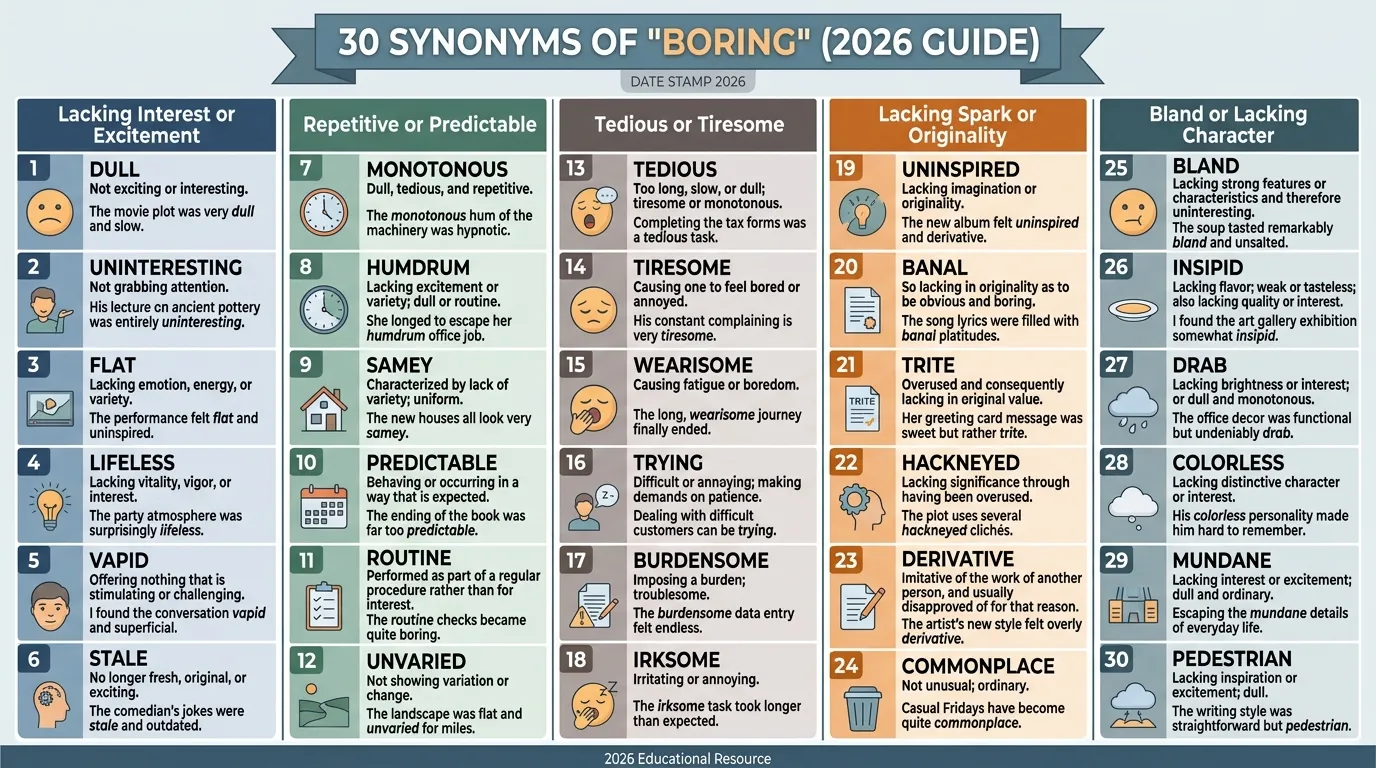
30 Synonyms of Boring
1. Dull (Adjective)
US: /dʌl/ | UK: /dʌl/
Meaning: Not interesting or exciting.
Examples
- The lecture was dull from beginning to end.
- His speech sounded dull to the audience.
2. Tedious (Adjective)
US: /ˈtiːdiəs/ | UK: /ˈtiːdiəs/
Meaning: Long, repetitive, and tiring.
Examples
- Copying the report was tedious.
- The work became tedious after several hours.
3. Monotonous (Adjective)
US: /məˈnɑːtənəs/ | UK: /məˈnɒtənəs/
Meaning: Always the same with little or no variety.
Examples
- The factory job was monotonous.
- His voice remained monotonous throughout the meeting.
4. Uninteresting (Adjective)
US: /ʌnˈɪntrəstɪŋ/ | UK: /ʌnˈɪntrəstɪŋ/
Meaning: Not able to attract attention or curiosity.
Examples
- I found the article uninteresting.
- The lesson seemed uninteresting to the students.
5. Tiresome (Adjective)
US: /ˈtaɪərsəm/ | UK: /ˈtaɪəsəm/
Meaning: Making people feel tired or annoyed.
Examples
- The repeated questions became tiresome.
- Waiting in line was tiresome.
6. Dreary (Adjective)
US: /ˈdrɪri/ | UK: /ˈdrɪəri/
Meaning: Dull, gloomy, and lacking excitement.
Examples
- It was a dreary afternoon.
- The office looked dreary without windows.
7. Dry (Adjective)
US: /draɪ/ | UK: /draɪ/
Meaning: Serious and not entertaining.
Examples
- The presentation was dry but informative.
- The book contains dry historical facts.
8. Lifeless (Adjective)
US: /ˈlaɪfləs/ | UK: /ˈlaɪfləs/
Meaning: Without energy or excitement.
Examples
- The party felt lifeless.
- His performance seemed lifeless.
9. Flat (Adjective)
US: /flæt/ | UK: /flæt/
Meaning: Lacking energy, emotion, or interest.
Examples
- The joke fell flat.
- Her speech sounded flat.
10. Routine (Adjective)
US: /ruːˈtiːn/ | UK: /ruːˈtiːn/
Meaning: Done regularly in the same way and therefore not exciting.
Examples
- His routine tasks became boring.
- The daily work was routine.
11. Mundane (Adjective)
US: /mʌnˈdeɪn/ | UK: /mʌnˈdeɪn/
Meaning: Ordinary and lacking excitement.
Examples
- The job involved many mundane tasks.
- His daily routine became mundane.
12. Humdrum (Adjective)
US: /ˈhʌmdrʌm/ | UK: /ˈhʌmdrʌm/
Meaning: Dull, ordinary, and repetitive.
Examples
- Life felt humdrum after the holidays.
- She wanted to escape her humdrum routine.
13. Repetitive (Adjective)
US: /rɪˈpetətɪv/ | UK: /rɪˈpetətɪv/
Meaning: Repeated many times in the same way.
Examples
- The exercise was repetitive.
- His stories became repetitive.
14. Wearisome (Adjective)
US: /ˈwerɪsəm/ | UK: /ˈwɪərɪsəm/
Meaning: Causing tiredness or boredom.
Examples
- The journey was wearisome.
- Long meetings are often wearisome.
15. Slow (Adjective)
US: /sloʊ/ | UK: /sləʊ/
Meaning: Moving or happening without excitement.
Examples
- The movie had a slow beginning.
- The class felt slow today.
16. Sleepy (Adjective)
US: /ˈsliːpi/ | UK: /ˈsliːpi/
Meaning: Making people feel sleepy because it lacks excitement.
Examples
- The lecture was sleepy.
- The quiet afternoon felt sleepy.
17. Colorless (Adjective)
US: /ˈkʌlərləs/ | UK: /ˈkʌlələs/
Meaning: Lacking interest, excitement, or personality.
Examples
- The story seemed colorless.
- His speech was colorless.
18. Stale (Adjective)
US: /steɪl/ | UK: /steɪl/
Meaning: No longer fresh, exciting, or original.
Examples
- The jokes became stale.
- The show felt stale after many seasons.
19. Predictable (Adjective)
US: /prɪˈdɪktəbəl/ | UK: /prɪˈdɪktəbəl/
Meaning: Easy to guess because nothing new happens.
Examples
- The ending was predictable.
- The story became predictable.
20. Trite (Adjective)
US: /traɪt/ | UK: /traɪt/
Meaning: Overused and lacking originality.
Examples
- The speech was full of trite expressions.
- His comments sounded trite.
21. Uneventful (Adjective)
US: /ˌʌnɪˈventfəl/ | UK: /ˌʌnɪˈventfəl/
Meaning: Having nothing interesting happen.
Examples
- It was an uneventful day.
- The trip was peaceful but uneventful.
22. Mind-Numbing (Adjective)
US: /ˈmaɪnd ˌnʌmɪŋ/ | UK: /ˈmaɪnd ˌnʌmɪŋ/
Meaning: Extremely boring and mentally tiring.
Examples
- The paperwork was mind-numbing.
- The training became mind-numbing.
23. Drear (Adjective)
US: /drɪr/ | UK: /drɪə/
Meaning: Gloomy and dull.
Examples
- The weather looked drear.
- The empty streets felt drear.
24. Uninspiring (Adjective)
US: /ˌʌnɪnˈspaɪərɪŋ/ | UK: /ˌʌnɪnˈspaɪərɪŋ/
Meaning: Failing to create interest or excitement.
Examples
- The design looked uninspiring.
- The lesson was uninspiring.
25. Forgettable (Adjective)
US: /fərˈɡetəbəl/ | UK: /fəˈɡetəbəl/
Meaning: Not interesting enough to remember.
Examples
- It was a forgettable film.
- His presentation was forgettable.
26. Vapid (Adjective)
US: /ˈvæpɪd/ | UK: /ˈvæpɪd/
Meaning: Offering little interest or intelligence.
Examples
- The conversation became vapid.
- The article seemed vapid.
27. Prosaic (Adjective)
US: /proʊˈzeɪɪk/ | UK: /prəˈzeɪɪk/
Meaning: Plain, ordinary, and lacking imagination.
Examples
- The novel became prosaic.
- His writing felt prosaic.
28. Unexciting (Adjective)
US: /ˌʌnɪkˈsaɪtɪŋ/ | UK: /ˌʌnɪkˈsaɪtɪŋ/
Meaning: Not exciting or interesting.
Examples
- The match was unexciting.
- The event turned out unexciting.
29. Drab (Adjective)
US: /dræb/ | UK: /dræb/
Meaning: Dull in appearance or character.
Examples
- The room looked drab.
- The town appeared drab during winter.
30. Spiritless (Adjective)
US: /ˈspɪrɪtləs/ | UK: /ˈspɪrɪtləs/
Meaning: Lacking energy, enthusiasm, or life.
Examples
- The audience gave a spiritless response.
- His performance was spiritless.
Prototype Meaning
The prototype meaning of boring is something that fails to keep a person’s attention or interest. When people hear the word boring, they usually imagine a long meeting, a slow lecture, a repetitive task, a dull movie, or a conversation that lacks excitement. The word commonly describes situations, activities, books, classes, speeches, and even people who do not make others feel interested or engaged having Synonyms of Boring.
Prototype Categorization
- General lack of interest: dull, uninteresting, unexciting, flat
- Long and tiring: tedious, tiresome, wearisome, mind-numbing
- Repetitive: monotonous, repetitive, routine, humdrum
- Ordinary: mundane, prosaic, predictable, trite
- Low energy or lifeless: lifeless, spiritless, colorless, drab
- Gloomy: dreary, drear
- Easy to forget: forgettable, stale
Antonyms of Boring
- Interesting (Adjective): Holding attention or curiosity.
- Exciting (Adjective): Full of energy and enthusiasm.
- Fascinating (Adjective): Extremely interesting.
- Engaging (Adjective): Keeping someone’s attention.
- Captivating (Adjective): Very attractive and interesting.
- Thrilling (Adjective): Causing strong excitement.
- Stimulating (Adjective): Encouraging thought or interest.
- Amusing (Adjective): Funny and entertaining.
- Entertaining (Adjective): Providing enjoyment.
- Compelling (Adjective): Difficult to ignore because it is so interesting.
Short Questions and Answers
- What does boring mean? It means something is not interesting, enjoyable, or exciting.
- When should boring be used? Use it to describe people, places, activities, books, movies, speeches, or events that fail to keep someone’s attention.
- Is boring positive or negative? It is usually negative because it describes a lack of interest or excitement. In some contexts, it may be neutral when simply expressing a personal opinion.
- How is it different from similar words? Boring is a general word. Tedious suggests something long and tiring. Monotonous focuses on repetition. Dull means lacking excitement, while mundane emphasizes ordinary everyday life.
Conclusion
Learning the Synonyms of Boring and Synonyms of Boring synonyms is an excellent way to improve your English vocabulary. Instead of repeating the same adjective, you can choose words such as dull, tedious, mundane, dreary, or captivating to express your ideas more accurately. A richer vocabulary makes your writing more engaging, your speaking more natural, and your communication more effective. Understanding pronunciation, history, grammar, connotation, and semantic categories also helps you use each synonym correctly in different situations. Practice using one or two new words every day in conversations, emails, essays, and stories. With regular practice, you will write with greater variety, avoid repetition, and build lasting confidence in English using Synonyms of Boring.

I’m Zahid Abbas, an educator, researcher, and digital publishing strategist with a passion for linguistics, grammar, and clear communication. As a content creator and SEO specialist, I craft research-driven, reader-focused content that empowers learners and makes knowledge accessible worldwide.