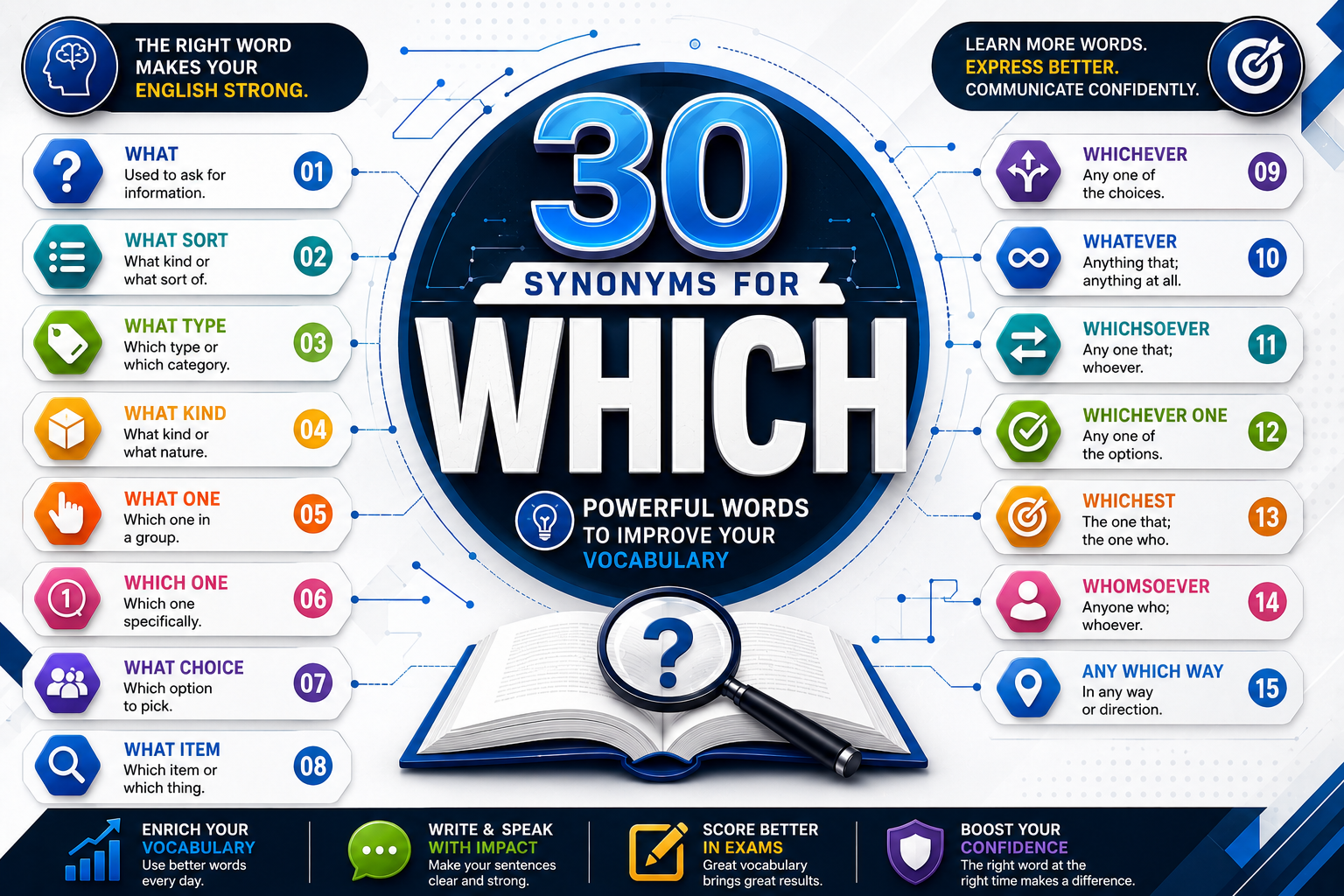
Which is a common English word. We use it when we ask about a choice or point to one thing from a group. For example, a child may ask, “Which toy do you want?” The child wants to know what one the other person wants. We use which many times in daily English. It helps us ask clear questions and give more details.Learning synonyms for which can help English learners use different words in the right way. It can also help writers avoid using the same word again and again. Some words have a meaning close to which, but they may work only in certain sentences. In this article, we will learn the meaning, grammar, history, pronunciation, word form, and 30 useful alternatives to which. We will also see examples and simple word groups.
Meaning of Which
Definition
Which (pronoun/determiner): A word used to ask about one person or thing from a group, or to add information about something.
Examples
- Which book do you want?
- I bought the blue bag, which was on sale.
Connotative Meaning
- Positive tone: Which can sound clear and polite when used in a question.
- Negative tone: Which has no negative feeling by itself.
- Neutral tone: Which is usually neutral and simply helps us ask or describe something.
Etymology
- Source: Which comes from Old English hwilc.
- Old meaning: It meant “what one” or “of what kind.”
- It is related to old Germanic words used to ask about a choice.
Short History of Which
- Old English (450–1100): The word appeared as hwilc.
- Middle English (1100–1500): It changed into forms such as whiche.
- Modern English (1500–Present): The form became which and is now used in questions and relative clauses.
- Also read more about https://synonymspot.com/synonyms-of-yes/
Pronunciation (US & UK – IPA)
US: /wɪtʃ/ UK: /wɪtʃ/
Syllables
which — 1 syllable
Affixation Pattern of Which
- Root: which
- Prefix: None
- Suffix: None
- Word formation: Which is mainly used as a pronoun, determiner, and relative pronoun.
- which one: used to ask about one choice.
- which kind: used to ask about a type.
- which way: used to ask about a direction or method.
Synonyms of Which
1. What (Pronoun/Determiner)
US: /wʌt/ | UK: /wɒt/
Meaning: Used to ask about a thing, person, or choice.
Examples:
- What book do you want?
- What color do you like?
2. Which One (Pronoun)
US: /wɪtʃ wʌn/ | UK: /wɪtʃ wʌn/
Meaning: Used to ask about one thing from a group.
Examples:
- Which one do you want?
- Which one is yours?
3. What One (Pronoun)
US: /wʌt wʌn/ | UK: /wɒt wʌn/
Meaning: A simple phrase used to ask about one choice.
Examples:
- What one do you like?
- What one should I buy?
4. Whatever (Pronoun/Determiner)
US: /wʌtˈɛvər/ | UK: /wɒtˈevə/
Meaning: Any thing or choice that is possible.
Examples:
- Choose whatever you like.
- Take whatever you need.
5. Whichever (Pronoun/Determiner)
US: /wɪtʃˈɛvər/ | UK: /wɪtʃˈevə/
Meaning: Any one from a small or known group.
Examples:
- Pick whichever you want.
- Use whichever color you like.
6. What Kind (Phrase)
US: /wʌt kaɪnd/ | UK: /wɒt kaɪnd/
Meaning: Used to ask about a type or group.
Examples:
- What kind of food do you like?
- What kind of car is it?
7. What Type (Phrase)
US: /wʌt taɪp/ | UK: /wɒt taɪp/
Meaning: Used to ask about a type of something.
Examples:
- What type of book is this?
- What type of music do you like?
8. What Sort (Phrase)
US: /wʌt sɔrt/ | UK: /wɒt sɔːt/
Meaning: Used to ask what group or kind something belongs to.
Examples:
- What sort of movie is it?
- What sort of food do you want?
9. What Choice (Phrase)
US: /wʌt tʃɔɪs/ | UK: /wɒt tʃɔɪs/
Meaning: Used to ask about a choice.
Examples:
- What choice did you make?
- What choice is best for you?
10. What Option (Phrase)
US: /wʌt ˈɑpʃən/ | UK: /wɒt ˈɒpʃən/
Meaning: Used to ask about one possible choice.
Examples:
- What option do you want?
- What option is better?
11. What Alternative (Phrase)
US: /wʌt ɔːlˈtɜrnətɪv/ | UK: /wɒt ɔːlˈtɜːnətɪv/
Meaning: Used to ask about another possible choice.
Examples:
- What alternative do we have?
- What alternative is better?
12. What Selection (Phrase)
US: /wʌt səˈlɛkʃən/ | UK: /wɒt sɪˈlekʃən/
Meaning: Used to ask about a choice from a group.
Examples:
- What selection did you make?
- What selection should I choose?
13. What Item (Phrase)
US: /wʌt ˈaɪtəm/ | UK: /wɒt ˈaɪtəm/
Meaning: Used to ask about one thing from a group.
Examples:
- What item do you need?
- What item did you buy?
14. What Thing (Phrase)
US: /wʌt θɪŋ/ | UK: /wɒt θɪŋ/
Meaning: Used to ask about a thing.
Examples:
- What thing do you want?
- What thing is missing?
15. What Person (Phrase)
US: /wʌt ˈpɜrsən/ | UK: /wɒt ˈpɜːsən/
Meaning: Used to ask about a person.
Examples:
- What person called you?
- What person can help us?
16. What Place (Phrase)
US: /wʌt pleɪs/ | UK: /wɒt pleɪs/
Meaning: Used to ask about a place.
Examples:
- What place do you want to visit?
- What place is safe?
17. What Time (Phrase)
US: /wʌt taɪm/ | UK: /wɒt taɪm/
Meaning: Used to ask about a time.
Examples:
- What time should I come?
- What time is the meeting?
18. What Way (Phrase)
US: /wʌt weɪ/ | UK: /wɒt weɪ/
Meaning: Used to ask about a method or direction.
Examples:
- What way should we go?
- What way can I solve this?
19. What Method (Phrase)
US: /wʌt ˈmɛθəd/ | UK: /wɒt ˈmeθəd/
Meaning: Used to ask about a way of doing something.
Examples:
- What method should we use?
- What method works best?
20. What Version (Phrase)
US: /wʌt ˈvɜrʒən/ | UK: /wɒt ˈvɜːʃən/
Meaning: Used to ask about one form of something.
Examples:
- What version do you have?
- What version is new?
21. What Model (Phrase)
US: /wʌt ˈmɑdəl/ | UK: /wɒt ˈmɒdəl/
Meaning: Used to ask about a certain model or type.
Examples:
- What model is your phone?
- What model should I buy?
22. What Brand (Phrase)
US: /wʌt brænd/ | UK: /wɒt brænd/
Meaning: Used to ask about the name of a product maker.
Examples:
- What brand is this?
- What brand do you use?
23. What Size (Phrase)
US: /wʌt saɪz/ | UK: /wɒt saɪz/
Meaning: Used to ask about the size of something.
Examples:
- What size do you need?
- What size should I buy?
24. What Color (Phrase)
US: /wʌt ˈkʌlər/ | UK: /wɒt ˈkʌlə/
Meaning: Used to ask about a color.
Examples:
- What color do you like?
- What color should I choose?
25. What Number (Phrase)
US: /wʌt ˈnʌmbər/ | UK: /wɒt ˈnʌmbə/
Meaning: Used to ask about a number.
Examples:
- What number is correct?
- What number did you choose?
26. What Name (Phrase)
US: /wʌt neɪm/ | UK: /wɒt neɪm/
Meaning: Used to ask about a name.
Examples:
- What name did you choose?
- What name is on the list?
27. What Subject (Phrase)
US: /wʌt ˈsʌbdʒɪkt/ | UK: /wɒt ˈsʌbdʒɪkt/
Meaning: Used to ask about a school or discussion topic.
Examples:
- What subject do you like?
- What subject is easy for you?
28. What Topic (Phrase)
US: /wʌt ˈtɑpɪk/ | UK: /wɒt ˈtɒpɪk/
Meaning: Used to ask about the main idea being discussed.
Examples:
- What topic should we discuss?
- What topic did you choose?
29. What Part (Phrase)
US: /wʌt pɑrt/ | UK: /wɒt pɑːt/
Meaning: Used to ask about one part of something.
Examples:
- What part do you need?
- What part is broken?
30. What Form (Phrase)
US: /wʌt fɔrm/ | UK: /wɒt fɔːm/
Meaning: Used to ask about the form or version of something.
Examples:
- What form should I use?
- What form is needed?
Prototype Meaning
The most common meaning of which is asking about one choice from a group. When people hear “which,” they often think about two or more things and choosing one. For example, “Which shirt do you want?” asks the person to choose a shirt.
Prototype Categorization
- Choice words: which, which one, what one, whichever — use these when choosing one thing.
- Type words: what kind, what type, what sort — use these when asking about a group or type.
- Option words: what choice, what option, what alternative — use these when talking about possible choices.
- Thing words: what item, what thing, what part — use these when asking about a specific thing.
- Detail words: what color, what size, what number, what name — use these when asking for a specific detail.
- Method words: what way, what method — use these when asking how something can be done.
Antonyms of Which
No exact antonym (Determiner/Pronoun)
Meaning: Which does not have one direct opposite because it is mainly used to ask about a choice or add information.
All (Determiner/Pronoun)
Meaning: Every person or thing in a group.
- Which books do you want?
- All books are useful.
Every (Determiner)
Meaning: Each person or thing in a group.
- Which student is ready?
- Every student is ready.
Both (Determiner/Pronoun)
Meaning: The two people or things together.
- Which two do you want?
- Both are good.
None (Pronoun)
Meaning: Not one of the group.
- Which one do you want?
- None of them.
Short Questions and Answers
What does which mean?
- Which is used to ask about one person or thing from a group.
- Example: “Which bag is yours?”
When should which be used?
- Use which when there is a choice or a known group.
- Example: “Which dress do you like?”
Is which positive or negative?
- Which is usually neutral.
- Its feeling depends on the sentence and the speaker’s tone.
How is which different from similar words?
- Which often asks about a choice from a known group.
- What can ask about a wider range of things.
- Whichever means any one from a group.
- What kind asks about a type.
Conclusion
Synonyms for Which and its close alternatives can make your English better. Which is a simple word, but it has many uses. Words such as what, which one, whichever, what kind, what type, and what option can help you make your meaning clear. Knowing these words can also help you avoid using the same word too often. This is useful for both speaking and writing. Writers can choose the best word for each sentence, while English learners can speak with more confidence. The best way to learn these words is to practice them every day. Try making short sentences with which and its alternatives. With regular practice, your vocabulary will grow, and English will become easier.
SEO Meta Description
Learn which synonyms, meanings, pronunciation, tone, history, examples, and easy tips to improve English vocabulary, writing, and speaking skills.

I’m Zahid Abbas, an educator, researcher, and digital publishing strategist with a passion for linguistics, grammar, and clear communication. As a content creator and SEO specialist, I craft research-driven, reader-focused content that empowers learners and makes knowledge accessible worldwide.