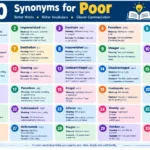
Poor is a common English word with several meanings. It can describe someone who has very little money, something of low quality, weak performance, or an unfortunate situation. For example, if a family has very little money, we may say they are poor. If a student gets a low result, we may describe the result as poor. Because poor has many meanings, choosing the right synonym is important. English learners and content writers can use synonyms to make their writing clearer, kinder, and more precise. Words such as needy, impoverished, inferior, weak, and inadequate do not mean exactly the same thing. This article explains the meaning, pronunciation, history, grammar, and word formation of poor. It also covers 30 useful synonyms, examples, semantic categories, antonyms, and practical usage tips.
Meaning of Poor
Definition
Poor (adjective): Having little money, resources, quality, ability, or success.
Poor can describe a person’s financial condition, the quality of something, a result, or an unsatisfactory situation.
Examples
- The family was poor but worked hard to improve their lives.
- The company received poor reviews for its service.
Connotative Meaning
- Positive tone: Poor can sometimes suggest sympathy, humility, or a difficult situation that deserves help.
- Negative tone: It may suggest low quality, weakness, failure, or lack of resources.
- Neutral tone: It can simply describe a low level of money, quality, ability, or performance.
Also read more abouthttps://synonymspot.com/synonyms-for-relationship/
Etymology
- Source: Poor comes from Old French povre and Latin pauper, meaning “having little” or “not wealthy.”
- Latin root: Pauper referred to a person with limited wealth or resources.
- French influence: The word entered Middle English through Anglo-French.
- Modern meaning: Its meaning expanded from lack of wealth to include low quality, weak performance, and unfortunate conditions.
Short History of Poor
- Old English (450–1100): Old English had native words for poverty and lack of wealth, but the modern word poor was not yet established.
- Middle English (1100–1500): French-derived forms such as povre entered English and became associated with people who had little wealth.
- Modern English (1500–Present): Poor developed several wider meanings, including low quality, weak performance, insufficient resources, and unfortunate conditions.
Pronunciation (US & UK – IPA)
US: /pʊr/ UK: /pʊə/
Syllables
poor
Affixation Pattern of Poor
- Root: poor
- Prefix: None
- Suffix: None
- Formation: poor is a basic adjective rather than a modern prefixed or suffixed form.
Word Formation of Poor
- poor — adjective: having little money or low quality
- poorly — adverb: in a bad or unsatisfactory way
- poorness — noun: the state or quality of being poor
- poverty — noun: the condition of being poor
- impoverish — verb: to make someone or something poor
- impoverished — adjective: made poor or lacking resources
- impoverishment — noun: the process of becoming poor
- poorhouse — noun: a former institution for people without money
- poor-minded — adjective: showing limited or negative thinking
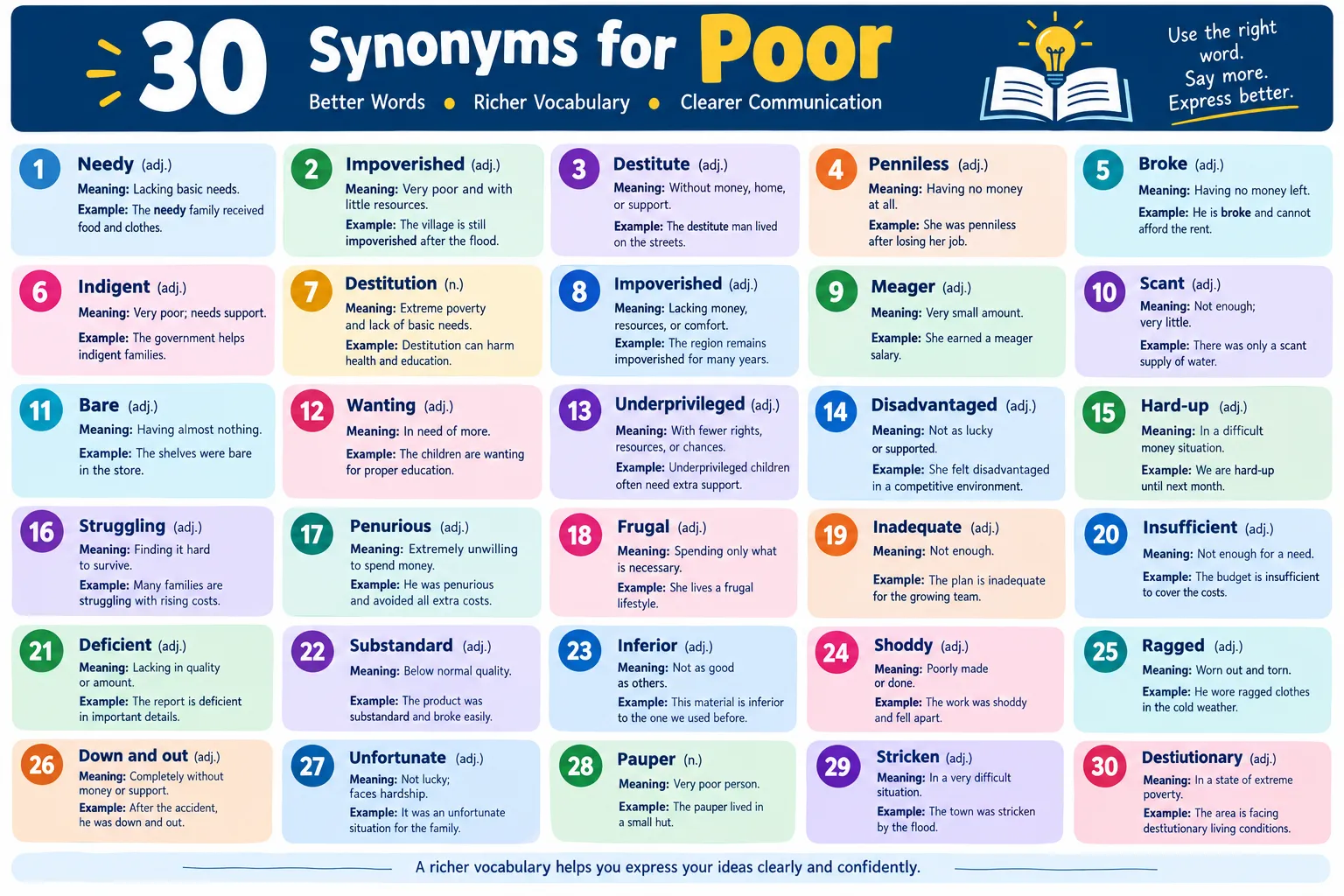
Synonyms of Poor
1. Needy (Adjective)
US: /ˈniːdi/ | UK: /ˈniːdi/
Meaning: Lacking money or basic resources and needing help.
Examples:
- The charity provides food to needy families.
- Many needy children need access to education.
2. Impoverished (Adjective)
US: /ɪmˈpɑːvərɪʃt/ | UK: /ɪmˈpɒvərɪʃt/
Meaning: Very poor and lacking money or resources.
Examples:
- The program supports impoverished communities.
- Many impoverished families need clean water.
3. Destitute (Adjective)
US: /ˈdestɪtuːt/ | UK: /ˈdestɪtjuːt/
Meaning: Having almost no money, food, or basic necessities.
Examples:
- The organization helps destitute families.
- He was left destitute after losing his job.
4. Penniless (Adjective)
US: /ˈpeniləs/ | UK: /ˈpenɪləs/
Meaning: Having no money at all.
Examples:
- He arrived in the city penniless.
- After the failed business, she was nearly penniless.
5. Broke (Adjective)
US: /broʊk/ | UK: /brəʊk/
Meaning: Having little or no money.
Examples:
- I’m broke until payday.
- He was broke after paying all his bills.
6. Indigent (Adjective)
US: /ˈɪndɪdʒənt/ | UK: /ˈɪndɪdʒənt/
Meaning: Extremely poor and in need of financial help.
Examples:
- The hospital offers free care to indigent patients.
- The program supports indigent families.
7. Underprivileged (Adjective)
US: /ˌʌndərˈprɪvəlɪdʒd/ | UK: /ˌʌndəˈprɪvəlɪdʒd/
Meaning: Having fewer social or economic opportunities than most people.
Examples:
- The school supports underprivileged students.
- The charity provides books to underprivileged children.
8. Low-Income (Adjective)
US: /ˌloʊ ˈɪnkʌm/ | UK: /ˌləʊ ˈɪnkʌm/
Meaning: Having a relatively small amount of income.
Examples:
- The program helps low-income families.
- They provide housing for low-income workers.
9. Deprived (Adjective)
US: /dɪˈpraɪvd/ | UK: /dɪˈpraɪvd/
Meaning: Lacking basic needs or important opportunities.
Examples:
- The project supports deprived communities.
- Children in deprived areas may have fewer resources.
10. Disadvantaged (Adjective)
US: /ˌdɪsədˈvæntɪdʒd/ | UK: /ˌdɪsədˈvɑːntɪdʒd/
Meaning: Having fewer opportunities or advantages than others.
Examples:
- The program helps disadvantaged students.
- The charity supports disadvantaged families.
11. Afflicted (Adjective)
US: /əˈflɪktɪd/ | UK: /əˈflɪktɪd/
Meaning: Seriously affected by a difficult problem or condition.
Examples:
- The region is afflicted by severe poverty.
- Aid was sent to afflicted communities.
12. Struggling (Adjective)
US: /ˈstrʌɡəlɪŋ/ | UK: /ˈstrʌɡəlɪŋ/
Meaning: Having difficulty managing financially or successfully.
Examples:
- The charity helps struggling families.
- Many struggling businesses need support.
13. Depleted (Adjective)
US: /dɪˈpliːtɪd/ | UK: /dɪˈpliːtɪd/
Meaning: Having used up most available resources.
Examples:
- The company had depleted financial resources.
- Years of drought left the region’s water supplies depleted.
14. Lacking (Adjective)
US: /ˈlækɪŋ/ | UK: /ˈlækɪŋ/
Meaning: Not having enough of something needed.
Examples:
- The report is lacking important details.
- The plan is lacking clear goals.
15. Insufficient (Adjective)
US: /ˌɪnsəˈfɪʃənt/ | UK: /ˌɪnsəˈfɪʃənt/
Meaning: Not enough to meet a need or requirement.
Examples:
- The evidence was insufficient.
- We had insufficient funds to complete the project.
16. Inadequate (Adjective)
US: /ɪnˈædɪkwət/ | UK: /ɪnˈædɪkwət/
Meaning: Not good enough or not sufficient for a purpose.
Examples:
- The equipment was inadequate.
- The report gave an inadequate explanation.
17. Inferior (Adjective)
US: /ɪnˈfɪriər/ | UK: /ɪnˈfɪəriə/
Meaning: Lower in quality or standard than something else.
Examples:
- The product was inferior to its competitor.
- They rejected the inferior materials.
18. Substandard (Adjective)
US: /ˌsʌbˈstændərd/ | UK: /ˌsʌbˈstændəd/
Meaning: Below the expected level of quality.
Examples:
- The building used substandard materials.
- Customers complained about the substandard service.
19. Deficient (Adjective)
US: /dɪˈfɪʃənt/ | UK: /dɪˈfɪʃənt/
Meaning: Lacking something important or necessary.
Examples:
- The diet was deficient in vitamins.
- The report was deficient in useful evidence.
20. Unsatisfactory (Adjective)
US: /ˌʌnsætɪsˈfæktəri/ | UK: /ˌʌnsætɪsˈfæktəri/
Meaning: Not good enough or not meeting expectations.
Examples:
- The results were unsatisfactory.
- His performance was unsatisfactory.
21. Weak (Adjective)
US: /wiːk/ | UK: /wiːk/
Meaning: Not strong, effective, or powerful.
Examples:
- The argument was weak.
- The team gave a weak performance.
22. Inferior-Quality (Adjective)
US: /ɪnˈfɪriər ˈkwɑːləti/ | UK: /ɪnˈfɪəriə ˈkwɒləti/
Meaning: Lower in quality than what is expected or desired.
Examples:
- The store removed the inferior-quality products.
- Customers complained about inferior-quality materials.
23. Mediocre (Adjective)
US: /ˌmiːdiˈoʊkər/ | UK: /ˌmiːdiˈəʊkə/
Meaning: Only average and not very good.
Examples:
- The restaurant received mediocre reviews.
- His performance was mediocre.
24. Unsatisfactory (Adjective)
US: /ˌʌnsætɪsˈfæktəri/ | UK: /ˌʌnsætɪsˈfæktəri/
Meaning: Not acceptable or good enough.
Examples:
- The service was unsatisfactory.
- The final answer was unsatisfactory.
25. Unsuccessful (Adjective)
US: /ˌʌnsəkˈsesfəl/ | UK: /ˌʌnsəkˈsesfəl/
Meaning: Not achieving the desired result.
Examples:
- The first attempt was unsuccessful.
- The campaign was largely unsuccessful.
26. Unproductive (Adjective)
US: /ˌʌnprəˈdʌktɪv/ | UK: /ˌʌnprəˈdʌktɪv/
Meaning: Producing little useful work or progress.
Examples:
- The meeting was unproductive.
- Too much discussion made the day unproductive.
27. Unsatisfactory (Adjective)
US: /ˌʌnsætɪsˈfæktəri/ | UK: /ˌʌnsætɪsˈfæktəri/
Meaning: Failing to reach an acceptable standard.
Examples:
- The quality was unsatisfactory.
- The solution was unsatisfactory.
28. Shoddy (Adjective)
US: /ˈʃɑːdi/ | UK: /ˈʃɒdi/
Meaning: Poorly made or of low quality.
Examples:
- The furniture was made with shoddy materials.
- Customers complained about the shoddy workmanship.
29. Paltry (Adjective)
US: /ˈpɔːltri/ | UK: /ˈpɔːltri/
Meaning: Very small or inadequate, especially in amount.
Examples:
- He received a paltry payment for his work.
- The project received only a paltry amount of funding.
30. Meager (Adjective)
US: /ˈmiːɡər/ | UK: /ˈmiːɡə/
Meaning: Very small or not enough to satisfy a need.
Examples:
- They survived on a meager income.
- The meal provided only a meager amount of food.
Prototype Meaning
The most typical meaning of poor depends on context. When used to describe people, it often means having little money or few resources. When used to describe things, it often means low in quality or below an expected standard. People may imagine a person with limited financial resources, a weak performance, a low-quality product, or an unsatisfactory result. Because poor can sound harsh when describing people, terms such as low-income, disadvantaged, or underprivileged may be more appropriate in formal and sensitive writing.
Prototype Categorization
- Financial hardship: needy, impoverished, destitute, penniless, broke, indigent, low-income — use these when discussing money or financial resources.
- Social disadvantage: underprivileged, deprived, disadvantaged — useful when discussing limited access to education, healthcare, housing, or opportunities.
- Lack of resources: lacking, insufficient, inadequate, deficient, depleted — best for resources, supplies, evidence, or support.
- Low quality: inferior, substandard, shoddy, mediocre, inferior-quality — use these for products, services, materials, or workmanship.
- Weak performance: weak, unsuccessful, unproductive, unsatisfactory — useful for results, arguments, work, performances, or plans.
- Small amount: paltry, meager — useful when something is much smaller than needed or expected.
- Difficult circumstances: struggling, afflicted — useful when describing people, groups, or areas facing serious problems.
Antonyms of Poor
- Rich (adjective): Having a lot of money or valuable resources.
- Wealthy (adjective): Having a large amount of money or property.
- Affluent (adjective): Having plenty of money and a high standard of living.
- Prosperous (adjective): Successful and financially comfortable.
- Well-off (adjective): Having enough money to live comfortably.
- Adequate (adjective): Good enough for a particular need or purpose.
- Sufficient (adjective): Enough to meet a need.
- Excellent (adjective): Extremely good in quality.
- Superior (adjective): Better in quality or ability than something else.
- Strong (adjective): Powerful, effective, or successful.
- Successful (adjective): Achieving the desired result.
- Productive (adjective): Producing useful results or progress.
Short Questions and Answers
What does poor mean?
- Poor can mean having little money or resources.
- It can also mean low in quality, weak, inadequate, or unsuccessful.
When should poor be used?
- Use poor when describing low financial resources, quality, performance, or results.
- Be careful when describing people. In formal writing, low-income or disadvantaged may sound more respectful.
Is poor positive or negative?
- Poor is usually negative because it can suggest lack, weakness, or low quality.
- However, when describing financial hardship, it may be used in a neutral factual sense.
How is poor different from similar words?
- Poor is a broad word with many meanings.
- Needy focuses on needing financial help.
- Destitute suggests extreme poverty.
- Broke is informal and means having little or no money.
- Inferior focuses on lower quality.
- Inadequate means not good enough or not sufficient.
- Mediocre means average or only moderately good.
- Shoddy suggests something is badly made.
- Meager describes a very small or insufficient amount.
Conclusion
Synonyms for poor and its synonyms can make your English more accurate, respectful, and expressive. The phrase synonyms for poor covers many words, but each word can have a slightly different meaning. Needy, low-income, and impoverished are useful when discussing financial hardship, while inferior, substandard, and shoddy describe low quality. Inadequate, insufficient, and deficient describe something that is not enough. Understanding synonyms for poor helps English learners avoid repetition and communicate their ideas clearly. It also helps content writers choose words that fit the tone of their audience. When discussing people or communities, use respectful terms and avoid words that may sound judgmental. Practice these synonyms for poor in short sentences each day. With regular practice, your vocabulary, writing skills, speaking ability, and confidence in English will steadily improve.

I’m Zahid Abbas, an educator, researcher, and digital publishing strategist with a passion for linguistics, grammar, and clear communication. As a content creator and SEO specialist, I craft research-driven, reader-focused content that empowers learners and makes knowledge accessible worldwide.