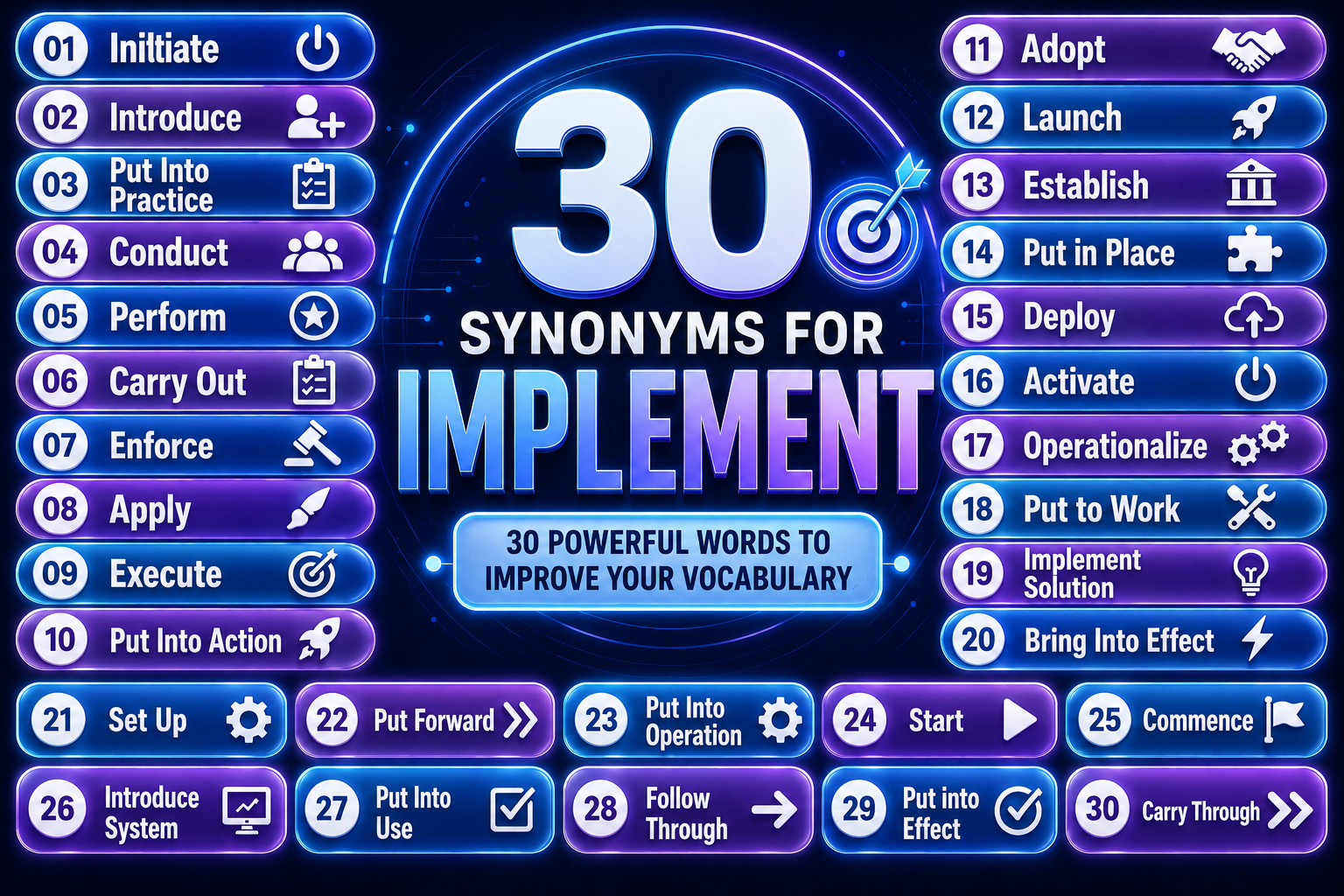
Implement means to put a plan, idea, or decision into action. For example, a school may create a new reading plan and implement it in class. This means the teachers start using the plan. We often use implement for plans, rules, systems, and changes.Learning Synonyms for Implement can help English learners write more clearly and avoid repetition. Each word may have a slightly different meaning or tone. In this guide, you will learn Synonyms for Implement, including 30 useful words, examples, semantic groups, antonyms, and simple usage tips. These Synonyms for Implement will help you choose the right word when you speak or write.
Meaning of Implement
Definition
Implement (verb): To put a plan, idea, rule, or decision into action.
Examples
- The company will implement a new safety plan.
- The school implemented new rules for students.
Connotative Meaning
- Positive tone: Can suggest progress, action, and successful change.
- Negative tone: May suggest forced rules or unwanted changes in some contexts.
- Neutral tone: Simply means putting a plan, rule, or idea into action.
Etymology
- Source language: Latin
- Latin root: implēre
- Original meaning: “To fill up” or “to fulfill”
- Later development: The word developed the sense of carrying something out or fulfilling a plan.
- English form: implement entered English through French and Latin-based usage.
- also read more about https://synonymspot.com/synonyms-for-beneficial/
Short History of Implement
- Old English (450–1100): Implement was not a common English word during this period. English used other native words to express ideas such as carrying out or fulfilling an action.
- Middle English (1100–1500): Latin and French words became more common in English. Forms related to implement began to appear in English.
- Modern English (1500–Present): Implement developed its modern sense of putting a plan or decision into action. It is now widely used in business, education, law, technology, and government.
Pronunciation (US & UK – IPA)
US: /ˈɪmpləˌment/
UK: /ˈɪmplɪˌment/
Syllables
im-ple-ment
Affixation Pattern of Implement
- Root: plen / ple- — linked to the Latin idea of “fill”
- Prefix: im- — a form of in-, meaning “in” or “into”
- Suffix: -ment — forms nouns related to actions or results
- implement — verb/noun
- implementation — noun
- implementer — noun
- implemented — past-tense verb/adjective
- implementing — present participle/gerund
- implementable — adjective
Synonyms of Implement.
1. Execute (Verb)
US IPA: /ˈeksəˌkjuːt/ | UK IPA: /ˈeksɪkjuːt/
Meaning: To carry out a plan, order, or task.
Examples:
- The team will execute the new plan.
- She executed the project with care.
2. Apply (Verb)
US IPA: /əˈplaɪ/ | UK IPA: /əˈplaɪ/
Meaning: To use an idea, rule, or method in a real situation.
Examples:
- We should apply the new safety rules.
- The teacher applied a new method.
3. Enforce (Verb)
US IPA: /ɪnˈfɔːrs/ | UK IPA: /ɪnˈfɔːs/
Meaning: To make sure a rule or law is followed.
Examples:
- Police enforce traffic laws.
- The school will enforce its new rules.
4. Carry Out (Phrasal Verb)
US IPA: /ˈkæri aʊt/ | UK IPA: /ˈkæri aʊt/
Meaning: To do or complete a planned action.
Examples:
- The team will carry out the plan.
- Workers carried out the repairs.
5. Perform (Verb)
US IPA: /pərˈfɔːrm/ | UK IPA: /pəˈfɔːm/
Meaning: To do a task or action.
Examples:
- The workers performed the task well.
- Doctors performed the procedure safely.
6. Conduct (Verb)
US IPA: /kənˈdʌkt/ | UK IPA: /kənˈdʌkt/
Meaning: To organize and carry out an activity.
Examples:
- Scientists conducted a study.
- The team conducted several tests.
7. Put Into Practice (Phrase)
US IPA: /pʊt ˈɪntuː ˈpræktɪs/ | UK IPA: /pʊt ˈɪntə ˈpræktɪs/
Meaning: To start using an idea or plan in real life.
Examples:
- The school put the plan into practice.
- We need to put these ideas into practice.
8. Introduce (Verb)
US IPA: /ˌɪntrəˈduːs/ | UK IPA: /ˌɪntrəˈdjuːs/
Meaning: To bring a new idea, system, or rule into use.
Examples:
- The company introduced a new system.
- The school introduced new study rules.
9. Initiate (Verb)
US IPA: /ɪˈnɪʃieɪt/ | UK IPA: /ɪˈnɪʃieɪt/
Meaning: To start a process or action.
Examples:
- The manager initiated a new project.
- They initiated changes in the system.
10. Establish (Verb)
US IPA: /ɪˈstæblɪʃ/ | UK IPA: /ɪˈstæblɪʃ/
Meaning: To create or set up something firmly.
Examples:
- The company established a new policy.
- The school established clear rules.
11. Institute (Verb)
US IPA: /ˈɪnstəˌtuːt/ | UK IPA: /ˈɪnstɪˌtjuːt/
Meaning: To officially start a rule, system, or practice.
Examples:
- The city instituted new safety rules.
- The school instituted a new policy.
12. Adopt (Verb)
US IPA: /əˈdɑːpt/ | UK IPA: /əˈdɒpt/
Meaning: To accept and begin using an idea, plan, or method.
Examples:
- The company adopted a new policy.
- The school adopted a better teaching method.
13. Deploy (Verb)
US IPA: /dɪˈplɔɪ/ | UK IPA: /dɪˈplɔɪ/
Meaning: To put something into use or position.
Examples:
- The company deployed a new software system.
- The team deployed the new technology.
14. Utilize (Verb)
US IPA: /ˈjuːtəˌlaɪz/ | UK IPA: /ˈjuːtɪlaɪz/
Meaning: To use something for a useful purpose.
Examples:
- We can utilize this new method.
- The team utilized modern tools.
15. Use (Verb)
US IPA: /juːz/ | UK IPA: /juːz/
Meaning: To employ something for a purpose.
Examples:
- We will use the new system.
- Teachers use this method in class.
16. Put in Place (Phrase)
US IPA: /pʊt ɪn pleɪs/ | UK IPA: /pʊt ɪn pleɪs/
Meaning: To create or start a system, rule, or plan.
Examples:
- The company put new rules in place.
- The school put a new system in place.
17. Activate (Verb)
US IPA: /ˈæktəˌveɪt/ | UK IPA: /ˈæktɪveɪt/
Meaning: To make a system or process start working.
Examples:
- The technician activated the new system.
- The app was activated yesterday.
18. Accomplish (Verb)
US IPA: /əˈkɑːmplɪʃ/ | UK IPA: /əˈkʌmplɪʃ/
Meaning: To successfully complete something.
Examples:
- The team accomplished its main goal.
- We accomplished the task on time.
19. Fulfill (Verb)
US IPA: /fʊlˈfɪl/ | UK IPA: /fʊlˈfɪl/
Meaning: To complete or meet a duty, promise, or plan.
Examples:
- The project fulfilled its main purpose.
- She fulfilled her promise.
20. Realize (Verb)
US IPA: /ˈriːəˌlaɪz/ | UK IPA: /ˈrɪəlaɪz/
Meaning: To make an idea or plan become real.
Examples:
- The team realized its vision.
- They worked hard to realize the plan.
21. Achieve (Verb)
US IPA: /əˈtʃiːv/ | UK IPA: /əˈtʃiːv/
Meaning: To successfully reach a goal.
Examples:
- The company achieved its goal.
- We achieved strong results.
22. Accomplish (Verb)
US IPA: /əˈkɑːmplɪʃ/ | UK IPA: /əˈkʌmplɪʃ/
Meaning: To successfully finish a task or goal.
Examples:
- She accomplished the task quickly.
- The team accomplished its mission.
23. Complete (Verb)
US IPA: /kəmˈpliːt/ | UK IPA: /kəmˈpliːt/
Meaning: To finish something that was planned or started.
Examples:
- They completed the project.
- We completed the new program.
24. Start (Verb)
US IPA: /stɑːrt/ | UK IPA: /stɑːt/
Meaning: To begin an action, process, or plan.
Examples:
- We will start the new program tomorrow.
- The company started its new plan.
25. Launch (Verb)
US IPA: /lɔːntʃ/ | UK IPA: /lɔːntʃ/
Meaning: To officially start or introduce something new.
Examples:
- The company launched a new program.
- They launched the project in June.
26. Initiate (Verb)
US IPA: /ɪˈnɪʃieɪt/ | UK IPA: /ɪˈnɪʃieɪt/
Meaning: To cause a process or activity to begin.
Examples:
- The manager initiated the project.
- They initiated a new process.
27. Organize (Verb)
US IPA: /ˈɔːrɡəˌnaɪz/ | UK IPA: /ˈɔːɡənaɪz/
Meaning: To arrange people or actions so that a plan can happen.
Examples:
- We organized the project carefully.
- She organized a new training program.
28. Develop (Verb)
US IPA: /dɪˈveləp/ | UK IPA: /dɪˈveləp/
Meaning: To create or improve something over time.
Examples:
- The team developed a new plan.
- They developed a better system.
29. Enact (Verb)
US IPA: /ɪˈnækt/ | UK IPA: /ɪˈnækt/
Meaning: To make a law or rule official and put it into effect.
Examples:
- The government enacted a new law.
- The city enacted stricter rules.
30. Operationalize (Verb)
US IPA: /ˌɑːpəˈreɪʃənəˌlaɪz/ | UK IPA: /ˌɒpəˈreɪʃənəlaɪz/
Meaning: To turn an idea or plan into practical actions.
Examples:
- The team operationalized the new strategy.
- The company operationalized its long-term plan.
Prototype Meaning
The most typical meaning of implement is to put a plan, rule, or idea into action. When people hear this word, they often imagine a plan moving from paper into real life. For example, a company may create a new policy and then implement it. The word focuses on action, not only on creating or discussing an idea.
Prototype Categorization
- General action: execute, carry out, perform, apply
- Starting something: start, initiate, launch, introduce
- Rules and laws: enforce, enact, institute, establish
- Using a method: apply, use, utilize, adopt
- Making ideas real: realize, operationalize, put into practice
- Completing goals: accomplish, achieve, fulfill, complete
- Systems and technology: deploy, activate, put in place
- Planning and creation: develop, organize, establish
Antonyms of Implement
Abandon (Verb)
Meaning: To stop supporting or doing a plan or activity.
- The company abandoned the project.
Cancel (Verb)
Meaning: To decide that a planned event or action will not happen.
- They cancelled the new program.
Prevent (Verb)
Meaning: To stop something from happening.
- The rule prevented the plan from starting.
Reject (Verb)
Meaning: To refuse to accept an idea, plan, or proposal.
- The board rejected the proposal.
Ignore (Verb)
Meaning: To choose not to notice or act on something.
- The manager ignored the recommendation.
Delay (Verb)
Meaning: To make something happen later than planned.
- They delayed the project.
Withdraw (Verb)
Meaning: To remove support for a plan or action.
- The company withdrew its proposal.
Short Questions and Answers
What does implement mean?
- Implement means to put a plan, idea, rule, or decision into action.
- Example: “The school implemented a new reading program.”
When should implement be used?
- Use implement when talking about putting plans, policies, systems, ideas, or decisions into action.
- It is common in business, education, government, and professional writing.
Is implement positive or negative?
- Implement is usually neutral.
- It can sound positive when the change brings improvement.
- It can sound negative when the change is unwanted or harmful.
How is implement different from similar words?
- Implement means to put a plan into action.
- Execute means to carry out a plan or task.
- Apply means to use an idea or rule in practice.
- Enforce means to make sure a rule is obeyed.
- Adopt means to accept and begin using something.
- Launch means to officially start something new.
Conclusion
Synonyms for Implement can improve your English vocabulary. Implement is useful when talking about plans, rules, systems, and ideas that become actions. Words like execute, apply, enforce, adopt, launch, establish, and carry out give you more ways to express the same idea.Learning Synonyms for Implement can make your writing clear and help you avoid repetition. They can also make your speaking more natural and confident. Learn a few words each day, write simple examples, and use Synonyms for Implement in real conversations. With daily practice, your English vocabulary will grow.

I’m Zahid Abbas, an educator, researcher, and digital publishing strategist with a passion for linguistics, grammar, and clear communication. As a content creator and SEO specialist, I craft research-driven, reader-focused content that empowers learners and makes knowledge accessible worldwide.








1 thought on “30 Powerful Synonyms for Implement — Meanings and Examples”