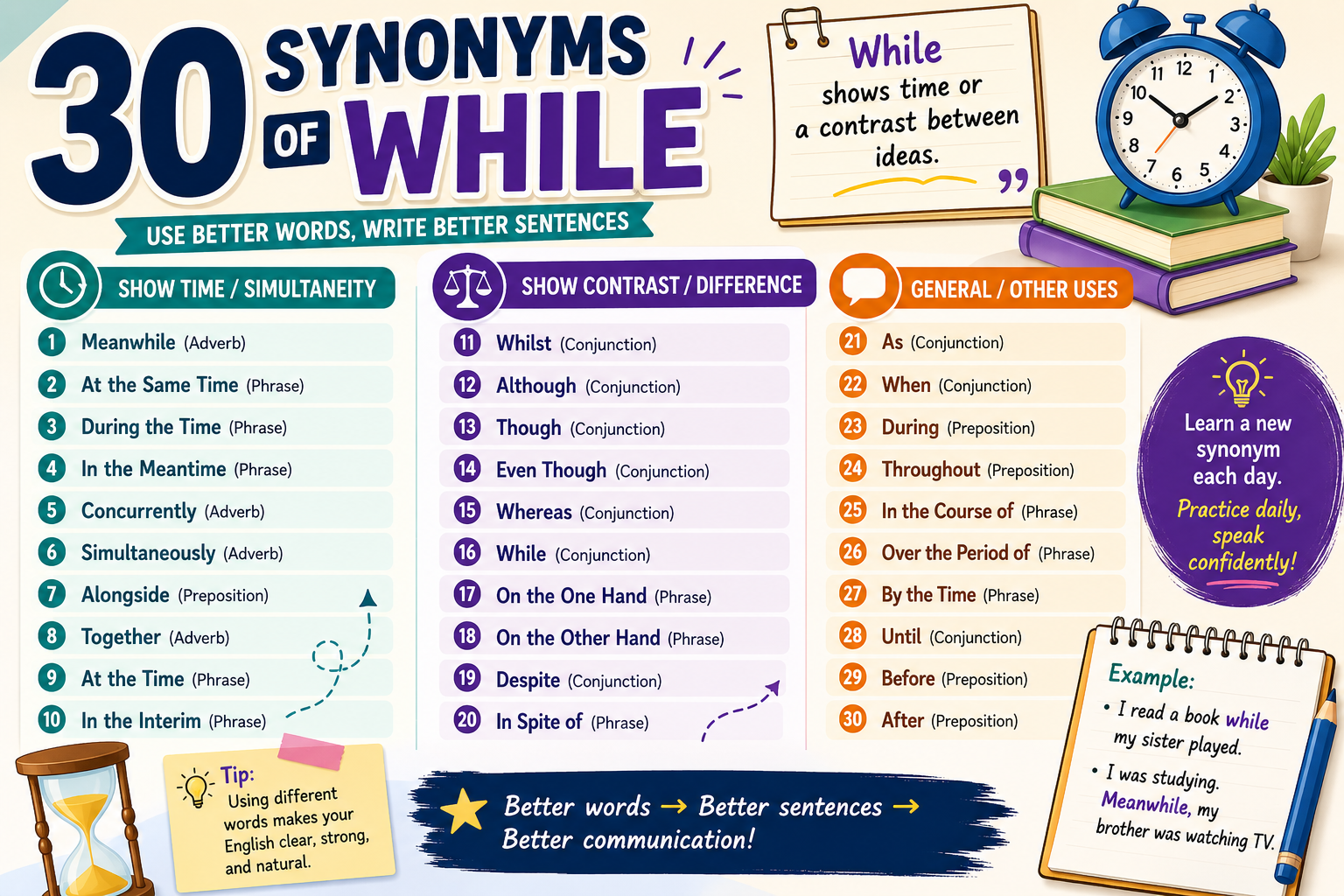
While is a common English word. It can show time or a contrast between two ideas. For example, you may say, “I read while my sister plays.” Here, while tells us that two things happen at the same time. You can also say, “While I like tea, my brother likes coffee.” Here, while shows a difference.The word while is often used in daily English, schoolwork, and writing. Learning synonyms for while can help English learners use more words and write better sentences. Synonyms for while can also help writers avoid using the same word again and again.In this article, we will learn the meaning, examples, grammar, history, pronunciation, and word forms of while. We will also learn 30 useful synonyms for while and group them by meaning. Learning synonyms for while will help you choose the right word for each sentence.
Meaning of While
While (conjunction, noun, and verb): While means during the time that something happens. It can also mean although when two ideas are different.
Examples
- I listened to music while I cleaned my room.
- She smiled while she talked to her friend.
Connotative Meaning
- Positive tone: While can give a calm and natural feeling when it talks about time.
- Negative tone: While can sometimes show a problem or difference between two ideas.
- Neutral tone: While is usually a neutral word. It simply shows time or contrast.
Etymology
- While comes from Old English.
- It came from the Old English word hwīl.
- The original meaning was a period of time or a short time.
Short history:
- Old English (450–1100): Hwīl meant a period or space of time.
- Middle English (1100–1500): The word became while and was used for a period of time.
- Modern English (1500–Present): While is now used as a noun, conjunction, and verb. It can show time or contrast.
- Also read more about https://www.thesaurus.com/browse/while
Pronunciation (US & UK – IPA)
- US: /waɪl/
- UK: /waɪl/
Syllables
while — while
Affixation Pattern of While
- Root: while
- Prefix: None
- Suffix: None
Word formation:
- while — noun
- while — conjunction
- while — verb
- awhile — adverb
Synonyms For While
1. During (Preposition)
US IPA: /ˈdʊrɪŋ/ | UK IPA: /ˈdjʊərɪŋ/
Meaning: During means at some time in a period or event.
Examples:
- I slept during the movie.
- We talked during lunch.
2. When (Conjunction)
US IPA: /wen/ | UK IPA: /wen/
Meaning: When means at the time that something happens.
Examples:
- Call me when you arrive.
- I was happy when I saw her.
3. As (Conjunction)
US IPA: /æz/ | UK IPA: /æz/
Meaning: As can mean at the same time that something happens.
Examples:
- She smiled as she walked in.
- I listened as he spoke.
4. Whilst (Conjunction)
US IPA: /waɪlst/ | UK IPA: /waɪlst/
Meaning: Whilst means during the time that.
Examples:
- She read whilst I cooked.
- He listened whilst she talked.
5. During the Time (Phrase)
US IPA: /ˈdʊrɪŋ ðə taɪm/ | UK IPA: /ˈdjʊərɪŋ ðə taɪm/
Meaning: This phrase means at the time when something happens.
Examples:
- I learned a lot during the time I lived there.
- She worked hard during the time she was at school.
6. At the Same Time (Phrase)
US IPA: /æt ðə seɪm taɪm/ | UK IPA: /ət ðə seɪm taɪm/
Meaning: It means two things happen at one time.
Examples:
- I cooked and listened to music at the same time.
- They talked at the same time.
7. Meanwhile (Adverb)
US IPA: /ˈmiːnwaɪl/ | UK IPA: /ˈmiːnwaɪl/
Meaning: Meanwhile means at the same time as another event.
Examples:
- I cooked. Meanwhile, my sister cleaned.
- He was studying. Meanwhile, his friends were playing.
8. Simultaneously (Adverb)
US IPA: /ˌsaɪməlˈteɪniəsli/ | UK IPA: /ˌsɪməlˈteɪniəsli/
Meaning: Simultaneously means happening at the same time.
Examples:
- The two doors opened simultaneously.
- Both students answered simultaneously.
9. Concurrently (Adverb)
US IPA: /kənˈkɜːrəntli/ | UK IPA: /kənˈkʌrəntli/
Meaning: Concurrently means happening at the same time.
Examples:
- The two projects ran concurrently.
- She studied and worked concurrently.
10. At Once (Phrase)
US IPA: /ət wʌns/ | UK IPA: /ət wʌns/
Meaning: At once can mean at the same time.
Examples:
- The children started talking at once.
- Both lights came on at once.
11. Together (Adverb)
US IPA: /təˈɡeðər/ | UK IPA: /təˈɡeðə/
Meaning: Together means at the same time or with each other.
Examples:
- We worked together.
- They arrived together.
12. At the Time (Phrase)
US IPA: /æt ðə taɪm/ | UK IPA: /ət ðə taɪm/
Meaning: At the time means during a certain period.
Examples:
- I was young at the time.
- She lived there at the time.
13. In the Meantime (Phrase)
US IPA: /ɪn ðə ˈmiːntaɪm/ | UK IPA: /ɪn ðə ˈmiːntaɪm/
Meaning: In the meantime means during the time before something else happens.
Examples:
- Dinner will be ready soon. In the meantime, sit here.
- The bus is late. In the meantime, we can wait.
14. At the Same Moment (Phrase)
US IPA: /æt ðə seɪm ˈmoʊmənt/ | UK IPA: /ət ðə seɪm ˈməʊmənt/
Meaning: It means at exactly the same time.
Examples:
- They arrived at the same moment.
- Both phones rang at the same moment.
15. At That Time (Phrase)
US IPA: /æt ðæt taɪm/ | UK IPA: /ət ðæt taɪm/
Meaning: At that time means during a certain past or future time.
Examples:
- I lived there at that time.
- She was working at that time.
16. Although (Conjunction)
US IPA: /ɔːlˈðoʊ/ | UK IPA: /ɔːlˈðəʊ/
Meaning: Although means even though something is true.
Examples:
- Although it was cold, we went outside.
- Although he was tired, he kept working.
17. Though (Conjunction)
US IPA: /ðoʊ/ | UK IPA: /ðəʊ/
Meaning: Though means although or even though.
Examples:
- Though she was tired, she smiled.
- Though it was late, we stayed.
18. Even Though (Conjunction)
US IPA: /ˈiːvən ðoʊ/ | UK IPA: /ˈiːvən ðəʊ/
Meaning: Even though means despite the fact that something is true.
Examples:
- Even though it rained, we played.
- Even though he was sick, he went to work.
19. Despite the Fact That (Phrase)
US IPA: /dɪˈspaɪt ðə fækt ðæt/ | UK IPA: /dɪˈspaɪt ðə fækt ðæt/
Meaning: This phrase means even though something is true.
Examples:
- Despite the fact that it was hard, she tried.
- Despite the fact that he was busy, he helped me.
20. Whereas (Conjunction)
US IPA: /werˈæz/ | UK IPA: /weərˈæz/
Meaning: Whereas is used to show a clear difference between two things.
Examples:
- I like tea, whereas my sister likes coffee.
- He is quiet, whereas his brother is loud.
21. On the Other Hand (Phrase)
US IPA: /ɑːn ði ˈʌðər hænd/ | UK IPA: /ɒn ði ˈʌðə hænd/
Meaning: This phrase introduces a different or opposite idea.
Examples:
- I like the house. On the other hand, it is very small.
- The job pays well. On the other hand, it is hard.
22. In Contrast (Phrase)
US IPA: /ɪn ˈkɑːntræst/ | UK IPA: /ɪn ˈkɒntrɑːst/
Meaning: In contrast means showing a clear difference.
Examples:
- John is quiet. In contrast, Mike is loud.
- This room is dark. In contrast, the other room is bright.
23. Conversely (Adverb)
US IPA: /kənˈvɜːrsli/ | UK IPA: /kənˈvɜːsli/
Meaning: Conversely means in an opposite way.
Examples:
- Some people like winter. Conversely, others love summer.
- The first plan is cheap. Conversely, the second plan is costly.
24. But (Conjunction)
US IPA: /bʌt/ | UK IPA: /bʌt/
Meaning: But connects ideas that are different or opposite.
Examples:
- I wanted to go, but I was tired.
- She is young, but she is very wise.
25. However (Adverb)
US IPA: /haʊˈevər/ | UK IPA: /haʊˈevə/
Meaning: However shows a different or opposite idea.
Examples:
- The task was hard. However, I finished it.
- It was raining. However, we went outside.
26. Nevertheless (Adverb)
US IPA: /ˌnevərðəˈles/ | UK IPA: /ˌnevəðəˈles/
Meaning: Nevertheless means even so or despite that.
Examples:
- The test was hard. Nevertheless, she passed.
- It was cold. Nevertheless, they went out.
27. Nonetheless (Adverb)
US IPA: /ˌnʌnðəˈles/ | UK IPA: /ˌnʌnðəˈles/
Meaning: Nonetheless means despite that.
Examples:
- The road was long. Nonetheless, we continued.
- He was tired. Nonetheless, he helped us.
28. In Spite of This (Phrase)
US IPA: /ɪn spaɪt əv ðɪs/ | UK IPA: /ɪn spaɪt əv ðɪs/
Meaning: This phrase means even though this happened.
Examples:
- It was raining. In spite of this, we went out.
- The work was hard. In spite of this, she finished it.
29. At the Same Time (Phrase)
US IPA: /æt ðə seɪm taɪm/ | UK IPA: /ət ðə seɪm taɪm/
Meaning: At the same time means two things happen together.
Examples:
- She talked and cooked at the same time.
- We arrived at the same time.
30. For the Duration of (Phrase)
US IPA: /fər ðə ˌdʊˈreɪʃən əv/ | UK IPA: /fə ðə djʊˈreɪʃən əv/
Meaning: For the duration of means during the whole time of something.
Examples:
- Please stay here for the duration of the lesson.
- He stayed quiet for the duration of the meeting.
Prototype Meaning
The most common meaning of while is during the time that something happens. When people hear while, they often think about two things happening at the same time. For example, “I read while my brother watches TV.” The word connects the two actions and shows that they happen during the same period.
Prototype Categorization
- Time: during, when, as, whilst, meanwhile — use these when you talk about when something happens.
- Same time: simultaneously, concurrently, together, at once — use these when two things happen at the same time.
- Contrast: although, though, whereas, however, but — use these when you show a difference between ideas.
- Opposite ideas: nevertheless, nonetheless, conversely, in contrast — use these when you want to show an opposite or different idea.
- Time phrases: during the time, at the time, in the meantime, for the duration of — use these when you want to give a clearer time meaning.
Antonyms of While
- Before (Preposition/Conjunction): Earlier than something happens.
- After (Preposition/Conjunction): Later than something happens.
- Separately (Adverb): In a different way or not together.
- Apart (Adverb): Away from each other.
- Different (Adjective): Not the same.
Short Questions and Answers
What does while mean?
- While usually means during the time that something happens.
- It can also mean although when showing a difference.
When should while be used?
- Use while to show that two actions happen at the same time.
- Use it to show a contrast between two ideas.
Is while positive or negative?
- While is usually neutral.
- Its feeling depends on the sentence and the ideas around it.
How is while different from similar words?
- While can show time or contrast.
- During mainly shows time.
- Although mainly shows contrast.
- Whereas mainly shows a difference between two things.
- Meanwhile shows that another action is happening at the same time.
Conclusion
Synonyms for while can make your English stronger. Synonyms for while are useful because they can show time or a difference between ideas. Words such as during, when, meanwhile, although, though, and whereas can help you give the same idea in different ways. Knowing synonym foe while can help you avoid repeating while too often. It can also make your writing and speaking clearer and more natural.Learning simple synonyms for while is a good way to build a strong English vocabulary.Using synonyms for while can also help you choose the right word for different situations. Try to learn a few new words each day and use synonyms for while in short sentences. Read them often and practice using them in daily English. With regular practice, you can write better, speak with more confidence, and understand English more easily.

I’m Zahid Abbas, an educator, researcher, and digital publishing strategist with a passion for linguistics, grammar, and clear communication. As a content creator and SEO specialist, I craft research-driven, reader-focused content that empowers learners and makes knowledge accessible worldwide.