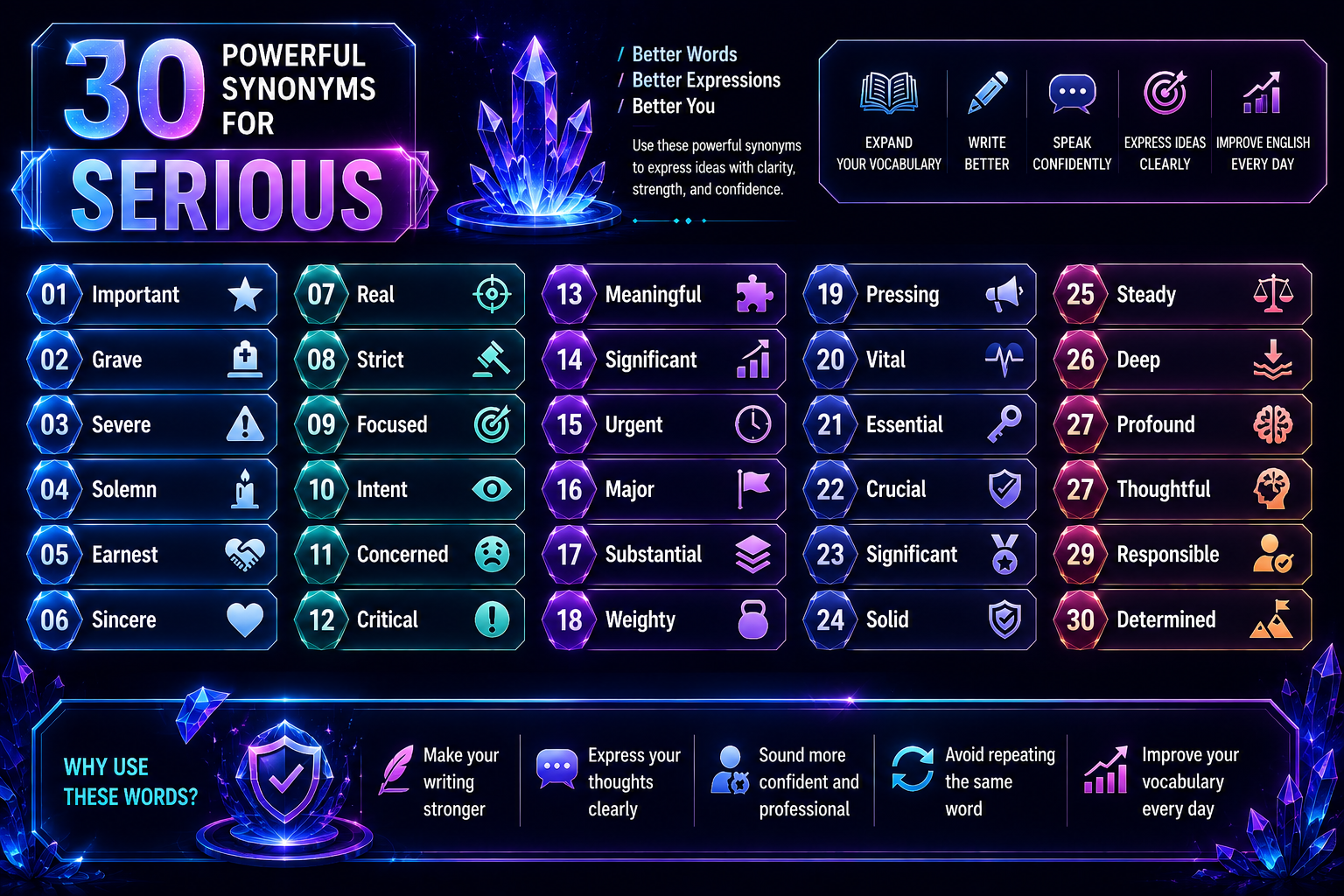
Serious means not joking or not playing. For example, a teacher may tell a child, “This test is serious.” The child knows that the test is important and needs care. We use the word serious many times in daily life. We can use it for people, problems, work, illness, and talks. Learning synonyms for serious helps English learners learn new words. It also helps writers use different words in their work. This can make writing clear and easy to read. In this article, we will learn the meaning of serious. We will also learn its word type, history, sound, and word forms. Then we will learn 30 words that have a close meaning. Each word has an easy meaning and two easy examples. We will also put the words into simple groups. This will help you pick the right word.
Meaning of Serious
Definition
Serious (Adjective): Not joking, or something that is important.
Easy meaning: Something that is important or not funny.
Examples
- This is a serious problem.
- Please be serious about your work.
Connotative Meaning
- Positive tone: It can show care, focus, or hard work.
- Negative tone: It can show worry, danger, or a bad problem.
- Neutral tone: It can simply mean that something is important or not a joke.
Etymology
- Serious comes from the Latin word serius.
- Serius meant important, grave, or not playful.
- The word later came into English as serious.
Short History of Serious
- Old English (450–1100): The word serious was not common in Old English.
- Middle English (1100–1500): The word entered English from French and Latin.
- Modern English (1500–Present): Serious became a common English word. It is now used for important things, problems, people, and talks.
- Also Explore https://synonymspot.com/synonyms-for-brave-2/
Pronunciation (US & UK – IPA)
US: /ˈsɪriəs/ UK: /ˈsɪəriəs/
Syllables
se-ri-ous
Affixation Pattern of Serious
Root: seri Prefix: None Suffix: -ous
The ending -ous helps make an adjective.
Word Formation of Serious
- Serious — adjective: important or not joking.
- Seriously — adverb: in a serious way.
- Seriousness — noun: the quality of being serious.
Synonyms of Serious
1. Important (Adjective)
US: /ɪmˈpɔːrtənt/ | UK: /ɪmˈpɔːtənt/
Meaning: Something that matters a lot.
Examples:
- This is an important meeting.
- School is important for children.
2. Grave (Adjective)
US: /ɡreɪv/ | UK: /ɡreɪv/
Meaning: Very serious or worrying.
Examples:
- The doctor gave us grave news.
- This is a grave problem.
3. Severe (Adjective)
US: /səˈvɪr/ | UK: /sɪˈvɪə/
Meaning: Very bad or very strong.
Examples:
- The storm was severe.
- He had severe pain.
4. Solemn (Adjective)
US: /ˈsɑːləm/ | UK: /ˈsɒləm/
Meaning: Very serious and calm.
Examples:
- The room was solemn.
- He had a solemn face.
5. Earnest (Adjective)
US: /ˈɜːrnɪst/ | UK: /ˈɜːnɪst/
Meaning: Honest and serious.
Examples:
- She made an earnest effort.
- He gave an earnest answer.
6. Sincere (Adjective)
US: /sɪnˈsɪr/ | UK: /sɪnˈsɪə/
Meaning: Honest and true.
Examples:
- She gave a sincere apology.
- He was sincere with me.
7. Real (Adjective)
US: /riːl/ | UK: /rɪəl/
Meaning: True and not made up.
Examples:
- This is a real problem.
- His fear was real.
8. Strict (Adjective)
US: /strɪkt/ | UK: /strɪkt/
Meaning: Making people follow rules.
Examples:
- My teacher is strict.
- The school has strict rules.
9. Focused (Adjective)
US: /ˈfoʊkəst/ | UK: /ˈfəʊkəst/
Meaning: Giving full attention to something.
Examples:
- She is focused on her work.
- He stayed focused in class.
10. Thoughtful (Adjective)
US: /ˈθɔːtfəl/ | UK: /ˈθɔːtfəl/
Meaning: Thinking carefully about something.
Examples:
- She gave a thoughtful answer.
- He is thoughtful about his work.
11. Careful (Adjective)
US: /ˈkerfəl/ | UK: /ˈkeəfəl/
Meaning: Taking care to avoid mistakes.
Examples:
- Be careful with the glass.
- She was careful with her work.
12. Important (Adjective)
US: /ɪmˈpɔːrtənt/ | UK: /ɪmˈpɔːtənt/
Meaning: Having great value or meaning.
Examples:
- This rule is important.
- Your health is important.
13. Meaningful (Adjective)
US: /ˈmiːnɪŋfəl/ | UK: /ˈmiːnɪŋfəl/
Meaning: Having a clear or important meaning.
Examples:
- We had a meaningful talk.
- Her words were meaningful.
14. Concerned (Adjective)
US: /kənˈsɜːrnd/ | UK: /kənˈsɜːnd/
Meaning: Worried about something.
Examples:
- Mom is concerned about me.
- He looked concerned.
15. Worried (Adjective)
US: /ˈwɜːrid/ | UK: /ˈwʌrid/
Meaning: Feeling afraid or nervous about something.
Examples:
- I am worried about the test.
- She looked worried.
16. Intent (Adjective)
US: /ɪnˈtent/ | UK: /ɪnˈtent/
Meaning: Giving full attention to something.
Examples:
- He was intent on his work.
- She was intent on learning.
17. Dedicated (Adjective)
US: /ˈdedɪkeɪtɪd/ | UK: /ˈdedɪkeɪtɪd/
Meaning: Giving a lot of time and care to something.
Examples:
- She is a dedicated teacher.
- He is dedicated to his job.
18. Committed (Adjective)
US: /kəˈmɪtɪd/ | UK: /kəˈmɪtɪd/
Meaning: Ready to work hard for something.
Examples:
- She is committed to her work.
- He is committed to the team.
19. Formal (Adjective)
US: /ˈfɔːrməl/ | UK: /ˈfɔːməl/
Meaning: Following a serious or proper style.
Examples:
- He wore formal clothes.
- This is a formal meeting.
20. Professional (Adjective)
US: /prəˈfeʃənəl/ | UK: /prəˈfeʃənəl/
Meaning: Showing care and skill at work.
Examples:
- She has a professional manner.
- He gave a professional answer.
21. Grave-Minded (Adjective)
US: /ˈɡreɪv ˌmaɪndɪd/ | UK: /ˈɡreɪv ˌmaɪndɪd/
Meaning: Having a serious way of thinking.
Examples:
- He is a grave-minded man.
- She is grave-minded at work.
22. Dignified (Adjective)
US: /ˈdɪɡnəfaɪd/ | UK: /ˈdɪɡnɪfaɪd/
Meaning: Calm and worthy of respect.
Examples:
- She looked dignified.
- He gave a dignified speech.
23. Mature (Adjective)
US: /məˈtʃʊr/ | UK: /məˈtʃʊə/
Meaning: Acting in a grown-up way.
Examples:
- He is very mature for his age.
- She gave a mature answer.
24. Steady (Adjective)
US: /ˈstedi/ | UK: /ˈstedi/
Meaning: Calm and controlled.
Examples:
- Keep a steady voice.
- She stayed steady during the test.
25. Calm (Adjective)
US: /kɑːm/ | UK: /kɑːm/
Meaning: Not upset or excited.
Examples:
- Please stay calm.
- He was calm during the talk.
26. Grave (Noun)
US: /ɡreɪv/ | UK: /ɡreɪv/
Meaning: A very serious matter.
Examples:
- The matter is a grave concern.
- They talked about the grave issue.
27. Urgent (Adjective)
US: /ˈɜːrdʒənt/ | UK: /ˈɜːdʒənt/
Meaning: Needing quick action.
Examples:
- This is an urgent matter.
- We have an urgent task.
28. Pressing (Adjective)
US: /ˈpresɪŋ/ | UK: /ˈpresɪŋ/
Meaning: Needing attention soon.
Examples:
- We have a pressing problem.
- This is a pressing need.
29. Critical (Adjective)
US: /ˈkrɪtɪkəl/ | UK: /ˈkrɪtɪkəl/
Meaning: Very important or very serious.
Examples:
- This is a critical time.
- Water is critical for life.
30. Major (Adjective)
US: /ˈmeɪdʒər/ | UK: /ˈmeɪdʒə/
Meaning: Very important or large.
Examples:
- This is a major problem.
- We made a major change.
Prototype Meaning
The most common meaning of serious is important or not funny. When people hear the word serious, they may think about a big problem, an important job, or a person who is not joking. For example, a doctor may talk about a serious illness. A teacher may ask students to be serious about their work. The word can also describe a person who is calm and does not joke much. The exact meaning depends on the sentence.
Prototype Categorization
- Important: important, major, meaningful — use these when something matters a lot.
- Very bad: grave, severe, critical — use these for big or bad problems.
- Not joking: solemn, earnest, sincere — use these when someone is not joking.
- Careful and focused: focused, careful, thoughtful, intent — use these for work or study.
- Worried: concerned, worried — use these when someone feels fear or worry.
- Hard-working: dedicated, committed — use these for people who work hard.
- Calm and grown-up: mature, steady, calm, dignified — use these for a calm person or manner.
Antonyms of Serious
Funny (Adjective)
Meaning: Making people laugh.
- The movie was funny.
Playful (Adjective)
Meaning: Full of fun and games.
- The child was playful.
Lighthearted (Adjective)
Meaning: Happy and not worried.
- We had a lighthearted talk.
Carefree (Adjective)
Meaning: Free from worry.
- She had a carefree day.
Trivial (Adjective)
Meaning: Not important.
- It was a trivial problem.
Unimportant (Adjective)
Meaning: Not important.
- This is unimportant now.
Short Questions and Answers
What does serious mean?
- Serious means important or not joking.
- Example: This is a serious problem.
When should serious be used?
- Use serious when something is important or not funny.
- Example: Please be serious about your work.
Is serious positive or negative?
- It can be positive, negative, or neutral.
- It depends on the sentence.
- A serious student can be a good thing.
- A serious illness can be a bad thing.
How is serious different from important?
- Serious can mean important or worrying.
- Important mainly means something that matters.
What Is the Difference Between Serious and Severe?
- Serious means important or bad.
- Severe means very bad or very strong.
How is serious different from strict?
- Serious can mean not joking.
- Strict means making people follow rules.
Is serious an adjective?
- Yes.
- Serious is an adjective.
- Example: This is a serious matter.
Can serious describe a person?
- Yes.
- Example: He is a serious person.
Can serious describe a problem?
- Yes.
- Example: It is a serious problem.
Why should English learners learn synonyms for serious?
- They help you learn new words.
- They help you write better.
- They help you avoid using the same word many times.
Conclusion
Synonyms for Serious can help you use English better. Serious is a useful English word. It can mean important, not funny, or worrying. Words like important, grave, severe, sincere, focused, careful, meaningful, urgent, critical, and major can help you express the same idea in different ways. Learning Synonyms for Serious can help you grow your vocabulary and make your writing clearer.You do not need to learn all 30 words in one day. Start with two or three words. Read their meanings and examples, then make your own short sentences. Using Synonyms for Serious in daily English can help you remember new words, avoid repetition, and feel more confident when speaking and writing.

I’m Zahid Abbas, an educator, researcher, and digital publishing strategist with a passion for linguistics, grammar, and clear communication. As a content creator and SEO specialist, I craft research-driven, reader-focused content that empowers learners and makes knowledge accessible worldwide.



1 thought on “30 Powerful Synonyms for Serious — Meanings and Examples”