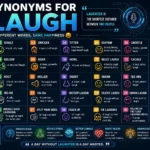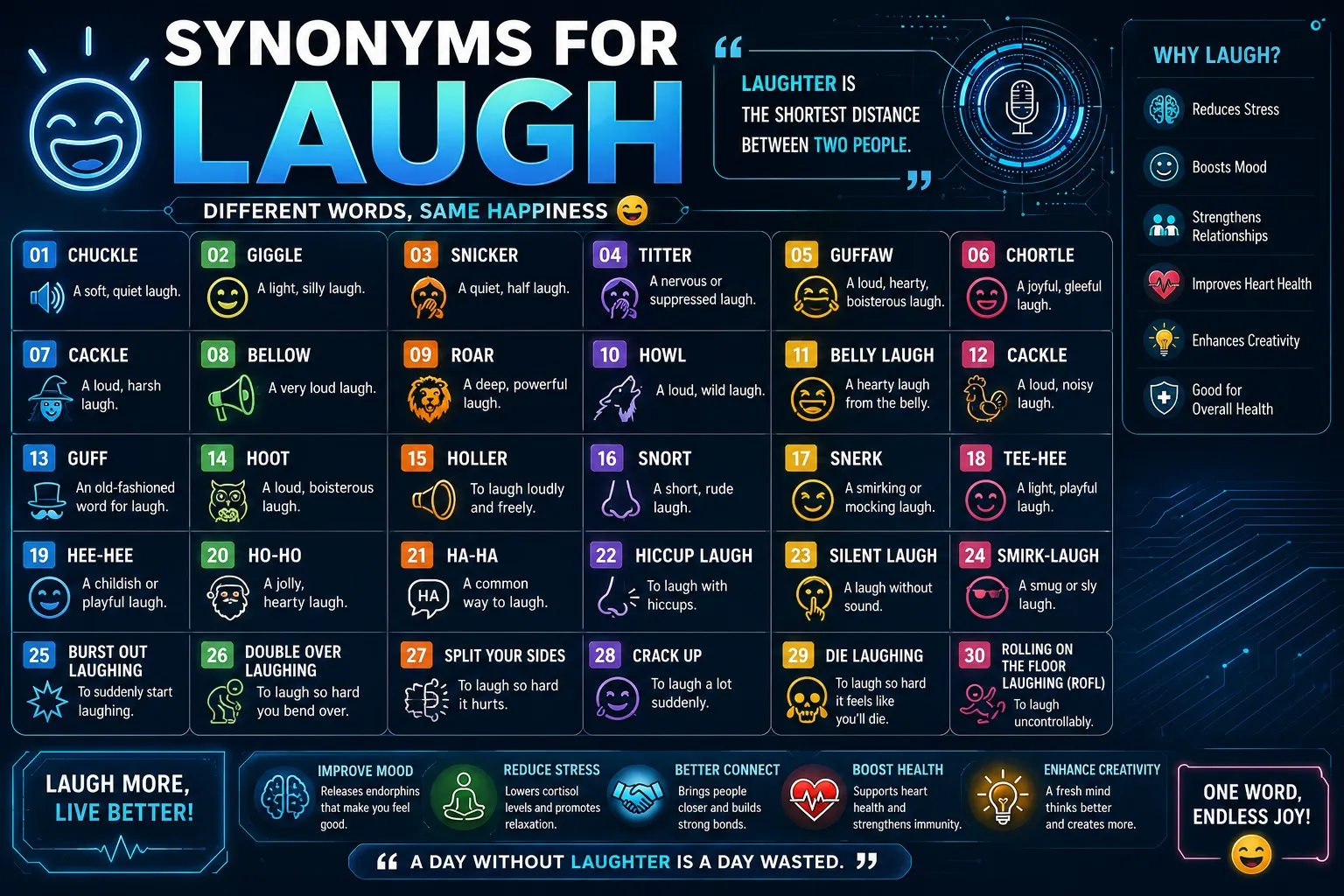
Laugh means to make a happy sound or show amusement by smiling and making sounds with your voice. Imagine sitting with friends after school. Someone tells a funny story, and you laugh without even thinking about it. This simple word is common because laughter is a natural way to show joy, fun, surprise, or even nervousness. For English learners and content writers, however, using only laugh again and again can make speech and writing sound plain. Learning synonyms for laugh helps you choose words that show the exact type, sound, or feeling of laughter. In this article, we explore the meaning of laugh and 30 useful synonyms. You will also learn their examples, grammar, pronunciation, history, word formation, emotional tone, and semantic categories. Synonyms for laugh will help you understand not only what each word means, but also when and why to use it.
Meaning of Laugh
Definition
Laugh (verb and noun): To make sounds and movements that show amusement, happiness, humor, or another strong feeling; a laugh is the sound or act of doing this.
Examples
- She laughed when her brother told the joke.
- We heard a loud laugh from the next room.
Connotative Meaning
- Positive tone: Laugh can suggest happiness, friendship, joy, fun, and amusement.
- Negative tone: In some contexts, laugh can suggest mocking, nervousness, embarrassment, or laughing at another person.
- Neutral tone: Laugh can simply describe the physical act of making a sound because something is funny.
Etymology
- Source: The word laugh comes from Old English hlæhhan or hlæhhan, meaning “to laugh.”
- Language family: It is related to similar words in other Germanic languages.
- Original idea: The early word described the human action and sound of laughter.
- Old English (450–1100): Forms such as hlæhhan were used for the act of laughing.
- Middle English (1100–1500): The spelling and pronunciation changed through forms such as laughen and laghen.
- Modern English (1500–Present): The spelling laugh became established, while its pronunciation developed into the modern forms /læf/ in American English and /lɑːf/ in British English.
Pronunciation (US & UK – IPA)
US: /læf/ UK: /lɑːf/
Syllables
laugh
Affixation Pattern of Laugh
- Root: laugh
- Prefix: None
- Suffix: None
Word Formation of Laugh
- laugh — verb and noun
- laughing — present participle/gerund
- laughed — past tense and past participle
- laughs — third-person singular verb and plural noun
- laughable — adjective
- laughingly — adverb
- laughter — noun
- laugher — noun for a person who laughs
- laughable — adjective meaning worthy of laug
Also read more about https://synonymspot.com/synonyms-for-serious-2/
Synonyms for Laugh
1. Chuckle (Verb/Noun)
US: /ˈtʃʌkəl/ | UK: /ˈtʃʌkəl/
Meaning: To laugh quietly in a warm or amused way.
Examples:
- He chuckled at the funny comment.
- She gave a quiet chuckle when she saw the picture.
2. Giggle (Verb/Noun)
US: /ˈɡɪɡəl/ | UK: /ˈɡɪɡəl/
Meaning: To laugh lightly and repeatedly, often in a high or nervous voice.
Examples:
- The children giggled during the game.
- She could not stop giggling at the silly joke.
3. Snicker (Verb/Noun)
US: /ˈsnɪkər/ | UK: /ˈsnɪkə/
Meaning: To laugh quietly, often in a rude, secret, or mocking way.
Examples:
- The students snickered when the teacher made a small mistake.
- I heard a snicker behind me.
4. Titter (Verb/Noun)
US: /ˈtɪtər/ | UK: /ˈtɪtə/
Meaning: To give a quiet, nervous, or silly laugh.
Examples:
- The audience tittered after the awkward comment.
- She gave a nervous titter before answering.
5. Guffaw (Verb/Noun)
US: /ɡəˈfɔː/ | UK: /ɡəˈfɔː/
Meaning: To laugh loudly and freely.
Examples:
- He guffawed at the comedian’s joke.
- His loud guffaw filled the room.
6. Chortle (Verb/Noun)
US: /ˈtʃɔːrtəl/ | UK: /ˈtʃɔːtəl/
Meaning: To laugh with pleasure, often with a soft or broken sound.
Examples:
- Grandpa chortled at the clever joke.
- She gave a happy chortle when she heard the news.
7. Cackle (Verb/Noun)
US: /ˈkækəl/ | UK: /ˈkækəl/
Meaning: To laugh loudly in a harsh, high, or unpleasant way.
Examples:
- The villain cackled in the old movie.
- We heard her loud cackle from outside.
8. Snort (Verb/Noun)
US: /snɔːrt/ | UK: /snɔːt/
Meaning: To laugh suddenly through the nose, often because something is very funny.
Examples:
- I snorted with laughter when I saw the picture.
- He gave a little snort when his friend told the joke.
9. Roar (Verb/Noun)
US: /rɔːr/ | UK: /rɔː/
Meaning: To laugh very loudly.
Examples:
- The audience roared with laughter.
- We heard a roar from the crowd.
10. Howl (Verb/Noun)
US: /haʊl/ | UK: /haʊl/
Meaning: To laugh very loudly and for a long time.
Examples:
- They howled with laughter at the comedian.
- Everyone began to howl when the dog copied the dancer.
11. Crack Up (Phrasal Verb)
US: /kræk ʌp/ | UK: /kræk ʌp/
Meaning: To suddenly laugh a lot because something is very funny.
Examples:
- I cracked up when I heard his story.
- She cracked up during the funny scene.
12. Break Into Laughter (Phrase)
US: /breɪk ˈɪntuː ˈlæftər/ | UK: /breɪk ˈɪntə ˈlɑːftə/
Meaning: To suddenly start laughing.
Examples:
- The children broke into laughter after the joke.
- She broke into laughter when she remembered the incident.
13. Burst Out Laughing (Phrase)
US: /bɜːrst aʊt ˈlæfɪŋ/ | UK: /bɜːst aʊt ˈlɑːfɪŋ/
Meaning: To begin laughing suddenly and strongly.
Examples:
- I burst out laughing when I saw his expression.
- She burst out laughing during the meeting.
14. Roar With Laughter (Phrase)
US: /rɔːr wɪð ˈlæftər/ | UK: /rɔː wɪð ˈlɑːftə/
Meaning: To laugh very loudly because something is extremely funny.
Examples:
- The audience roared with laughter.
- We roared with laughter at the comedian’s performance.
15. Smile (Verb/Noun)
US: /smaɪl/ | UK: /smaɪl/
Meaning: To show happiness or amusement with the face, usually without making a laughing sound.
Examples:
- She smiled at the funny comment.
- He gave me a warm smile.
16. Grin (Verb/Noun)
US: /ɡrɪn/ | UK: /ɡrɪn/
Meaning: To smile widely, often because you are happy, amused, or pleased.
Examples:
- He grinned when he heard the good news.
- She had a huge grin on her face.
17. Snigger (Verb/Noun)
US: /ˈsnɪɡər/ | UK: /ˈsnɪɡə/
Meaning: To laugh quietly in a disrespectful or mocking way.
Examples:
- The boys sniggered at the strange answer.
- I heard a snigger from the back of the class.
18. Tee-Hee (Interjection/Noun)
US: /ˌtiː ˈhiː/ | UK: /ˌtiː ˈhiː/
Meaning: A written or spoken representation of a small, playful, or silly laugh.
Examples:
- “Tee-hee,” she said after hiding the gift.
- The character gave a quiet tee-hee.
19. Chortle With Delight (Phrase)
US: /ˈtʃɔːrtəl wɪð dɪˈlaɪt/ | UK: /ˈtʃɔːtəl wɪð dɪˈlaɪt/
Meaning: To laugh with clear pleasure and happiness.
Examples:
- The child chortled with delight at the new toy.
- Dad chortled with delight when he won the game.
20. Chuckle to Oneself (Phrase)
US: /ˈtʃʌkəl tə wʌnˈsɛlf/ | UK: /ˈtʃʌkəl tə wʌnˈsɛlf/
Meaning: To laugh quietly because you are thinking about something amusing.
Examples:
- He chuckled to himself while reading the message.
- She chuckled to herself as she remembered the joke.
21. Laugh Heartily (Phrase)
US: /læf ˈhɑːrtəli/ | UK: /lɑːf ˈhɑːtɪli/
Meaning: To laugh in a strong, warm, and sincere way.
Examples:
- They laughed heartily at the story.
- Grandpa laughed heartily during dinner.
22. Laugh Out Loud (Phrase)
US: /læf aʊt laʊd/ | UK: /lɑːf aʊt laʊd/
Meaning: To laugh loudly enough for other people to hear.
Examples:
- I laughed out loud when I read the message.
- She laughed out loud during the movie.
23. Laugh One’s Head Off (Idiom)
US: /læf wʌnz hɛd ɔːf/ | UK: /lɑːf wʌnz hɛd ɒf/
Meaning: To laugh extremely hard.
Examples:
- We laughed our heads off at the comedy show.
- They laughed their heads off all evening.
24. Have a Laugh (Phrase)
US: /hæv ə læf/ | UK: /hæv ə lɑːf/
Meaning: To enjoy something funny or spend time having fun.
Examples:
- We had a laugh at the party.
- Come over and have a laugh with us.
25. Be Amused (Verb Phrase)
US: /bi əˈmjuːzd/ | UK: /bi əˈmjuːzd/
Meaning: To feel entertained or pleased by something funny.
Examples:
- She was amused by the child’s answer.
- The teacher was amused by his clever joke.
26. Find Funny (Verb Phrase)
US: /faɪnd ˈfʌni/ | UK: /faɪnd ˈfʌni/
Meaning: To think that something is amusing enough to make you laugh or smile.
Examples:
- I find his jokes funny.
- She found the story funny.
27. React With Laughter (Verb Phrase)
US: /riˈækt wɪð ˈlæftər/ | UK: /riˈækt wɪð ˈlɑːftə/
Meaning: To respond to something by laughing.
Examples:
- The audience reacted with laughter.
- Everyone reacted with laughter to the joke.
28. Laugh Lightly (Verb Phrase)
US: /læf ˈlaɪtli/ | UK: /lɑːf ˈlaɪtli/
Meaning: To laugh softly and gently.
Examples:
- She laughed lightly at his comment.
- He laughed lightly and changed the subject.
29. Laugh Nervously (Verb Phrase)
US: /læf ˈnɜːrvəsli/ | UK: /lɑːf ˈnɜːvəsli/
Meaning: To laugh because you feel worried, shy, or uncomfortable.
Examples:
- He laughed nervously before giving his speech.
- She laughed nervously when everyone looked at her.
30. Laugh Mockingly (Verb Phrase)
US: /læf ˈmɑːkɪŋli/ | UK: /lɑːf ˈmɒkɪŋli/
Meaning: To laugh at someone in an unkind way to show disrespect or make fun of them.
Examples:
- The bully laughed mockingly at the new student.
- He laughed mockingly when she gave the wrong answer.
Prototype Meaning
The most typical meaning of laugh is to make a natural sound because something is funny, amusing, or joyful. When people hear the word laugh, they usually imagine a person smiling, opening the mouth, and making a series of sounds after hearing a joke or seeing something funny. Unlike words such as giggle, chuckle, or guffaw, the basic word laugh does not tell us exactly how loud, soft, nervous, or rude the laughter is. It is the general word that covers many forms of laughter.
Prototype Categorization
- Quiet or soft laughter: chuckle, giggle, titter, snicker, snigger, laugh lightly
- Loud laughter: guffaw, cackle, roar, howl, laugh out loud
- Sudden laughter: crack up, burst out laughing, break into laughter
- Warm and happy laughter: chuckle, chortle, laugh heartily, chortle with delight
- Mocking or unkind laughter: snicker, snigger, laugh mockingly
- Nervous laughter: titter, laugh nervously
- Facial expressions related to amusement: smile, grin
- General amusement: be amused, find funny, have a laugh.
Antonyms of Laugh
- Cry (verb): To produce tears and sounds because of sadness, pain, or strong emotion.
- Weep (verb): To cry, often quietly or for a longer time.
- Sob (verb): To cry with short, difficult breaths.
- Frown (verb/noun): To show worry, anger, or displeasure by moving the eyebrows and mouth.
- Mourn (verb): To show deep sadness, especially after a loss.
- Sigh (verb/noun): To breathe out slowly, often because of sadness, tiredness, or relief.
- Grieve (verb): To feel or express deep sadness after a loss.
- Scowl (verb/noun): To look angry or displeased.
Short Questions and Answers
What does laugh mean?
- Laugh means to make a sound or show an expression that often comes from amusement, happiness, humor, or another strong feeling.
When should laugh be used?
- Use laugh when you want a general word for the act of laughing.
- Use more specific synonyms when you want to describe the sound, strength, or emotional tone of the laughter.
Is laugh positive or negative?
- Laugh is usually positive when it shows happiness or amusement.
- It can have a negative meaning when someone laughs at another person.
- It can also describe nervous laughter in an uncomfortable situation.
How is laugh different from similar words?
- Laugh is the general term.
- Giggle suggests a light or high laugh.
- Chuckle suggests a quiet and often warm laugh.
- Guffaw suggests a loud laugh.
- Snicker or snigger often suggests mocking laughter.
- Cackle suggests a harsh or unpleasant laugh.
- Grin and smile show amusement through facial expression but do not necessarily involve a laughing sound.
Conclusion
Synonyms for laugh can make your English more natural, clear, and expressive. The word laugh is useful in everyday speaking and writing, but its synonyms help you describe different sounds and feelings with greater accuracy. Synonyms for laugh such as giggle, chuckle, guffaw, snicker, and roar give readers a clearer picture of what is happening. Understanding pronunciation, grammar, connotation, history, and semantic categories also helps English learners use synonyms for laugh with confidence. For content writers, a wider vocabulary reduces repetition and makes articles, stories, and conversations more engaging. Try learning two or three synonyms each day and use them in your own sentences. With regular practice, you can improve your vocabulary, strengthen your writing and speaking, avoid repetition, and build greater confidence in English.

I’m Zahid Abbas, an educator, researcher, and digital publishing strategist with a passion for linguistics, grammar, and clear communication. As a content creator and SEO specialist, I craft research-driven, reader-focused content that empowers learners and makes knowledge accessible worldwide.