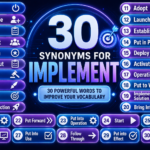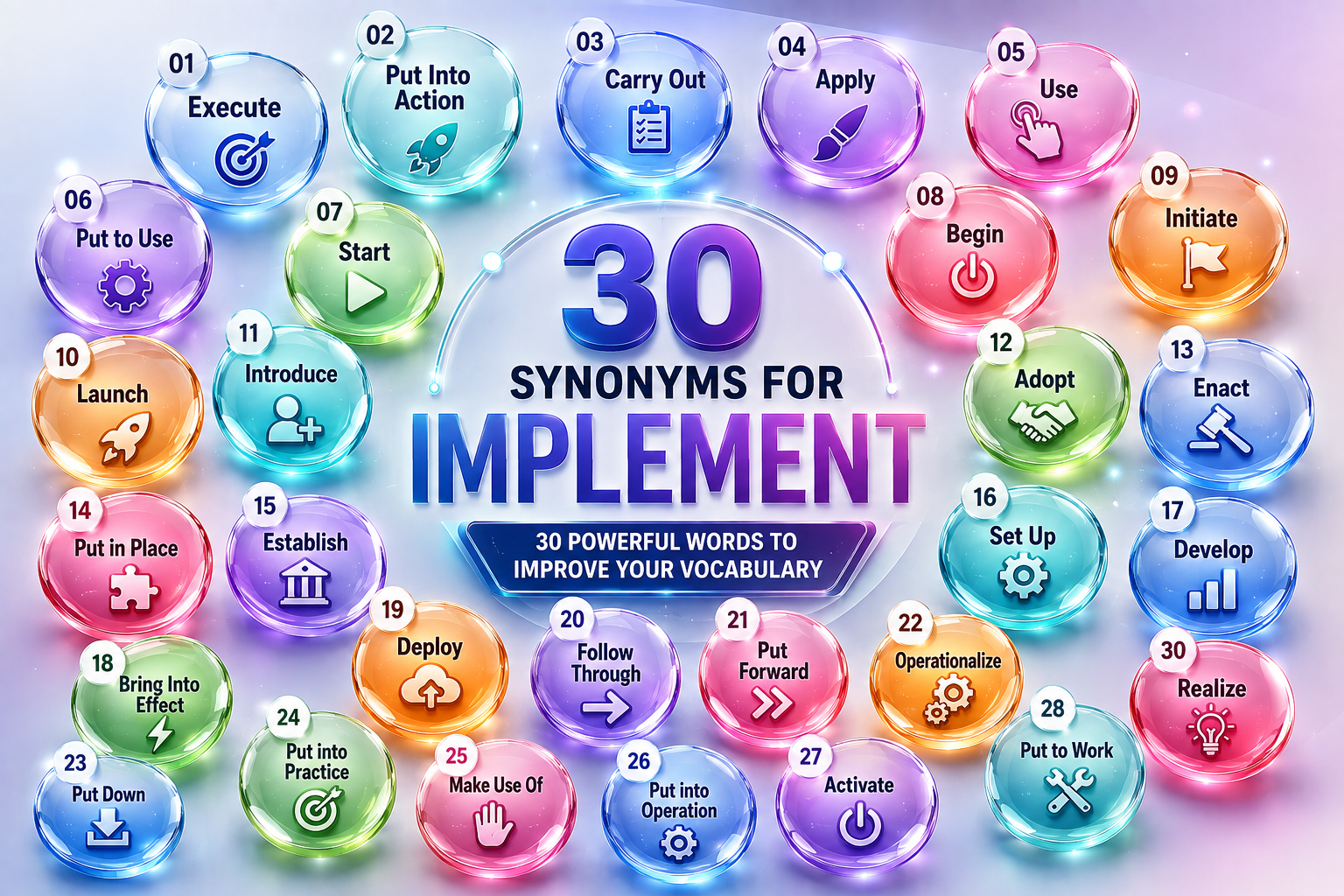
Implement means to put a plan or idea into action. For example, a school may make a new rule. The teachers then implement the rule. This means they start using it. We often use implement when we talk about plans, rules, ideas, and changes. Learning Synonyms for Implement can help English learners use more words and write clearly.In this article, we will learn the meaning of implement, its word type, history, pronunciation, and word forms. We will also learn 30 Synonyms for Implement with simple meanings and examples. Learning Synonyms for Implement can help you choose the right word when you speak or write. Each word will be easy to understand and use.
Meaning of Implement
Definition
Implement (Verb): To start using a plan, rule, or idea.
In easy words, implement means to put a plan into action.
Examples
- The school will implement a new rule.
- The team will implement the new plan.
Connotative Meaning
- Positive tone: Implement can sound good because it often means making a useful plan work.
- Negative tone: It can sound bad when a new rule or plan causes trouble.
- Neutral tone: It is often neutral when it simply means putting a plan into action.
Etymology
- Source: Implement comes from Latin.
- Latin word: It comes from implēre.
- Old meaning: The Latin word meant to fill up or complete.
- Later, the word got the meaning of carrying out or putting a plan into action.
Short History of Implement
- Old English (450–1100): The modern verb implement was not common in Old English. English used other words for doing or completing something.
- Middle English (1100–1500): Words from Latin and French became more common in English. The word family linked to implement began to enter English.
- Modern English (1500–Present): Implement became common as a verb. Today, we often use it for plans, rules, ideas, and changes.
- Also read more about https://synonymspot.com/synonyms-for-fake/
Pronunciation (US & UK – IPA)
US: /ˈɪmpləment/ UK: /ˈɪmplɪment/
Syllables
im-ple-ment
Affixation Pattern of Implement
Root: ple Prefix: im- Suffix: -ment
The word comes from an older Latin word. Its parts do not work like simple English word parts today.
Word Formation of Implement
- Implement — verb: to put a plan into action.
- Implementation — noun: the act of putting a plan into action.
- Implemented — verb/adjective: put into action.
- Implementing — verb: putting a plan into action.
- Implementer — noun: a person who puts a plan into action.
- Implementation plan — noun phrase: a plan that explains how to start using an idea.
Synonyms of Implement
1. Apply (Verb)
US: /əˈplaɪ/ | UK: /əˈplaɪ/
Meaning: To use an idea, rule, or plan.
Examples:
- The school will apply the new rule.
- We can apply this plan at work.
2. Use (Verb)
US: /juːz/ | UK: /juːz/
Meaning: To do something with a plan, idea, or rule.
Examples:
- We will use the new plan.
- The school will use the new rule.
3. Start (Verb)
US: /stɑːrt/ | UK: /stɑːt/
Meaning: To begin doing something.
Examples:
- We will start the new plan today.
- The school will start the new program.
4. Begin (Verb)
US: /bɪˈɡɪn/ | UK: /bɪˈɡɪn/
Meaning: To start something.
Examples:
- We will begin the new plan soon.
- The team will begin the new work.
5. Carry Out (Verb/Phrase)
US: /ˈkæri aʊt/ | UK: /ˈkæri aʊt/
Meaning: To do what a plan says.
Examples:
- We will carry out the plan.
- The team carried out the new rule.
6. Put Into Action (Verb/Phrase)
US: /pʊt ˈɪntuː ˈækʃən/ | UK: /pʊt ˈɪntuː ˈækʃən/
Meaning: To start using a plan or idea.
Examples:
- We will put the plan into action.
- They put the new idea into action.
7. Execute (Verb)
US: /ˈeksɪkjuːt/ | UK: /ˈeksɪkjuːt/
Meaning: To do a plan or task.
Examples:
- The team will execute the plan.
- They executed the plan well.
8. Perform (Verb)
US: /pərˈfɔːrm/ | UK: /pəˈfɔːm/
Meaning: To do a task or action.
Examples:
- The team will perform the task.
- She performed the work well.
9. Do (Verb)
US: /duː/ | UK: /duː/
Meaning: To take action or complete a task.
Examples:
- We will do the work today.
- They did what the plan said.
10. Follow (Verb)
US: /ˈfɑːloʊ/ | UK: /ˈfɒləʊ/
Meaning: To act according to a plan or rule.
Examples:
- We should follow the new plan.
- Please follow the school rules.
11. Adopt (Verb)
US: /əˈdɑːpt/ | UK: /əˈdɒpt/
Meaning: To start using a new idea, plan, or rule.
Examples:
- The school will adopt a new rule.
- The team adopted a new plan.
12. Introduce (Verb)
US: /ˌɪntrəˈduːs/ | UK: /ˌɪntrəˈdjuːs/
Meaning: To bring something new into use.
Examples:
- The school will introduce a new rule.
- They will introduce a new plan.
13. Establish (Verb)
US: /ɪˈstæblɪʃ/ | UK: /ɪˈstæblɪʃ/
Meaning: To start something in a clear and lasting way.
Examples:
- The school will establish new rules.
- They want to establish a new system.
14. Create (Verb)
US: /kriˈeɪt/ | UK: /kriˈeɪt/
Meaning: To make something new.
Examples:
- We will create a new plan.
- They created a new system.
15. Develop (Verb)
US: /dɪˈveləp/ | UK: /dɪˈveləp/
Meaning: To make or improve something over time.
Examples:
- We will develop a new plan.
- The team developed a better system.
16. Organize (Verb)
US: /ˈɔːrɡənaɪz/ | UK: /ˈɔːɡənaɪz/
Meaning: To plan and arrange things.
Examples:
- We will organize the new project.
- She organized the work well.
17. Arrange (Verb)
US: /əˈreɪndʒ/ | UK: /əˈreɪndʒ/
Meaning: To plan or put things in order.
Examples:
- We will arrange the work.
- She arranged the plan.
18. Set Up (Verb/Phrase)
US: /set ʌp/ | UK: /set ʌp/
Meaning: To prepare something so it can be used.
Examples:
- We will set up the new system.
- They set up the program.
19. Put in Place (Verb/Phrase)
US: /pʊt ɪn pleɪs/ | UK: /pʊt ɪn pleɪs/
Meaning: To start using a plan, rule, or system.
Examples:
- The school put a new rule in place.
- The team put the plan in place.
20. Enforce (Verb)
US: /ɪnˈfɔːrs/ | UK: /ɪnˈfɔːs/
Meaning: To make sure people follow a rule.
Examples:
- The police enforce the law.
- The school enforces its rules.
21. Practice (Verb)
US: /ˈpræktɪs/ | UK: /ˈpræktɪs/
Meaning: To use something often so it becomes a habit.
Examples:
- We practice the new method.
- She practices the new skill each day.
22. Act On (Verb/Phrase)
US: /ækt ɑːn/ | UK: /ækt ɒn/
Meaning: To do something because of an idea or plan.
Examples:
- We must act on the plan.
- The team acted on the new idea.
23. Put to Use (Verb/Phrase)
US: /pʊt tə juːz/ | UK: /pʊt tə juːz/
Meaning: To start using something.
Examples:
- We can put the plan to use.
- They put the new system to use.
24. Work On (Verb/Phrase)
US: /wɜːrk ɑːn/ | UK: /wɜːk ɒn/
Meaning: To spend time doing or improving something.
Examples:
- We will work on the new plan.
- She is working on the project.
25. Complete (Verb)
US: /kəmˈpliːt/ | UK: /kəmˈpliːt/
Meaning: To finish something.
Examples:
- We will complete the plan.
- They completed the task.
26. Manage (Verb)
US: /ˈmænɪdʒ/ | UK: /ˈmænɪdʒ/
Meaning: To control or take care of something.
Examples:
- She will manage the project.
- He managed the new system.
27. Handle (Verb)
US: /ˈhændəl/ | UK: /ˈhændəl/
Meaning: To deal with something.
Examples:
- She will handle the new task.
- He handled the work well.
28. Put Into Practice (Verb/Phrase)
US: /pʊt ˈɪntuː ˈpræktɪs/ | UK: /pʊt ˈɪntuː ˈpræktɪs/
Meaning: To start using an idea or plan.
Examples:
- We will put the idea into practice.
- The teacher put the new method into practice.
29. Use in Real Life (Verb/Phrase)
US: /juːz ɪn riːəl laɪf/ | UK: /juːz ɪn rɪəl laɪf/
Meaning: To use an idea in a real situation.
Examples:
- We can use this plan in real life.
- She used the new skill in real life.
30. Bring About (Verb/Phrase)
US: /brɪŋ əˈbaʊt/ | UK: /brɪŋ əˈbaʊt/
Meaning: To make something happen.
Examples:
- The plan can bring about change.
- The new rule brought about better results.
Prototype Meaning
The main meaning of implement is to start using a plan, rule, or idea. When people hear implement, they often think about a plan that is ready to use. For example, a school may make a new plan to help students. When the school starts using that plan, it implements the plan. The word is often used at work, at school, and in other places where people make plans and rules.
Prototype Categorization
- Start using a plan: apply, use, adopt, introduce — these words are good when a new idea or rule starts being used.
- Do a plan: carry out, execute, perform, do — use these when a person or team does what a plan says.
- Start something: start, begin, put into action — use these when an action begins.
- Set up something: set up, put in place, establish, arrange — use these when something is prepared or started.
- Follow a rule: follow, enforce — use these when talking about rules.
- Work on something: develop, organize, manage, handle — use these when people work on a plan or task.
- Make something happen: bring about, act on — use these when an action causes a result.
Antonyms of Implement
Stop (Verb)
Meaning: To end an action or activity.
- The school will stop the old plan.
Cancel (Verb)
Meaning: To decide that a plan will not happen.
- They canceled the new plan.
Abandon (Verb)
Meaning: To stop a plan and not continue it.
- The team abandoned the old plan.
Ignore (Verb)
Meaning: To not pay attention to something.
- He ignored the new rule.
Prevent (Verb)
Meaning: To stop something from happening.
- The rule can prevent the problem.
Reject (Verb)
Meaning: To say no to an idea or plan.
- The team rejected the new plan.
Short Questions and Answers
What does implement mean?
- Implement means to start using a plan, rule, or idea.
- Example: The school implemented a new rule.
When should implement be used?
- Use implement when a plan or idea is ready to be used.
- Example: The team will implement the new plan.
Is implement positive or negative?
- Implement is mostly a neutral word.
- It can sound positive when the plan helps people.
- It can sound negative when the plan causes problems.
How is implement different from similar words?
- Implement means to put a plan into action.
- Use means to do something with something.
- Apply means to use an idea or rule.
- Adopt means to start using a new idea or plan.
- Carry out means to do what a plan says.
- Start means to begin something.
Is implement a noun or a verb?
- Implement is a verb when it means to put a plan into action.
- Example: They implemented the new rule.
- Implement can also be a noun, but that is a different meaning. As a noun, it means a tool used for a task.
What is the noun form of implement?
- The noun form is implementation.
- It means the act of putting a plan into action.
- Example: The implementation of the plan began today.
Which is the adjective form of implement?
- Implemented can describe something that has been put into action.
- Example: The new rule was implemented.
What is the opposite of implement?
- Some opposite words are stop, cancel, abandon, ignore, prevent, and reject.
- The best opposite depends on the sentence.
Why should English learners learn synonyms for implement?
- They help you learn more English words.
- They help you avoid using the same word many times.
- They can make your writing clear and strong.
Can implement be used for rules?
- Yes.
- Example: The school implemented a new rule.
Can implement be used for ideas?
- Yes.
- Example: The team implemented a new idea.
Conclusion
Synonyms for Implement can help you use English better. Implement means to put a plan, rule, or idea into action. Words like apply, use, adopt, start, begin, carry out, and put into action can help you talk about plans in different ways. Learning Synonyms for Implement can make your writing clear and help you avoid repeating the same word.These words can also help you speak with more confidence. You do not need to learn all 30 words in one day. Start with two or three words, learn their meanings, and write short sentences. Then try to use Synonyms for Implement in your daily English. With daily practice, your vocabulary will grow. Learning Synonyms for Implement can help you improve your English writing and speaking.

I’m Zahid Abbas, an educator, researcher, and digital publishing strategist with a passion for linguistics, grammar, and clear communication. As a content creator and SEO specialist, I craft research-driven, reader-focused content that empowers learners and makes knowledge accessible worldwide.