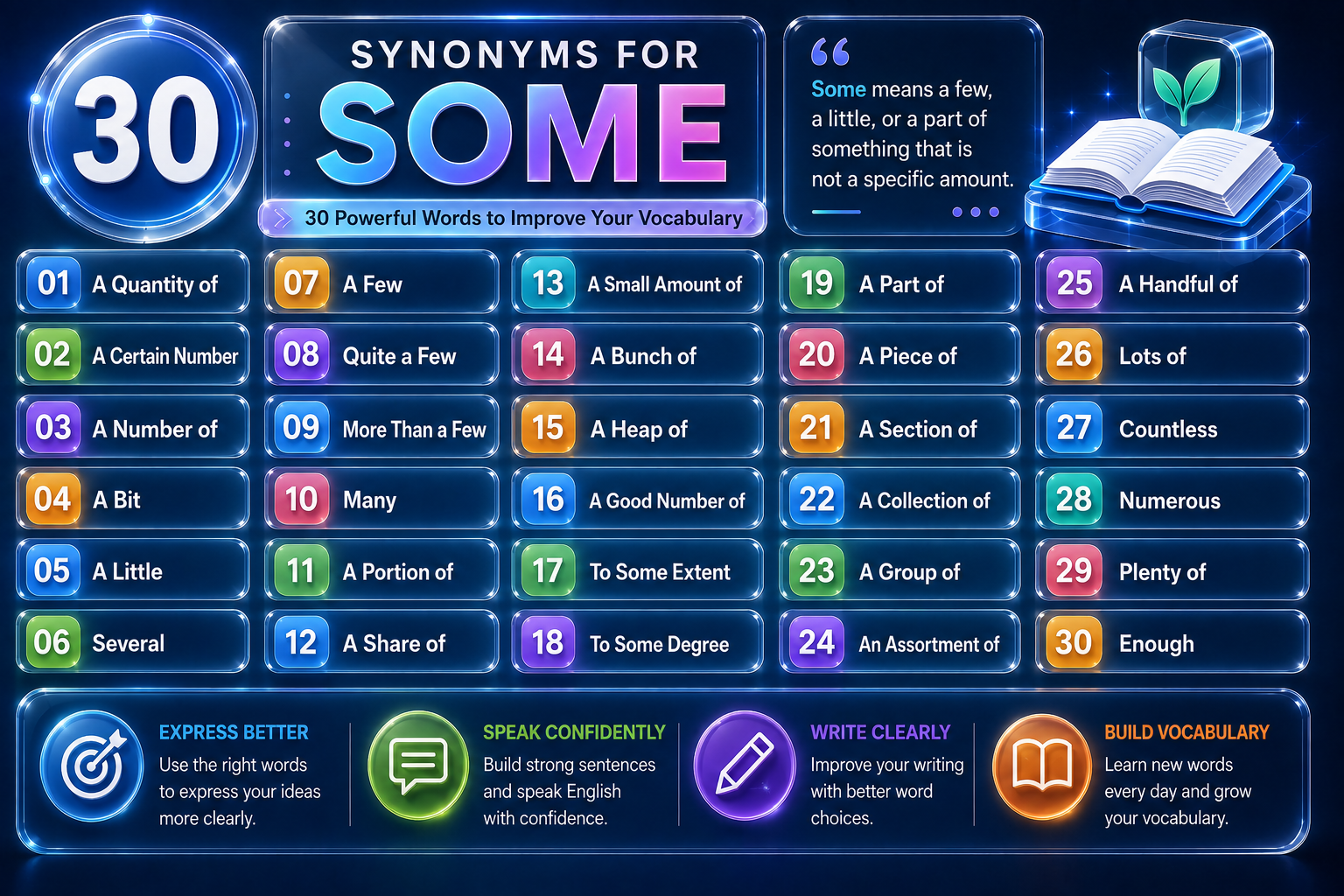
Some means a few or a part of something. We use it when we do not know the exact amount. For example, “I have some apples” means I have a few apples. We use some very often in English. Learning Synonyms for Some can help English learners speak and write better.In this article, we will learn the meaning, word type, history, sound, and word forms of some. We will also learn 30 Synonyms for Some with simple meanings and examples. Learning Synonyms for Some can help you choose the right words. These Synonyms for Some can make your English clear and easy.
Meaning of Some
Definition
Some (Determiner/Pronoun): A number or amount that is not known or not stated.
In easy words, some means a few, a little, or part of something.
Examples
- I have some books.
- She wants some water.
Connotative Meaning
- Positive tone: Some can sound warm when we offer or share something.
- Negative tone: Some can sound unclear when we want an exact number.
- Neutral tone: Some is mostly a neutral word. It simply tells us that there is a part or amount.
Etymology
- Source: Some comes from Old English.
- Old English word: It was written as sum.
- Old meaning: It meant a certain amount or number.
- The word stayed in English and slowly changed to the form some.
Short History of Some
- Old English (450–1100): People used sum to mean a certain amount or number.
- Middle English (1100–1500): The word changed in spelling and became closer to some.
- Modern English (1500–Present): Some became a very common English word. We use it for people, things, amounts, and numbers.
- Learn more about https://synonymspot.com/synonyms-for-respect/
Pronunciation (US & UK – IPA)
US: /sʌm/ UK: /sʌm/
Syllables
some
Affixation Pattern of Some
Root: some Prefix: None Suffix: None
Some is a basic word. It does not have a common prefix or suffix.
Word Formation of Some
- Some — determiner: a number or amount that is not exact.
- Some — pronoun: a few people or things.
- Somehow — adverb: in a way that is not known.
- Someone — pronoun: one person.
- Somebody — pronoun: one person.
- Something — pronoun: one thing that is not named.
- Sometimes — adverb: at some times, but not always.
- Somewhere — adverb: in a place that is not named.
- Somewhat — adverb: a little or to a small degree.
Synonyms of Some
1. A Few (Determiner/Phrase)
US: /ə fjuː/ | UK: /ə fjuː/
Meaning: A small number of people or things.
Examples:
- I have a few books.
- She bought a few apples.
2. Several (Determiner/Pronoun)
US: /ˈsevərəl/ | UK: /ˈsevrəl/
Meaning: More than two but not many.
Examples:
- I saw several birds.
- She has several toys.
3. A Little (Determiner/Phrase)
US: /ə ˈlɪtəl/ | UK: /ə ˈlɪtəl/
Meaning: A small amount of something.
Examples:
- I need a little water.
- Add a little sugar.
4. A Bit (Noun/Phrase)
US: /ə bɪt/ | UK: /ə bɪt/
Meaning: A small amount.
Examples:
- I need a bit of help.
- Add a bit of salt.
5. A Number of (Phrase)
US: /ə ˈnʌmbər əv/ | UK: /ə ˈnʌmbər əv/
Meaning: More than one, but not a clear number.
Examples:
- A number of kids came.
- A number of books are here.
6. A Quantity of (Phrase)
US: /ə ˈkwɑːntəti əv/ | UK: /ə ˈkwɒntəti əv/
Meaning: An amount of something.
Examples:
- We need a quantity of water.
- He bought a quantity of rice.
7. A Portion of (Phrase)
US: /ə ˈpɔːrʃən əv/ | UK: /ə ˈpɔːʃən əv/
Meaning: A part of something.
Examples:
- I ate a portion of the cake.
- She gave me a portion of her food.
8. A Part of (Phrase)
US: /ə pɑːrt əv/ | UK: /ə pɑːt əv/
Meaning: One part of something.
Examples:
- I read a part of the book.
- This is a part of the plan.
9. A Share of (Phrase)
US: /ə ʃer əv/ | UK: /ə ʃeər əv/
Meaning: A part that belongs to someone.
Examples:
- I got a share of the cake.
- She took a share of the money.
10. A Certain Amount (Phrase)
US: /ə ˈsɝːtən əˈmaʊnt/ | UK: /ə ˈsɜːtən əˈmaʊnt/
Meaning: An amount that is not named.
Examples:
- I need a certain amount of water.
- He saved a certain amount of money.
11. A Certain Number (Phrase)
US: /ə ˈsɝːtən ˈnʌmbər/ | UK: /ə ˈsɜːtən ˈnʌmbər/
Meaning: A number that is not named.
Examples:
- A certain number of students came.
- We need a certain number of chairs.
12. Various (Determiner/Adjective)
US: /ˈveriəs/ | UK: /ˈveəriəs/
Meaning: More than one kind or type.
Examples:
- We saw various animals.
- She tried various foods.
13. Different (Determiner/Adjective)
US: /ˈdɪfrənt/ | UK: /ˈdɪfrənt/
Meaning: Not the same.
Examples:
- I have different books.
- She likes different colors.
14. Certain (Determiner/Adjective)
US: /ˈsɝːtən/ | UK: /ˈsɜːtən/
Meaning: Some people or things that are not named.
Examples:
- Certain people like quiet places.
- Certain foods can be bad for some people.
15. Specific (Adjective)
US: /spəˈsɪfɪk/ | UK: /spəˈsɪfɪk/
Meaning: One exact person, thing, or kind.
Examples:
- I need a specific book.
- She asked for a specific color.
16. Any (Determiner/Pronoun)
US: /ˈeni/ | UK: /ˈeni/
Meaning: One or more, without saying which.
Examples:
- Do you have any books?
- I do not have any money.
17. A Handful of (Phrase)
US: /ə ˈhændfʊl əv/ | UK: /ə ˈhændfʊl əv/
Meaning: A small number or amount.
Examples:
- I picked a handful of berries.
- Only a handful of people came.
18. A Couple of (Phrase)
US: /ə ˈkʌpəl əv/ | UK: /ə ˈkʌpəl əv/
Meaning: Two or a small number.
Examples:
- I need a couple of minutes.
- She bought a couple of books.
19. A Small Number of (Phrase)
US: /ə smɔːl ˈnʌmbər əv/ | UK: /ə smɔːl ˈnʌmbər əv/
Meaning: A few people or things.
Examples:
- A small number of students came.
- Only a small number of shops were open.
20. A Small Amount of (Phrase)
US: /ə smɔːl əˈmaʊnt əv/ | UK: /ə smɔːl əˈmaʊnt əv/
Meaning: A little of something.
Examples:
- Add a small amount of milk.
- I need a small amount of water.
21. A Little Bit of (Phrase)
US: /ə ˈlɪtəl bɪt əv/ | UK: /ə ˈlɪtəl bɪt əv/
Meaning: A very small amount.
Examples:
- I need a little bit of help.
- Add a little bit of salt.
22. A Few of (Phrase)
US: /ə fjuː əv/ | UK: /ə fjuː əv/
Meaning: A small number from a group.
Examples:
- A few of my friends came.
- A few of the books are new.
23. A Selection of (Phrase)
US: /ə səˈlekʃən əv/ | UK: /ə sɪˈlekʃən əv/
Meaning: A group of things chosen from many.
Examples:
- We saw a selection of toys.
- She bought a selection of fruits.
24. A Group of (Phrase)
US: /ə ɡruːp əv/ | UK: /ə ɡruːp əv/
Meaning: A number of people or things together.
Examples:
- A group of children played outside.
- A group of birds flew away.
25. A Set of (Phrase)
US: /ə set əv/ | UK: /ə set əv/
Meaning: A group of things that belong together.
Examples:
- I bought a set of cups.
- She has a set of books.
26. More Than One (Phrase)
US: /mɔːr ðæn wʌn/ | UK: /mɔː ðæn wʌn/
Meaning: Two or more people or things.
Examples:
- More than one child was there.
- More than one answer can be right.
27. Not All (Phrase)
US: /nɑːt ɔːl/ | UK: /nɒt ɔːl/
Meaning: Only part of a group.
Examples:
- Not all students came.
- Not all the food was ready.
28. Part (Noun)
US: /pɑːrt/ | UK: /pɑːt/
Meaning: One piece of a whole thing.
Examples:
- I ate part of the cake.
- She read part of the story.
29. Portion (Noun)
US: /ˈpɔːrʃən/ | UK: /ˈpɔːʃən/
Meaning: A part or amount of something.
Examples:
- He ate a small portion of rice.
- I saved a portion for you.
30. Amount (Noun)
US: /əˈmaʊnt/ | UK: /əˈmaʊnt/
Meaning: How much of something there is.
Examples:
- Use a small amount of sugar.
- I need a good amount of water.
Prototype Meaning
The main meaning of some is an amount or number that is not exact. When people hear some, they often think about a few things or a little amount. For example, “I have some money” means the person has money, but we do not know how much. “Some children are playing” means a few children are playing, but we do not know the exact number. The word some is useful because we do not always need to give an exact number or amount.
Prototype Categorization
- Small number: a few, several, a couple of, a handful of — use these for people or things we can count.
- Small amount: a little, a bit, a little bit of, a small amount of — use these for things we do not count one by one.
- Part of something: a part of, a portion of, a share of — use these when talking about only one part.
- Unknown number: a number of, a certain number, more than one — use these when the exact number is not given.
- Unknown amount: a quantity of, a certain amount, an amount — use these when the exact amount is not given.
- Different things: various, different, certain — use these when talking about more than one kind or group.
- Groups: a group of, a set of, a selection of — use these for things or people that are together.
Antonyms of Some
All (Determiner/Pronoun)
Meaning: The whole group or whole amount.
- All the children came.
Every (Determiner)
Meaning: Each person or thing in a group.
- Every child got a book.
Whole (Adjective/Noun)
Meaning: All of something.
- I ate the whole cake.
Entire (Adjective)
Meaning: All of something from start to end.
- She read the entire book.
None (Pronoun)
Meaning: Not one or not any.
- None of the students came.
Nothing (Pronoun)
Meaning: Not one thing.
- There is nothing in the box.
No (Determiner)
Meaning: Not any.
- There is no water left.
Short Questions and Answers
What does some mean?
- Some means a few, a little, or a part.
- It does not give an exact number or amount.
When should some be used?
- Use some when the exact number or amount is not known.
- Example: I bought some apples.
Is some positive or negative?
- Some is mostly a neutral word.
- It does not usually show a good or bad feeling.
How is some different from similar words?
- Some means an amount or number that is not exact.
- A few means a small number.
- A little means a small amount.
- Several means more than two, but not many.
- All means the whole group.
- None means zero.
Is some a noun or an adjective?
- Some can be a determiner.
- It can also work as a pronoun.
- Example: I have some books.
- Example: I want some.
Can some be used with people?
- Yes.
- Example: Some people like tea.
Is some used with things?
- Yes.
- Example: I have some books.
Can some be used with food?
- Yes.
- Example: I want some rice.
What is the opposite of some?
- Common opposite ideas are all, every, none, no, and nothing.
- The best word depends on the sentence.
Why should English learners learn synonyms for some?
- Synonyms help you learn more words.
- They can help you write better.
- They can also help you avoid using the same word too much.
Can some mean a small number?
- Yes.
- Example: Some children are playing.
- It means a few children are playing.
Can some mean a small amount?
- Yes.
- Example: I need some water.
- It means I need an amount of water.
Conclusion
Synonyms for Some can help you use English better. Synonyms for Some help you say the same idea in different ways. Some means a few, a little, or a part of something. Words like a few, several, a little, a bit, and a portion of are useful Synonyms for Some.These words can make your writing clear and help you speak with confidence. Learning Synonyms for Some can also help you choose the right word. Start with two or three words each day. Practice them in simple sentences and use these Synonyms for Some when you speak or write.

I’m Zahid Abbas, an educator, researcher, and digital publishing strategist with a passion for linguistics, grammar, and clear communication. As a content creator and SEO specialist, I craft research-driven, reader-focused content that empowers learners and makes knowledge accessible worldwide.