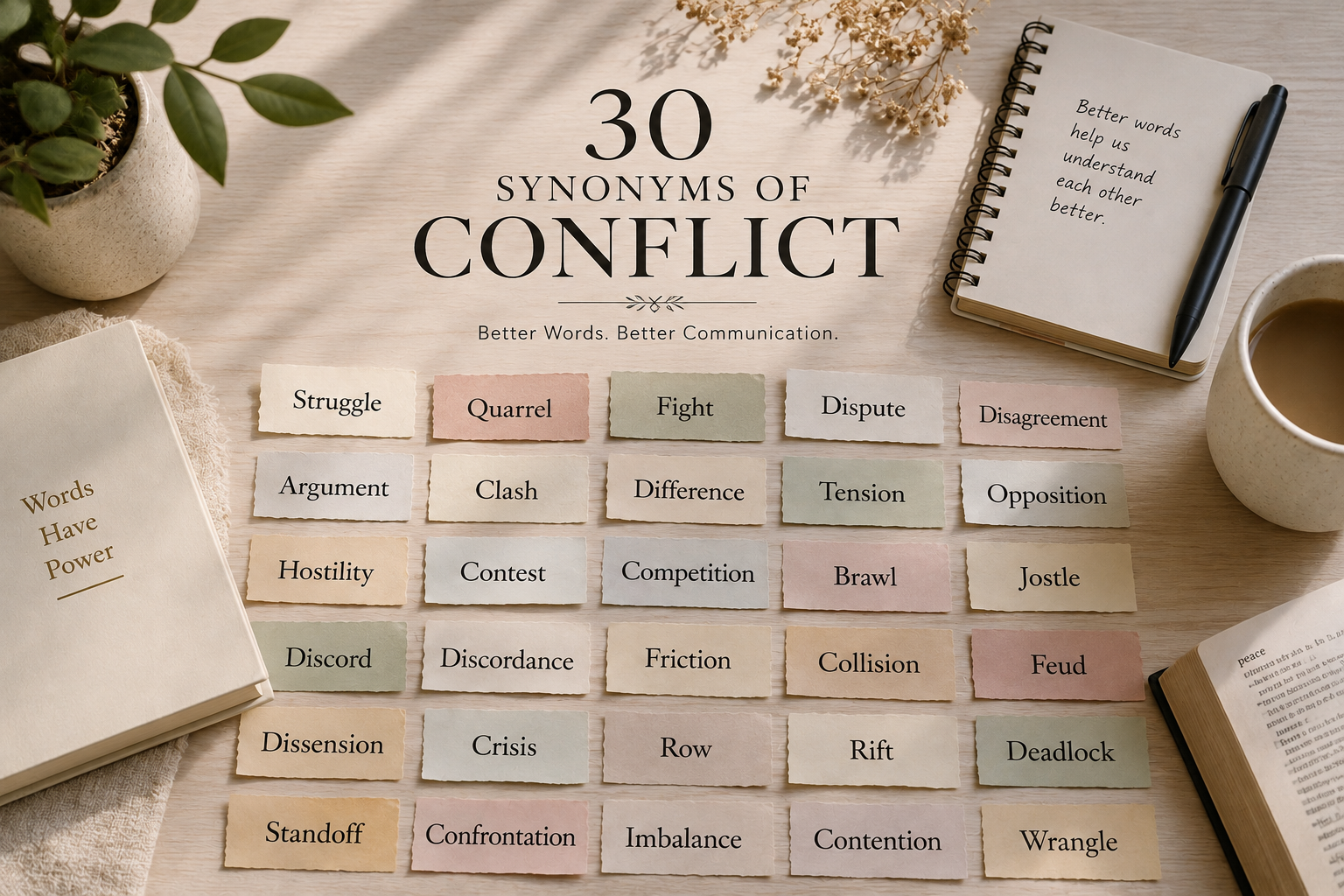
A synonym for conflict is a word that has a similar meaning to conflict. For example, two friends may have a conflict when they do not agree about something. They may argue and feel upset. Conflict is a common word in English. A synonym of conflict can be used when people, teams, countries, or even ideas do not agree. Learning synonyms for conflict can help English learners use synonym of conflict. It can also help writers make their work clear and less boring. In this article, you will learn 30 easy synonyms for conflict. You will also learn synonym of conflict their meanings, examples, word types, pronunciation, history, and tone. We will also look at groups of similar words and their opposite words. This guide will help you choose the right word for each situation.
Meaning of Conflict
Conflict (noun/verb):
Conflict means a fight, problem, or disagreement between two or more people or groups.
Examples
- The two boys had a conflict.
- The two teams were in conflict.
Connotative Meaning
- Positive tone: Conflict can help people talk about problems and find a better answer.
- Negative tone: Conflict can make people feel angry, sad, or worried.
- Neutral tone: Conflict can simply mean that two people or ideas are not the same.
also read more about https://synonymspot.com/synonyms-of-boring/
Etymology
- Origin: The word conflict comes from Latin.
- The Latin word conflictus meant “a clash” or “a striking together.”
- The word later entered English through French and Latin.
Short History of Conflict
- Old English (450–1100): English had other words for fights and struggles. The modern word conflict was not common.
- Middle English (1100–1500): The word conflict came into English and was used for fights and struggles.
- Modern English (1500–Present): Conflict became a common word. It is now used for fights, disagreements, wars, and personal problems.
Pronunciation of Conflict
- US: /ˈkɑːn.flɪkt/ — noun
- UK: /ˈkɒn.flɪkt/ — noun
As a verb:
- US: /kənˈflɪkt/
- UK: /kənˈflɪkt/
Syllables
con-flict
Affixation Pattern of Conflict
- Root: flict — linked to the idea of striking or fighting.
- Prefix: con- — means “together.”
- Suffix: None.
Word Formation of Conflict
- Conflict — noun: a fight or disagreement.
- Conflict — verb: to disagree or not match.
- Conflicting — adjective: not agreeing or matching.
- Conflicted — adjective: having mixed feelings.
Synonym of Conflict
1. Disagreement (Noun)
US: /ˌdɪs.əˈɡriː.mənt/ | UK: /ˌdɪs.əˈɡriː.mənt/
Meaning: A disagreement is when people have different ideas.
Examples:
- We had a disagreement.
- Their disagreement was small.
2. Argument (Noun)
US: /ˈɑːrɡjəmənt/ | UK: /ˈɑːɡjʊmənt/
Meaning: An argument is when people speak angrily because they do not agree.
Examples:
- I had an argument with my brother.
- Their argument ended quickly.
3. Dispute (Noun/Verb)
US: /dɪˈspjuːt/ | UK: /dɪˈspjuːt/
Meaning: A dispute is a serious disagreement.
Examples:
- They had a dispute about money.
- The two sides disputed the plan.
4. Fight (Noun/Verb)
US: /faɪt/ | UK: /faɪt/
Meaning: A fight is a physical or verbal struggle.
Examples:
- The boys had a fight.
- They fought over a toy.
5. Quarrel (Noun/Verb)
US: /ˈkwɔːrəl/ | UK: /ˈkwɒrəl/
Meaning: A quarrel is an angry argument.
Examples:
- The sisters had a quarrel.
- The children often quarrel.
6. Clash (Noun/Verb)
US: /klæʃ/ | UK: /klæʃ/
Meaning: A clash is a strong disagreement or fight.
Examples:
- The two teams had a clash.
- Their ideas often clash.
7. Struggle (Noun/Verb)
US: /ˈstrʌɡəl/ | UK: /ˈstrʌɡəl/
Meaning: A struggle is a hard fight against a problem.
Examples:
- Life can be a struggle.
- She struggled with the problem.
8. Tension (Noun)
US: /ˈtenʃən/ | UK: /ˈtenʃən/
Meaning: Tension is a feeling of stress or worry.
Examples:
- There was tension in the room.
- The tension grew after the argument.
9. Friction (Noun)
US: /ˈfrɪkʃən/ | UK: /ˈfrɪkʃən/
Meaning: Friction means small problems between people.
Examples:
- There is friction between them.
- Their different ideas caused friction.
10. Feud (Noun/Verb)
US: /fjuːd/ | UK: /fjuːd/
Meaning: A feud is a long and angry fight.
Examples:
- The two families had a feud.
- The groups have feuded for years.
11. Rivalry (Noun)
US: /ˈraɪvəlri/ | UK: /ˈraɪvəlri/
Meaning: Rivalry is a strong competition between people or groups.
Examples:
- There is a rivalry between the teams.
- Their rivalry is very strong.
12. Opposition (Noun)
US: /ˌɑːpəˈzɪʃən/ | UK: /ˌɒpəˈzɪʃən/
Meaning: Opposition means being against someone or something.
Examples:
- The plan faced opposition.
- Many people showed opposition to the idea.
13. Resistance (Noun)
US: /rɪˈzɪstəns/ | UK: /rɪˈzɪstəns/
Meaning: Resistance means trying to stop something.
Examples:
- The rule met resistance.
- The workers showed resistance.
14. Confrontation (Noun)
US: /ˌkɑːnfrənˈteɪʃən/ | UK: /ˌkɒnfrənˈteɪʃən/
Meaning: A confrontation is a direct meeting with someone who disagrees with you.
Examples:
- He wanted to avoid a confrontation.
- The meeting became a confrontation.
15. Hostility (Noun)
US: /hɑˈstɪləti/ | UK: /hɒˈstɪləti/
Meaning: Hostility means strong anger or unfriendliness.
Examples:
- I could feel his hostility.
- There was hostility between the groups.
16. Discord (Noun)
US: /ˈdɪskɔːrd/ | UK: /ˈdɪskɔːd/
Meaning: Discord means a lack of agreement.
Examples:
- The decision caused discord.
- Discord grew in the group.
17. Strife (Noun)
US: /straɪf/ | UK: /straɪf/
Meaning: Strife means serious and long conflict.
Examples:
- The country faced years of strife.
- Family strife caused many problems.
18. Turmoil (Noun)
US: /ˈtɝːmɔɪl/ | UK: /ˈtɜːmɔɪl/
Meaning: Turmoil means a state of great trouble or confusion.
Examples:
- The country was in turmoil.
- She felt emotional turmoil.
19. Contention (Noun)
US: /kənˈtenʃən/ | UK: /kənˈtenʃən/
Meaning: Contention means strong disagreement about something.
Examples:
- Money was a point of contention.
- The rule caused contention.
20. Battle (Noun/Verb)
US: /ˈbætəl/ | UK: /ˈbætəl/
Meaning: A battle is a serious fight or struggle.
Examples:
- The soldiers fought a battle.
- She battled against the problem.
21. Contest (Noun/Verb)
US: /ˈkɑːntest/ | UK: /ˈkɒntest/
Meaning: A contest is a struggle to win something.
Examples:
- It was a close contest.
- They contested the final place.
22. Competition (Noun)
US: /ˌkɑːmpəˈtɪʃən/ | UK: /ˌkɒmpəˈtɪʃən/
Meaning: Competition is when people try to win or do better than others.
Examples:
- There is strong competition.
- Competition can make us work harder.
23. Altercation (Noun)
US: /ˌɔːltərˈkeɪʃən/ | UK: /ˌɔːltəˈkeɪʃən/
Meaning: An altercation is a short angry argument or fight.
Examples:
- The police stopped the altercation.
- An altercation started outside.
24. Brawl (Noun/Verb)
US: /brɔːl/ | UK: /brɔːl/
Meaning: A brawl is a loud physical fight.
Examples:
- A brawl started after the game.
- Several people joined the brawl.
25. Wrangle (Noun/Verb)
US: /ˈræŋɡəl/ | UK: /ˈræŋɡəl/
Meaning: A wrangle is a long argument.
Examples:
- The plan caused a wrangle.
- They wrangled over the price.
26. Antagonism (Noun)
US: /ænˈtæɡənɪzəm/ | UK: /ænˈtæɡənɪzəm/
Meaning: Antagonism means strong dislike or opposition.
Examples:
- There was antagonism between them.
- His words caused antagonism.
27. Hostilities (Noun)
US: /hɑˈstɪlətiz/ | UK: /hɒˈstɪlətiz/
Meaning: Hostilities means acts of fighting between two sides.
Examples:
- The two sides stopped hostilities.
- Hostilities continued for days.
28. Warfare (Noun)
US: /ˈwɔːrfer/ | UK: /ˈwɔːfeə/
Meaning: Warfare means fighting between countries or groups.
Examples:
- Warfare can destroy cities.
- The country suffered from warfare.
29. Turbulence (Noun)
US: /ˈtɝːbjələns/ | UK: /ˈtɜːbjʊləns/
Meaning: Turbulence means a time of trouble and change.
Examples:
- The company faced turbulence.
- Political turbulence caused fear.
30. Struggle (Noun/Verb)
US: /ˈstrʌɡəl/ | UK: /ˈstrʌɡəl/
Meaning: A struggle is a hard effort to deal with a problem.
Examples:
- He had a struggle at school.
- She struggled to finish her work.
Prototype Meaning
The most common meaning of conflict is a fight or disagreement. When people hear this word, they often think about two people or groups who do not agree. They may argue, fight, or have different goals. Conflict can also happen inside a person. For example, a person may want to study but also want to play. This is an inner conflict.
Prototype Categorization
- Simple disagreement: disagreement, argument, dispute — use these for people who do not agree.
- Small personal fight: quarrel, fight, clash — use these for common fights.
- Long conflict: feud, rivalry, strife — use these for problems that last a long time.
- Stress or worry: tension, friction, turmoil — use these for feelings and pressure.
- Strong opposition: opposition, resistance, antagonism — use these when someone is against something.
- Physical fighting: battle, brawl, altercation — use these for physical fights.
- War: hostilities, warfare — use these for fighting between groups or countries.
- Competition: contest, competition, rivalry — use these when people try to win.
Knowing these groups helps writers choose the right synonym. It also helps English learners understand the small differences between similar words.
Antonyms of Conflict
- Agreement (noun): when people have the same idea.
- Peace (noun): a time without fighting.
- Harmony (noun): a peaceful relationship.
- Unity (noun): being together as one group.
- Cooperation (noun): working together.
- Friendship (noun): a good relationship between people.
- Agree (verb): to have the same opinion.
- Cooperate (verb): to work well with others.
- Reconcile (verb): to become friendly again after a fight.
Short Questions and Answers
What does conflict mean?
- Conflict means a fight, struggle, or disagreement.
When should conflict be used?
- Use conflict when two people, groups, or ideas do not agree.
- It can be used in speaking and writing.
Is conflict positive or negative?
- Conflict is usually negative.
- It can mean anger, fighting, or problems.
- But some conflict can help people solve problems.
How is conflict different from similar words?
- Conflict: a general word for a fight or disagreement.
- Argument: a disagreement with words.
- Dispute: a serious disagreement.
- Quarrel: an angry personal argument.
- Feud: a long fight.
- Rivalry: strong competition.
- Battle: a serious fight.
- Tension: stress between people.
Conclusion
Synonym for conflict can make your English better. Synonym of conflict words help you talk about fights, problems, disagreements, and struggles. You do not need to use the same word again and again. You can use words like argument, dispute, quarrel, clash, feud, rivalry, and tension when they fit the situation.Synonym of conflict can make your writing and speaking more clear. Synonym of conflict can also help you feel more confident when using English. Try to learn two or three new words each day. Write a short sentence with each word. Then use the words when you speak or write. Small daily practice can help you build a strong vocabulary.

I’m Zahid Abbas, an educator, researcher, and digital publishing strategist with a passion for linguistics, grammar, and clear communication. As a content creator and SEO specialist, I craft research-driven, reader-focused content that empowers learners and makes knowledge accessible worldwide.