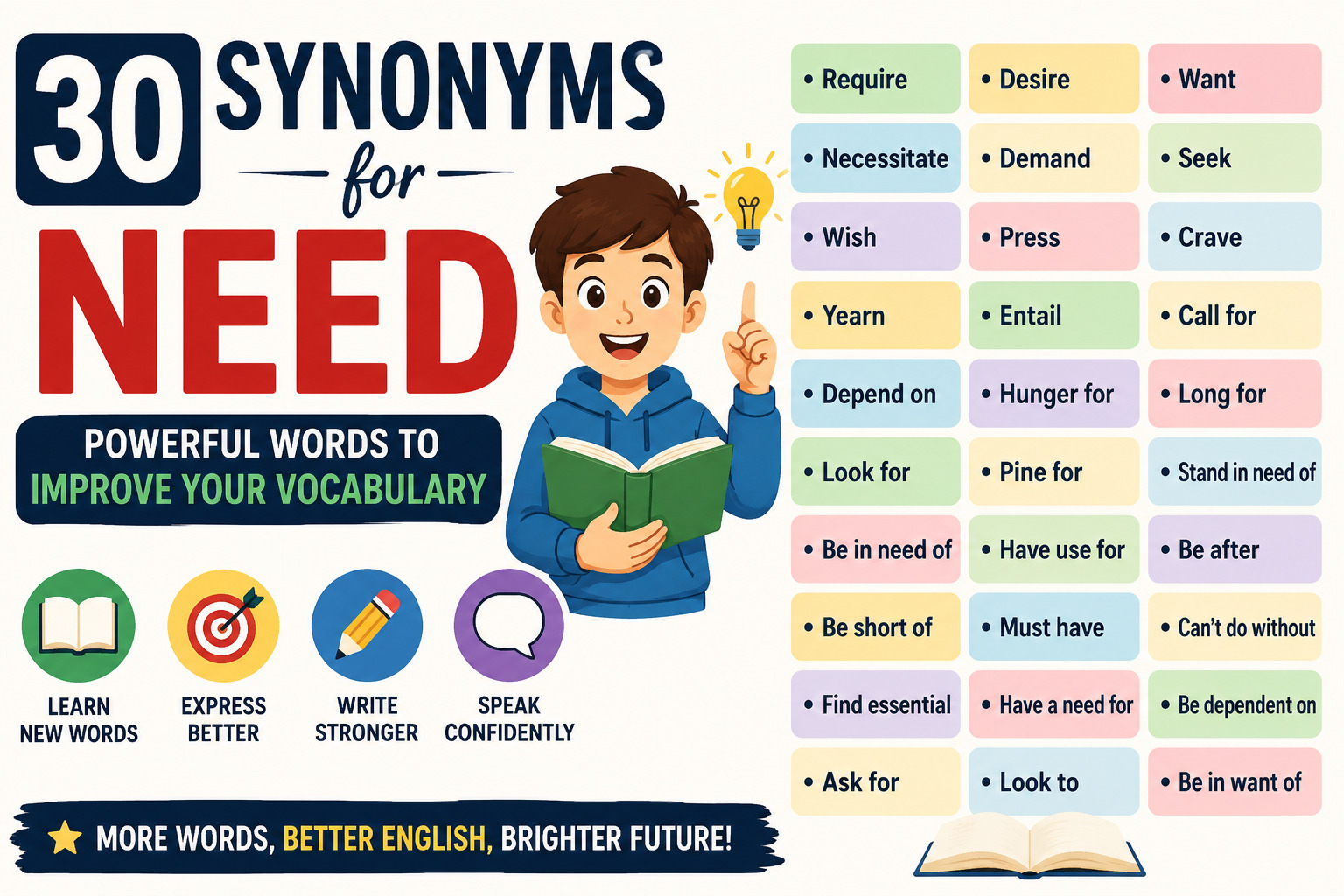
Need is a common English word. It means to want or require something because it is important or necessary.. Imagine a student preparing for an exam. She realizes, “I need more time to study.” Here, need clearly shows that something is necessary.People use the word need every day. We use synonyms for need when we talk about things that are important, wanted, or necessary. Learning words like synonyms for need can help English learners speak and write better It also helps content writers avoid repeating the same word in every sentence. In this article, you will learn the meaning, grammar, pronunciation, history, and word formation of need. You will also explore 30 synonyms for need their meanings, examples, tones, and semantic categories. Synonyms for need will help you choose the right word for each situation.
Meaning of Need
Need (verb/noun): to require something because it is necessary, important, or useful; a thing that is nceessary or strongly wanted.
Definition
Need means that something is necessary for a person, situation, or purpose.
Examples
- I need some water after my workout.
- We need more time to finish the project.
Connotative Meaning
- Positive tone: Can suggest a healthy goal, useful support, or an important requirement.
- Negative tone: Can suggest dependence, shortage, pressure, or difficulty.
- Neutral tone: Simply states that something is necessary or required.
- Also read more about https://synonymspot.com/synonyms-of-hate/
Etymology
- Source: Old English
- Old English form: nēod or nēd
- Original meaning: necessity, compulsion, distress, or urgent requirement.
Short History of Need
- Old English (450–1100): Nēd referred to necessity, hardship, or a situation that forced someone to act.
- Middle English (1100–1500): The word became nede and still meant something necessary or something that was missing requirement.
- Modern English (1500–Present): Need became a common noun and verb used for necessities, requirements, desires, and practical conditions.
Pronunciation (US & UK – IPA)
- US: /niːd/
- UK: /niːd/
Syllables
need
Affixation Pattern of Need
- Root: need
- Prefix: none
- Suffix: none
Word Formation of Need
- Need — noun/verb
- Needed — adjective/verb form
- Needing — present participle/gerund
- Needs — noun/third-person singular verb
- Needless — adjective
- Needlessly — adverb
- Needful — adjective
- Neediness — noun
- Needy — adjective
Synonym of Need
The following words are related to need, but they are not all interchangeable. Some describe necessity, while others describe desire, shortage, obligation, or demand.
1. Require (Verb)
US IPA: /rɪˈkwaɪr/ | UK IPA: /rɪˈkwaɪə/
Meaning: To need something because it is necessary.
Examples:
- This job requires good communication skills.
- Plants require sunlight to grow.
2. Necessitate (Verb)
US IPA: /nəˈsesɪteɪt/ | UK IPA: /nəˈsesɪteɪt/
Meaning: To make something necessary.
Examples:
- The damage necessitated immediate repairs.
- Heavy rain necessitated a change of plans.
3. Want (Verb/Noun)
US IPA: /wɑːnt/ | UK IPA: /wɒnt/
Meaning: To desire or lack something.
Examples:
- I want a new notebook.
- She wants more time to practice.
4. Demand (Verb/Noun)
US IPA: /dɪˈmænd/ | UK IPA: /dɪˈmɑːnd/
Meaning: To require something strongly or firmly.
Examples:
- This task demands careful attention.
- The situation demands quick action.
5. Desire (Verb/Noun)
US IPA: /dɪˈzaɪər/ | UK IPA: /dɪˈzaɪə/
Meaning: To strongly want something.
Examples:
- She desires a better education.
- He has a strong desire to succeed.
6. Require the Use of (Verb Phrase)
US IPA: /rɪˈkwaɪr ðə juːs əv/ | UK IPA: /rɪˈkwaɪə ðə juːs əv/
Meaning: To make the use of something necessary.
Examples:
- The machine requires the use of special tools.
- This recipe requires the use of fresh herbs.
7. Call For (Phrasal Verb)
US IPA: /kɔːl fɔːr/ | UK IPA: /kɔːl fɔː/
Meaning: To require or make something necessary.
Examples:
- The problem calls for a simple solution.
- The weather calls for warm clothing.
8. Necessity (Noun)
US IPA: /nəˈsesəti/ | UK IPA: /nəˈsesəti/
Meaning: Something that is necessary.
Examples:
- Food is a basic necessity.
- Clean water is a human necessity.
9. Requirement (Noun)
US IPA: /rɪˈkwaɪərmənt/ | UK IPA: /rɪˈkwaɪəmənt/
Meaning: Something that must be available or completed.
Examples:
- A passport is a requirement for the trip.
- Experience is an important job requirement.
10. Essential (Adjective/Noun)
US IPA: /ɪˈsenʃəl/ | UK IPA: /ɪˈsenʃəl/
Meaning: Completely necessary or extremely important.
Examples:
- Sleep is essential for good health.
- Water is an essential for life.
11. Prerequisite (Noun)
US IPA: /ˌpriːˈrekwəzɪt/ | UK IPA: /ˌpriːˈrekwəzɪt/
Meaning: Something required before another thing can happen.
Examples:
- A degree is a prerequisite for the position.
- Basic computer skills are a prerequisite for the course.
12. Oblige (Verb)
US IPA: /əˈblaɪdʒ/ | UK IPA: /əˈblaɪdʒ/
Meaning: To force or require someone to do something.
Examples:
- The rules oblige visitors to show identification.
- The law obliges companies to protect customer data.
13. Compel (Verb)
US IPA: /kəmˈpel/ | UK IPA: /kəmˈpel/
Meaning: To force someone to do something.
Examples:
- The evidence compelled him to change his opinion.
- The emergency compelled us to leave early.
14. Warrant (Verb)
US IPA: /ˈwɔːrənt/ | UK IPA: /ˈwɒrənt/
Meaning: To make an action necessary or reasonable.
Examples:
- The situation warrants further investigation.
- The problem warrants immediate attention.
15. Entail (Verb)
US PA: /ɪnˈteɪl/ | UK IPA: /ɪnˈteɪl
Meaning: To involve something as a necessary part or result.
Examples:
- The job entails working long hours.
- Moving abroad entails many changes.
16. Involve (Verb)
US IPA: /ɪnˈvɑːlv/ | UK IPA: /ɪnˈvɒlv/
Meaning: To include something as a necessary part.
Examples:
- The project involves careful planning.
- Learning a language involves regular practice.
17. Take (Verb)
US IPA: /teɪk/ | UK IPA: /teɪk/
Meaning: To require a particular amount of time, effort, or resources.
Examples:
- The journey takes three hours.
- This task takes a lot of patience.
18. Depend On (Phrasal Verb)
US IPA: /dɪˈpend ɑːn/ | UK IPA: /dɪˈpend ɒn/
Meaning: To need or rely on something for support or success.
Examples:
- Plants depend on water to survive.
- Success often depends on hard work.
19. Lack (Verb/Noun)
US IPA: /læk/ | UK IPA: /læk/
Meaning: To not have something that is necessary or wanted.
Examples:
- The team lacks experience.
- A lack of sleep can affect concentration.
20. Be Short Of (Phrase)
US IPA: /bi ʃɔːrt əv/ | UK IPA: /biː ʃɔːt əv/
Meaning: To have less of something than is needed.
Examples:
- We are short of time.
- The hospital is short of nurses.
21. Be In Need Of (Phrase)
US IPA: /bi ɪn niːd əv/ | UK IPA: /biː ɪn niːd əv/
Meaning: To require or lack something important.
Examples:
- The house is in need of repair.
- Many families are in need of help.
22. Yearn (Verb)
US IPA: /jɝːn/ | UK IPA: /jɜːn/
Meaning: To strongly and emotionally desire something.
Examples:
- She yearned for freedom.
- He yearns to see his family again.
23. Crave (Verb)
US IPA: /kreɪv/ | UK IPA: /kreɪv/
Meaning: To strongly want something.
Examples:
- I crave a cup of tea in the morning.
- She craved attention after the event.
24. Wish (Verb/Noun)
US IPA: /wɪʃ/ | UK IPA: /wɪʃ/
Meaning: To want something to happen or to be true.
Examples:
- I wish I had more free time.
- His greatest wish is to travel the world.
25. Long For (Phrasal Verb)
US IPA: /lɔːŋ fɔːr/ | UK IPA: /lɒŋ fɔː/
Meaning: To strongly desire something, usually for a long time.
Examples:
- She longs for a peaceful life.
- He longed for his childhood home.
26. Demand For (Noun Phrase)
US IPA: /dɪˈmænd fɔːr/ | UK IPA: /dɪˈmɑːnd fɔː/
Meaning: The amount of something that people want or require.
Examples:
- There is a high demand for skilled workers.
- Demand for clean energy is increasing.
27. Deficiency (Noun)
US IPA: /dɪˈfɪʃənsi/ | UK IPA: /dɪˈfɪʃənsi/
Meaning: A lack of something that is necessary or important.
Examples:
- The report showed a deficiency in staff.
- A vitamin deficiency can affect the body.
28. Shortage (Noun)
US IPA: /ˈʃɔːrtɪdʒ/ | UK IPA: /ˈʃɔːtɪdʒ/
Meaning: A situation in which there is not enough of something.
Examples:
- The city faced a water shortage.
- A food shortage affected many families.
29. Want For (Phrasal Verb)
US IPA: /wɑːnt fɔːr/ | UK IPA: /wɒnt fɔː/
Meaning: To lack something necessary or desirable.
Examples:
- The children never wanted for food.
- The family did not want for anything important.
30. Needful (Adjective)
US IPA: /ˈniːdfəl/ | UK IPA: /ˈniːdfəl/
Meaning: Necessary or required.
Examples:
- Please take the needful steps to solve the problem.
- The team completed all the needful work.
Usage note: Some words have meanings close to need, but they are not exactly the same. Crave, yearn, and wish mean to want something. Require, necessitate, and prerequisite mean that something is needed or necessaryLack, shortage, and deficiency describe the absence of something needed.
Prototype Meaning
The most typical meaning of need is to require something necessary. When people hear the word need, they often think about things like food, water, money, time, help, or information. It usually means that someone does not have something they need to reach a goal or solve a problem.
Prototype Categorization
- Basic necessity: necessity, essential, needful — useful when something is truly necessary.
- Formal requirement: require, requirement, prerequisite, necessitate — common in academic, business, legal, and professional writing.
- Strong obligation: demand, oblige, compel, warrant — useful when circumstances or rules make action necessary.
- Desire: want, desire, wish, crave, yearn, long for — used when you want something, not when you need it.
- Shortage or absence: lack, shortage, deficiency, be short of — used when something needed is missing.
- Practical use: entail, involve, take, call for — used when a task needs time, effort, skill, or action.
- Dependence: depend on, be in need of — useful when something relies on another thing for support.
Categorizing synonyms helps writers choose words with the right meaning, strength, tone, and context. It prevents awkward substitutions and makes writing more precise.
Antonyms of Need
- Have (Verb): to possess or already have something that may otherwise be needed.
- Possess (Verb): to own or have something.
- Lack of Need (Noun Phrase): a situation in which something is not necessary.
- Sufficiency (Noun): having enough of something.
- Abundance (Noun): having more than enough of something.
- Satisfaction (Noun): a state in which a desire or requirement has been fulfilled.
- Unnecessary (Adjective): not needed or required.
- Optional (Adjective): not required and left to personal choice.
Short Questions and Answers
What does Need mean?
- Need means to require something because it is necessary, useful, or important.
When should Need be used?
- Use need when you want to show that a person, object, or situation requires something.
- Example: “We need more information.”
Is Need positive or negative?
- Need is usually neutral.
- Its tone depends on context. It can suggest a positive goal, such as needing education, or a negative problem, such as needing emergency help.
How is Need different from similar words?
- Need is broad and common.
- Require sounds more formal and often describes rules or conditions.
- Want focuses more on desire.
- Demand suggests a stronger requirement.
- Crave and yearn describe strong emotional desire.
- Lack describes not having something.
Conclusion
Synonyms for Need and its can greatly improve your English vocabulary. Synonyms for Need and its can greatly improve your English vocabulary.Synonyms for need help you express different levels of necessity, desire, obligation, and absence. They also strengthen both writing and speaking by helping you avoid unnecessary repetition. For content writers, a wider vocabulary can make articles more natural and engaging. For English learners, understanding pronunciation, tone, grammar, and context makes it easier to choose the right word. Practice one or two synonyms each day. Use Synonyms for Need and its can greatly improve your English in your own sentences, and soon your vocabulary and English confidence will grow.

I’m Zahid Abbas, an educator, researcher, and digital publishing strategist with a passion for linguistics, grammar, and clear communication. As a content creator and SEO specialist, I craft research-driven, reader-focused content that empowers learners and makes knowledge accessible worldwide.