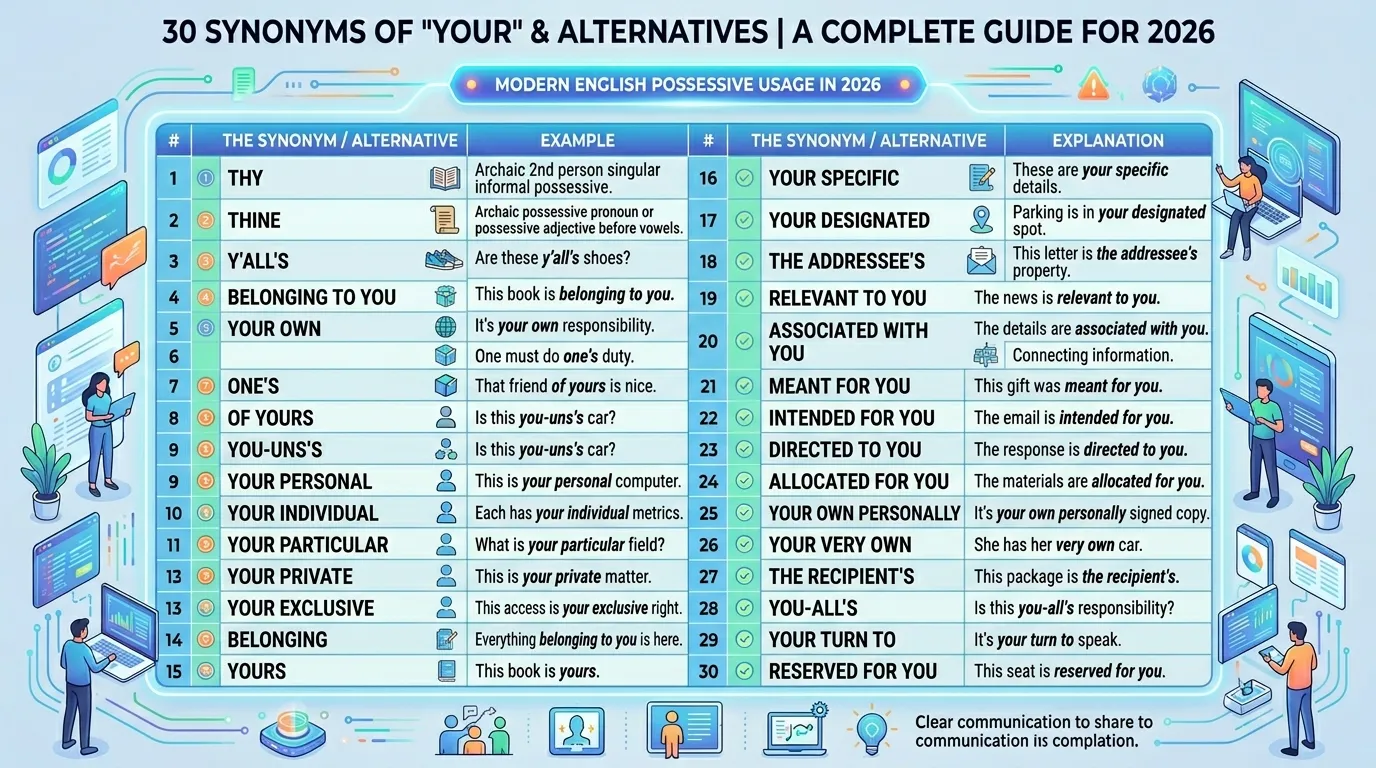
The word your is one of the most common words in English. It shows possession or ownership. For example, when someone says, “Is this your book?” they are asking if the book belongs to you. We use this word every day in speaking, writing, emails, conversations, and stories.
Because your is very common, learning similar words and related expressions helps English learners improve vocabulary and avoid repetition. Writers also use alternatives to make sentences sound more natural and engaging. Although exact synonyms for your are limited because it is a possessive determiner, many related words and phrases can express similar meanings in different contexts.
In this article, you will learn the meaning of your, its pronunciation, history, grammar, and 30 useful related synonyms with examples. You will also explore semantic categories, antonyms, and simple questions to strengthen your English skills.
Meaning of Your
Definition
Your (possessive determiner/pronoun): belonging to or connected with the person being spoken to.
Examples
- Is this your bag?
- I like your idea.
Connotative Meaning
(Connotation means the feeling or emotion a word suggests beyond its basic meaning.)
- Positive tone: personal, caring, direct
- Negative tone: sometimes controlling or blaming depending on context
- Neutral tone: showing ownership or connection
Etymology
- From Old English ēower meaning “belonging to you”
- Related to Germanic language roots
Short History:
- Old English (450–1100): forms like ēower were used
- Middle English (1100–1500): changed into forms closer to “your”
- Modern English (1500–Present): “your” became the standard possessive form
Pronunciation (US & UK – IPA)
- US: /jʊr/ or /jɔːr/
- UK: /jɔː/
Syllables
- your
Affixation Pattern of Your
- Root: your
- Prefix: none
- Suffix: none
Word Formation:
- you (pronoun)
- your (possessive determiner)
- yours (possessive pronoun)
- yourself (reflexive pronoun)
- yourselves (plural reflexive pronoun)
30 Synonyms of Your
1. Yours (pronoun)
US: /jʊrz/ | UK: /jɔːz/
Meaning: belonging to you
Examples:
- This pen is yours.
- The blue car is yours.
2. Belonging to You (phrase)
US: /bɪˈlɔːŋɪŋ tə juː/ | UK: /bɪˈlɒŋɪŋ tə juː/
Meaning: owned by you
Examples:
- The jacket belonging to you is here.
- I found the files belonging to you.
3. Personal (adjective)
US: /ˈpɜːrsənl/ | UK: /ˈpɜːsənl/
Meaning: relating to one person
Examples:
- Keep your personal items safe.
- This is personal information.
4. Owned (adjective)
US: /oʊnd/ | UK: /əʊnd/
Meaning: possessed by someone
Examples:
- The house is privately owned.
- She showed her owned collection.
5. Individual (adjective)
US: /ˌɪndɪˈvɪdʒuəl/ | UK: /ˌɪndɪˈvɪdʒuəl/
Meaning: belonging to one person
Examples:
- Each student has an individual desk.
- Respect individual choices.
6. Private (adjective)
US: /ˈpraɪvət/ | UK: /ˈpraɪvət/
Meaning: intended for one person only
Examples:
- This is a private room.
- Keep your private notes secure.
7. Native (adjective)
US: /ˈneɪtɪv/ | UK: /ˈneɪtɪv/
Meaning: belonging naturally to a person or place
Examples:
- English is your native language.
- She loves her native culture.
8. Own (adjective)
US: /oʊn/ | UK: /əʊn/
Meaning: belonging to oneself
Examples:
- Bring your own lunch.
- He built his own business.
9. Particular (adjective)
US: /pərˈtɪkjələr/ | UK: /pəˈtɪkjʊlə/
Meaning: specific to one person or thing
Examples:
- This is your particular seat.
- Everyone has particular interests.
10. Exclusive (adjective)
US: /ɪkˈskluːsɪv/ | UK: /ɪkˈskluːsɪv/
Meaning: limited to one person or group
Examples:
- This offer is exclusive to members.
- She has exclusive rights.
11. Proprietary (adjective)
US: /prəˈpraɪəteri/ | UK: /prəˈpraɪətəri/
Meaning: owned privately
Examples:
- The company uses proprietary software.
- This is proprietary information.
12. Possessed (adjective)
US: /pəˈzɛst/ | UK: /pəˈzest/
Meaning: owned or controlled
Examples:
- The land is possessed legally.
- She possessed strong skills.
13. Domestic (adjective)
US: /dəˈmɛstɪk/ | UK: /dəˈmestɪk/
Meaning: relating to home or family
Examples:
- Domestic responsibilities are important.
- He handles domestic tasks.
14. Household (adjective)
US: /ˈhaʊshoʊld/ | UK: /ˈhaʊshəʊld/
Meaning: connected with a home
Examples:
- Household items are expensive.
- She manages household duties.
15. Familiar (adjective)
US: /fəˈmɪliər/ | UK: /fəˈmɪliə/
Meaning: well known personally
Examples:
- Your voice sounds familiar.
- The place felt familiar.
16. Intimate (adjective)
US: /ˈɪntəmət/ | UK: /ˈɪntɪmət/
Meaning: very personal or close
Examples:
- They shared intimate details.
- This is an intimate conversation.
17. Related (adjective)
US: /rɪˈleɪtɪd/ | UK: /rɪˈleɪtɪd/
Meaning: connected to something
Examples:
- Your question is related to science.
- These topics are related.
18. Connected (adjective)
US: /kəˈnɛktɪd/ | UK: /kəˈnektɪd/
Meaning: linked together
Examples:
- Your ideas are connected.
- The systems are connected.
19. Associated (adjective)
US: /əˈsoʊsieɪtɪd/ | UK: /əˈsəʊsieɪtɪd/
Meaning: linked with something
Examples:
- Risks are associated with smoking.
- Her name is associated with success.
20. Assigned (adjective)
US: /əˈsaɪnd/ | UK: /əˈsaɪnd/
Meaning: given officially to someone
Examples:
- This is your assigned seat.
- Students completed assigned tasks.
21. Reserved (adjective)
US: /rɪˈzɜːrvd/ | UK: /rɪˈzɜːvd/
Meaning: kept for someone specific
Examples:
- This table is reserved for you.
- Reserved parking is available.
22. Dedicated (adjective)
US: /ˈdɛdɪkeɪtɪd/ | UK: /ˈdedɪkeɪtɪd/
Meaning: intended for a particular person
Examples:
- She has a dedicated workspace.
- This page is dedicated to teachers.
23. Tailored (adjective)
US: /ˈteɪlərd/ | UK: /ˈteɪləd/
Meaning: made specially for someone
Examples:
- The course is tailored to your needs.
- He wore a tailored suit.
24. Customized (adjective)
US: /ˈkʌstəmaɪzd/ | UK: /ˈkʌstəmaɪzd/
Meaning: changed for personal use
Examples:
- She ordered a customized bag.
- The phone has customized settings.
25. Unique (adjective)
US: /juˈniːk/ | UK: /juˈniːk/
Meaning: special and different
Examples:
- Your style is unique.
- Every person has unique talents.
26. Distinctive (adjective)
US: /dɪˈstɪŋktɪv/ | UK: /dɪˈstɪŋktɪv/
Meaning: clearly different from others
Examples:
- She has a distinctive voice.
- Your design looks distinctive.
27. Characteristic (adjective)
US: /ˌkærɪktəˈrɪstɪk/ | UK: /ˌkærəktəˈrɪstɪk/
Meaning: typical of a person
Examples:
- That smile is characteristic of you.
- His behavior is characteristic.
28. Identifiable (adjective)
US: /aɪˈdɛntəˌfaɪəbəl/ | UK: /aɪˈdentɪfaɪəbəl/
Meaning: easy to recognize
Examples:
- Your handwriting is identifiable.
- The logo is identifiable instantly.
29. Signature (adjective/noun)
US: /ˈsɪɡnətʃər/ | UK: /ˈsɪɡnətʃə/
Meaning: closely connected with a person
Examples:
- This is her signature style.
- The chef created a signature dish.
30. Trademark (noun/adjective)
US: /ˈtreɪdmɑːrk/ | UK: /ˈtreɪdmɑːk/
Meaning: a special feature belonging to someone
Examples:
- Humor is his trademark quality.
- The company registered its trademark logo.
Prototype Meaning
The most typical meaning of your is showing that something belongs to the person being spoken to. People usually imagine ownership, connection, or personal relationships when hearing this word.
Prototype Categorization
- Ownership and possession: yours, own, belonging to you
- Personal connection: private, personal, intimate
- Identity and uniqueness: unique, distinctive, trademark
- Assignment and relation: assigned, related, associated
Categorization helps writers choose the best synonym depending on context and tone.
Antonyms of Your
Antonyms
- My (possessive determiner): belonging to me
- His (possessive determiner): belonging to him
- Her (possessive determiner): belonging to her
- Their (possessive determiner): belonging to them
- Public (adjective): open to everyone rather than personal
Short Questions and Answers
What does your mean?
- It means something belongs to the person being spoken to.
When should your be used?
- Use it to show ownership or connection.
Is your positive or negative?
- It is usually neutral, but tone depends on context.
How is it different from similar words?
- “Your” is a possessive determiner, while “yours” is a possessive pronoun.
Conclusion
Learning synonyms of your and synonyms of your improves vocabulary and communication skills. It helps English learners express ownership, identity, and personal connection more clearly in speaking and writing. Using different related words also avoids repetition and makes sentences more natural. Understanding these words builds stronger grammar skills and increases confidence in conversations, essays, emails, and professional writing. Practice using new vocabulary every day. Small improvements in word choice can make your English clearer, richer, and more fluent over time.

I’m Zahid Abbas, an educator, researcher, and digital publishing strategist with a passion for linguistics, grammar, and clear communication. As a content creator and SEO specialist, I craft research-driven, reader-focused content that empowers learners and makes knowledge accessible worldwide.