The word perspective means a way of thinking about something or a particular point of view. Imagine two friends watching the same movie. One thinks it is funny, while the other thinks it is sad. Their perspectives are different because each person sees the story in a unique way.
People use this word often in conversations, education, psychology, business, art, and writing. It helps explain opinions, understanding, and ways of seeing the world. Learning synonyms of perspective helps English learners improve vocabulary and communicate ideas more clearly. It also helps writers avoid repetition and choose the best word for different situations. In this article, you will learn the meaning of perspective, its pronunciation, history, grammar, and 30 useful synonyms with examples. You will also explore semantic categories, antonyms, and simple questions to strengthen your English skills.
Meaning of Perspective
Definition
Perspective (noun): a particular way of thinking about, understanding, or viewing something.
Examples
- Her perspective on life changed after traveling.
- We should hear every person’s perspective.
Connotative Meaning
- Positive tone: understanding, wisdom, open-mindedness
- Negative tone: bias, limited thinking, misunderstanding
- Neutral tone: a viewpoint or opinion
Etymology
- From Latin perspectiva meaning “to look through”
- Entered English through Medieval Latin and French
Short History:
- Old English (450–1100): no direct form of perspective existed
- Middle English (1100–1500): related ideas appeared in art and vision studies
- Modern English (1500–Present): perspective became common in art, thinking, and communication
Pronunciation (US & UK – IPA)
- US: /pərˈspɛktɪv/
- UK: /pəˈspektɪv/
Syllables
- per-spec-tive
Affixation Pattern of Perspective
- Root: spect (look/see)
- Prefix: per-
- Suffix: -ive
Word Formation:
- perspective (noun)
- perspectives (noun plural)
- perspectival (adjective)
- perspectively (adverb)
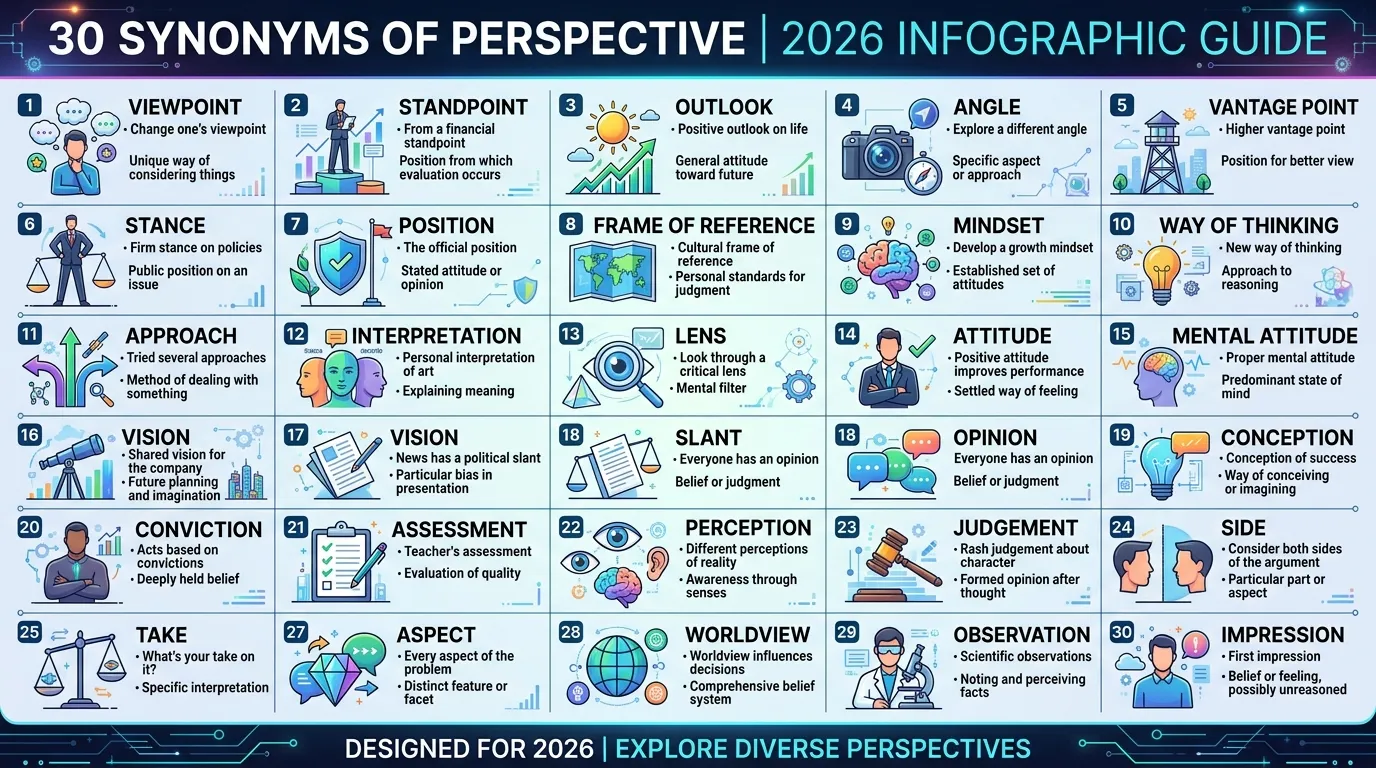
30 Synonyms of Perspective
1. Viewpoint (noun)
US: /ˈvjuːpɔɪnt/ | UK: /ˈvjuːpɔɪnt/
Meaning: a particular way of thinking about something
Examples:
- Her viewpoint was very practical.
- I respect your viewpoint.
2. Opinion (noun)
US: /əˈpɪnjən/ | UK: /əˈpɪnjən/
Meaning: a personal belief or idea
Examples:
- Everyone shared an opinion.
- My opinion is different.
3. Outlook (noun)
US: /ˈaʊtlʊk/ | UK: /ˈaʊtlʊk/
Meaning: a general attitude toward life
Examples:
- She has a positive outlook.
- His outlook changed over time.
4. Attitude (noun)
US: /ˈætɪtuːd/ | UK: /ˈætɪtjuːd/
Meaning: a way of thinking or feeling
Examples:
- Her attitude was friendly.
- He showed a calm attitude.
5. Standpoint (noun)
US: /ˈstændpɔɪnt/ | UK: /ˈstændpɔɪnt/
Meaning: a position from which something is judged
Examples:
- From my standpoint, the plan works.
- The teacher explained another standpoint.
6. Position (noun)
US: /pəˈzɪʃən/ | UK: /pəˈzɪʃən/
Meaning: a particular opinion or side
Examples:
- She defended her position.
- His position was clear.
7. Angle (noun)
US: /ˈæŋɡəl/ | UK: /ˈæŋɡəl/
Meaning: a special way of looking at something
Examples:
- The story has a new angle.
- Journalists searched for another angle.
8. Interpretation (noun)
US: /ɪnˌtɜːrprɪˈteɪʃən/ | UK: /ɪnˌtɜːprɪˈteɪʃən/
Meaning: an explanation of meaning
Examples:
- Her interpretation was interesting.
- We discussed different interpretations.
9. Approach (noun)
US: /əˈproʊtʃ/ | UK: /əˈprəʊtʃ/
Meaning: a method or way of thinking
Examples:
- His approach solved the problem.
- She used a creative approach.
10. Frame of Reference (noun)
US: /freɪm əv ˈrɛfərəns/ | UK: /freɪm əv ˈrefərəns/
Meaning: a set of ideas influencing understanding
Examples:
- Culture shapes our frame of reference.
- Her frame of reference was different.
11. Mindset (noun)
US: /ˈmaɪndˌsɛt/ | UK: /ˈmaɪndset/
Meaning: a fixed way of thinking
Examples:
- Success requires a positive mindset.
- His mindset improved.
12. Philosophy (noun)
US: /fəˈlɑːsəfi/ | UK: /fɪˈlɒsəfi/
Meaning: a system of beliefs or ideas
Examples:
- Her life philosophy is simple.
- They discussed political philosophy.
13. Perception (noun)
US: /pərˈsɛpʃən/ | UK: /pəˈsepʃən/
Meaning: the way something is understood
Examples:
- Public perception matters.
- My perception changed.
14. Insight (noun)
US: /ˈɪnsaɪt/ | UK: /ˈɪnsaɪt/
Meaning: deep understanding
Examples:
- Her book offers useful insight.
- He shared valuable insights.
15. Judgment (noun)
US: /ˈdʒʌdʒmənt/ | UK: /ˈdʒʌdʒmənt/
Meaning: an opinion formed after thinking
Examples:
- Trust your judgment.
- His judgment was fair.
16. Belief (noun)
US: /bəˈliːf/ | UK: /bɪˈliːf/
Meaning: something accepted as true
Examples:
- Her beliefs are strong.
- He defended his belief.
17. View (noun)
US: /vjuː/ | UK: /vjuː/
Meaning: an opinion or idea
Examples:
- I understand your view.
- Their views differ.
18. Vision (noun)
US: /ˈvɪʒən/ | UK: /ˈvɪʒən/
Meaning: an imagined idea of the future
Examples:
- The leader shared a strong vision.
- Her artistic vision impressed everyone.
19. Understanding (noun)
US: /ˌʌndərˈstændɪŋ/ | UK: /ˌʌndəˈstændɪŋ/
Meaning: knowledge or comprehension
Examples:
- He showed deep understanding.
- Our understanding improved.
20. Assessment (noun)
US: /əˈsɛsmənt/ | UK: /əˈsesmənt/
Meaning: evaluation or judgment
Examples:
- The report included an assessment.
- Her assessment was accurate.
21. Evaluation (noun)
US: /ɪˌvæljuˈeɪʃən/ | UK: /ɪˌvæljuˈeɪʃən/
Meaning: careful examination of value
Examples:
- The teacher made an evaluation.
- We reviewed the evaluation.
22. Reflection (noun)
US: /rɪˈflɛkʃən/ | UK: /rɪˈflekʃən/
Meaning: serious thought about something
Examples:
- The trip inspired reflection.
- Her journal showed deep reflection.
23. Conception (noun)
US: /kənˈsɛpʃən/ | UK: /kənˈsepʃən/
Meaning: an idea or understanding
Examples:
- His conception of success changed.
- The artist explained her conception.
24. Interpretation Angle (noun)
US: /ɪnˌtɜːrprɪˈteɪʃən ˈæŋɡəl/ | UK: /ɪnˌtɜːprɪˈteɪʃən ˈæŋɡəl/
Meaning: a particular way of explaining something
Examples:
- The article used a new interpretation angle.
- Her interpretation angle was unique.
25. Orientation (noun)
US: /ˌɔːriənˈteɪʃən/ | UK: /ˌɔːriənˈteɪʃən/
Meaning: a way of positioning ideas or beliefs
Examples:
- His political orientation changed.
- Cultural orientation affects behavior.
26. Way of Thinking (noun phrase)
US: /weɪ əv ˈθɪŋkɪŋ/ | UK: /weɪ əv ˈθɪŋkɪŋ/
Meaning: a mental approach to ideas
Examples:
- Her way of thinking is logical.
- Travel changed my way of thinking.
27. Slant (noun)
US: /slænt/ | UK: /slɑːnt/
Meaning: a particular opinion or bias
Examples:
- The article had a political slant.
- His comments showed a clear slant.
28. Bias (noun)
US: /ˈbaɪəs/ | UK: /ˈbaɪəs/
Meaning: unfair preference or opinion
Examples:
- Everyone has some bias.
- The report showed cultural bias.
29. Point of View (noun phrase)
US: /pɔɪnt əv vjuː/ | UK: /pɔɪnt əv vjuː/
Meaning: a personal way of seeing something
Examples:
- From my point of view, it was fair.
- She explained her point of view calmly.
30. Worldview (noun)
US: /ˈwɜːrldvjuː/ | UK: /ˈwɜːldvjuː/
Meaning: a complete way of understanding life and the world
Examples:
- Religion shaped his worldview.
- Her travels expanded her worldview.
Prototype Meaning
The most typical meaning of perspective is a personal way of seeing or understanding something. People usually imagine different opinions, life experiences, and ways of thinking that influence how individuals understand situations.
Prototype Categorization
- Opinions and views: opinion, viewpoint, point of view
- Mental understanding: perception, understanding, insight
- Beliefs and attitudes: mindset, philosophy, worldview
- Evaluation and judgment: assessment, evaluation, judgment
Antonyms of Perspective
Antonyms
- Ignorance (noun): lack of knowledge or understanding
- Blindness (noun): inability to see or understand clearly
- Narrow-mindedness (noun): limited thinking or intolerance
- Bias-free thinking (noun phrase): absence of personal viewpoint
- Confusion (noun): lack of clear understanding
Short Questions and Answers
What does perspective mean?
- It means a way of thinking about or understanding something.
When should perspective be used?
- Use it when discussing opinions, understanding, or ways of seeing situations.
Is perspective positive or negative?
- It can be positive or negative depending on the situation and viewpoint.
How is it different from similar words?
- “Perspective” focuses on overall understanding, while “opinion” mainly means a personal belief.
Conclusion
Learning synonyms of perspective and synonyms of perspective vocabulary and communication skills. It helps English learners express opinions, understanding, and ideas more clearly in speaking and writing. Using different synonyms also avoids repetition and makes communication more natural and engaging. These words are useful in education, storytelling, business, psychology, and daily conversation. They help writers describe thoughts, beliefs, and viewpoints with greater accuracy. Practicing new vocabulary every day builds stronger English confidence and improves both writing and speaking abilities over time.

I’m Zahid Abbas, an educator, researcher, and digital publishing strategist with a passion for linguistics, grammar, and clear communication. As a content creator and SEO specialist, I craft research-driven, reader-focused content that empowers learners and makes knowledge accessible worldwide.