The word house means a building where people live. Imagine coming home after a long day, opening the door, and relaxing with your family. That safe and comfortable place is your house. People use this word every day because homes are an important part of life by using synonyms of house.
The word house is common in speaking, writing, business, and real estate. However, repeating the same word again and again can make communication dull. Learning synonyms of house helps English learners improve vocabulary and speak more naturally. It also helps writers choose better words for stories, essays, and conversations.
In this article, you will learn the meaning of house, its pronunciation, grammar, history, and 30 useful synonyms with meanings and examples. You will also explore categories, antonyms, and common questions to strengthen your English skills.
Meaning of House
Definition
House (noun): a building where people live, sleep, and stay with their families.
Examples
- They bought a new house near the park.
- Her house has a beautiful garden.
Connotative Meaning
(Connotation means the feeling or emotion a word suggests beyond its basic meaning.)
- Positive tone: comfort, safety, family, warmth
- Negative tone: loneliness, emptiness, expensive living
- Neutral tone: a place for living
Etymology
- From Old English hūs, meaning “dwelling” or “shelter”
- Related to German and Dutch words for home and shelter
Short History:
- Old English (450–1100): used for shelter and living places
- Middle English (1100–1500): became common for family dwellings
- Modern English (1500–Present): expanded to include buildings, businesses, and institutions
Pronunciation (US & UK – IPA)
- US: /haʊs/
- UK: /haʊs/
Syllables
- house
Affixation Pattern of House
- Root: house
- Prefix: none
- Suffix: none
Word Formation:
- house (noun/verb)
- housing (noun)
- household (noun)
- housekeeper (noun)
- housework (noun)
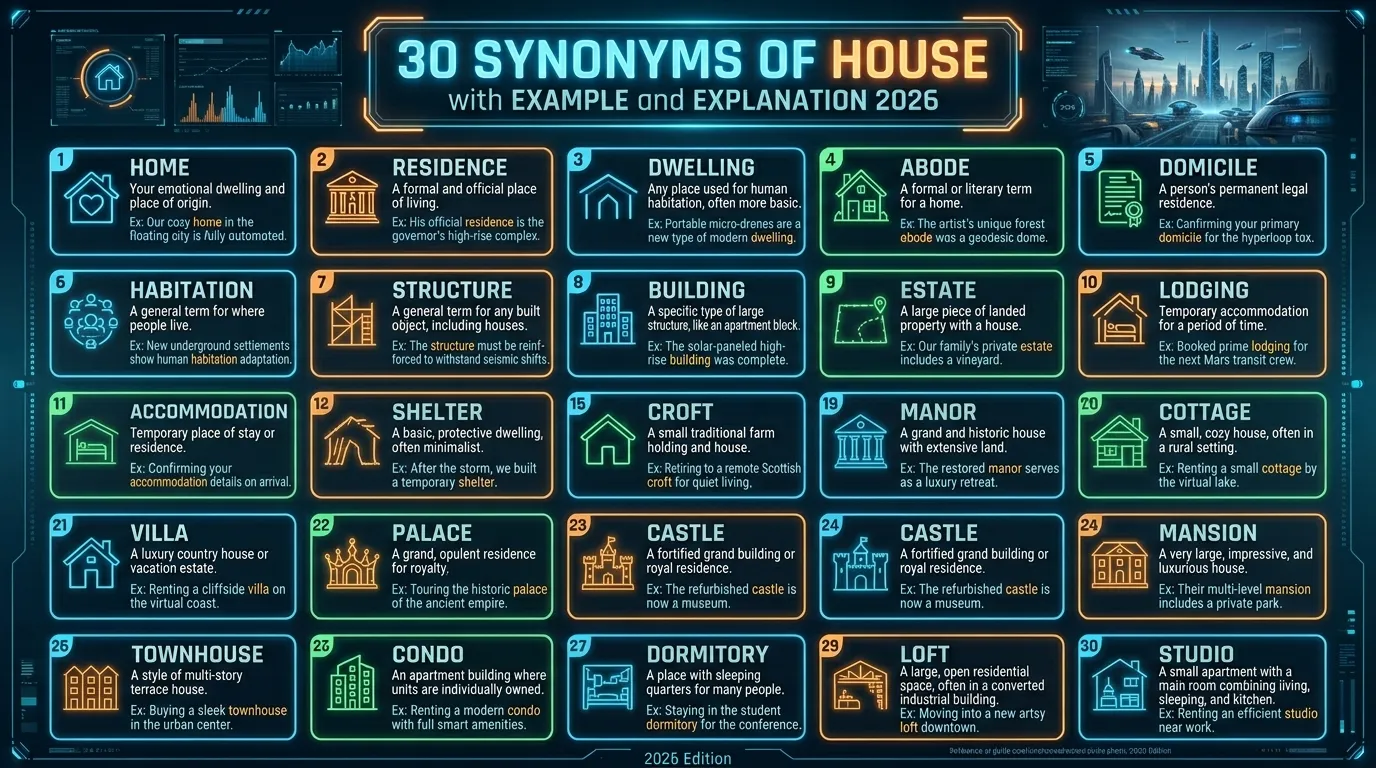
30 Synonyms of House
1. Home (noun)
US: /hoʊm/ | UK: /həʊm/
Meaning: the place where someone lives and feels comfortable
Examples:
- She returned home after work.
- Their home feels warm and peaceful.
2. Residence (noun)
US: /ˈrɛzɪdəns/ | UK: /ˈrezɪdəns/
Meaning: an official or formal place where someone lives
Examples:
- The president’s residence is heavily guarded.
- They changed their place of residence.
3. Dwelling (noun)
US: /ˈdwɛlɪŋ/ | UK: /ˈdwelɪŋ/
Meaning: a place where people live
Examples:
- The small dwelling stood near the forest.
- Ancient people lived in simple dwellings.
4. Apartment (noun)
US: /əˈpɑːrtmənt/ | UK: /əˈpɑːtmənt/
Meaning: a set of rooms for living in a building
Examples:
- She rented a small apartment downtown.
- Their apartment is on the fifth floor.
5. Condo (noun)
US: /ˈkɑːndoʊ/ | UK: /ˈkɒndəʊ/
Meaning: a privately owned apartment
Examples:
- They bought a beach condo.
- His condo has a sea view.
6. Cottage (noun)
US: /ˈkɑːtɪdʒ/ | UK: /ˈkɒtɪdʒ/
Meaning: a small cozy house in the countryside
Examples:
- The old cottage looked charming.
- They stayed in a mountain cottage.
7. Cabin (noun)
US: /ˈkæbɪn/ | UK: /ˈkæbɪn/
Meaning: a small wooden shelter or house
Examples:
- We stayed in a forest cabin.
- The hunter built a small cabin.
8. Mansion (noun)
US: /ˈmænʃən/ | UK: /ˈmænʃən/
Meaning: a very large and expensive house
Examples:
- The actor owns a huge mansion.
- The mansion has twenty rooms.
9. Villa (noun)
US: /ˈvɪlə/ | UK: /ˈvɪlə/
Meaning: a large comfortable country house
Examples:
- They rented a luxury villa.
- The villa overlooked the ocean.
10. Hut (noun)
US: /hʌt/ | UK: /hʌt/
Meaning: a small simple shelter
Examples:
- The fisherman lived in a small hut.
- A wooden hut stood near the river.
11. Shelter (noun)
US: /ˈʃɛltər/ | UK: /ˈʃeltə/
Meaning: a place offering protection or safety
Examples:
- The storm forced them into a shelter.
- Animals searched for shelter.
12. Bungalow (noun)
US: /ˈbʌŋɡəloʊ/ | UK: /ˈbʌŋɡələʊ/
Meaning: a one-story house
Examples:
- They moved into a quiet bungalow.
- The bungalow has a large yard.
13. Palace (noun)
US: /ˈpæləs/ | UK: /ˈpælɪs/
Meaning: a grand home for royalty or leaders
Examples:
- The king lived in a beautiful palace.
- Tourists visited the royal palace.
14. Estate (noun)
US: /ɪˈsteɪt/ | UK: /ɪˈsteɪt/
Meaning: a large property with land and buildings
Examples:
- The family owned a huge estate.
- Workers maintained the estate gardens.
15. Farmhouse (noun)
US: /ˈfɑːrmhaʊs/ | UK: /ˈfɑːmhaʊs/
Meaning: a house on a farm
Examples:
- The old farmhouse was peaceful.
- They repaired the country farmhouse.
16. Duplex (noun)
US: /ˈduːplɛks/ | UK: /ˈdjuːpleks/
Meaning: a building divided into two homes
Examples:
- They rented one side of the duplex.
- The duplex has two entrances.
17. Townhouse (noun)
US: /ˈtaʊnhaʊs/ | UK: /ˈtaʊnhaʊs/
Meaning: a tall narrow city house connected to others
Examples:
- She bought a modern townhouse.
- The townhouse is near the station.
18. Homestead (noun)
US: /ˈhoʊmstɛd/ | UK: /ˈhəʊmsted/
Meaning: a family home with land
Examples:
- The family protected their homestead.
- The old homestead remained strong.
19. Lodge (noun)
US: /lɑːdʒ/ | UK: /lɒdʒ/
Meaning: a small house used during vacations
Examples:
- We stayed at a mountain lodge.
- The hunting lodge was quiet.
20. Hostel (noun)
US: /ˈhɑːstəl/ | UK: /ˈhɒstəl/
Meaning: a low-cost shared living place
Examples:
- Travelers stayed in a youth hostel.
- The hostel was clean and friendly.
21. Dormitory (noun)
US: /ˈdɔːrməˌtɔːri/ | UK: /ˈdɔːmətri/
Meaning: a shared student living building
Examples:
- Students live in the college dormitory.
- The dormitory is near campus.
22. Quarters (noun)
US: /ˈkwɔːrtərz/ | UK: /ˈkwɔːtəz/
Meaning: living spaces assigned to people
Examples:
- Soldiers returned to their quarters.
- Workers stayed in temporary quarters.
23. Habitat (noun)
US: /ˈhæbɪtæt/ | UK: /ˈhæbɪtæt/
Meaning: the natural home of people or animals
Examples:
- Forests are animal habitats.
- Pollution harms natural habitats.
24. Nest (noun)
US: /nɛst/ | UK: /nest/
Meaning: a safe and comfortable home
Examples:
- They built a cozy nest together.
- Birds returned to the nest.
25. Abode (noun)
US: /əˈboʊd/ | UK: /əˈbəʊd/
Meaning: a place where someone lives
Examples:
- Welcome to my humble abode.
- Their peaceful abode overlooks the lake.
26. Refuge (noun)
US: /ˈrɛfjuːdʒ/ | UK: /ˈrefjuːdʒ/
Meaning: a safe place for protection
Examples:
- The cabin became a refuge from the storm.
- Many people searched for refuge.
27. Building (noun)
US: /ˈbɪldɪŋ/ | UK: /ˈbɪldɪŋ/
Meaning: a structure with walls and a roof
Examples:
- The old building was renovated.
- They entered the large building.
28. Residence Hall (noun)
US: /ˈrɛzɪdəns hɔːl/ | UK: /ˈrezɪdəns hɔːl/
Meaning: student housing building
Examples:
- Freshmen moved into the residence hall.
- The residence hall has shared kitchens.
29. Chateau (noun)
US: /ʃæˈtoʊ/ | UK: /ˈʃætəʊ/
Meaning: a large French country house
Examples:
- They visited a historic chateau.
- The chateau looked beautiful.
30. Hearth (noun)
US: /hɑːrθ/ | UK: /hɑːθ/
Meaning: the symbolic center of a home
Examples:
- Families gathered around the hearth.
- The warm hearth felt comforting.
Prototype Meaning
The most common meaning of house is a place where people live with safety, comfort, and family. Most people imagine a building with rooms, furniture, and loved ones when they hear the word.
Prototype Categorization
- Small homes: cottage, cabin, hut
- Luxury homes: mansion, villa, palace
- Urban homes: apartment, condo, townhouse
- Temporary living places: hostel, lodge, quarters
- Emotional or symbolic homes: home, nest, hearth
Categorization helps writers choose the best synonym based on size, style, emotion, and situation.
Antonyms of House
- Homelessness (noun): having no place to live
- Outside (noun/adjective): not inside a home or shelter
- Wilderness (noun): wild natural land without homes
- Street (noun): public outdoor area without shelter
- Open space (noun): an area without buildings or housing
Short Questions and Answers
What does house mean?
- A house is a building where people live.
When should house be used?
- Use it when talking about homes, buildings, or living spaces.
Is house positive or negative?
- It is usually positive because it suggests comfort and safety.
How is it different from similar words?
- “House” refers to the physical building, while “home” often includes emotional feelings and comfort.
Conclusion
Learning synonyms of house and synonyms of house improves vocabulary and communication skills. It helps English learners describe homes, buildings, and living spaces more clearly and naturally. Using different synonyms also avoids repetition and makes speaking and writing more engaging. These words are useful in conversations, storytelling, travel writing, and professional communication. They help writers express ideas about comfort, shelter, luxury, and family life with greater accuracy. Practice using new vocabulary every day. Small daily learning habits can build stronger English confidence and fluency over time.

I’m Zahid Abbas, an educator, researcher, and digital publishing strategist with a passion for linguistics, grammar, and clear communication. As a content creator and SEO specialist, I craft research-driven, reader-focused content that empowers learners and makes knowledge accessible worldwide.