Therefore is a common English word that shows a result, conclusion, or consequence. Imagine you studied hard for an exam and got excellent marks. You might say, “I studied every day; therefore, I passed the test.” In this sentence, therefore connects the cause and the result.
This word is widely used in everyday conversations, academic writing, business communication, and formal documents because it helps ideas flow clearly and logically. Learning synonyms of therefore is important for English learners, students, writers, and content creators because it helps avoid repetition and makes communication more effective.
In this article, you will learn the meaning of therefore, its pronunciation, grammar, origin, history, semantic categories, and 30 useful synonyms with examples. This knowledge will help improve your vocabulary and strengthen your writing and speaking skills.
Meaning of Therefore
Therefore (Adverb):
A word used to show that something happens as a result of something else.
Examples
- She practiced every day; therefore, she became a skilled musician.
- The road was closed; therefore, we took a different route.
Connotative Meaning
- Positive tone: Therefore can introduce a positive result or success.
- Negative tone: Therefore can introduce an unfortunate consequence.
- Neutral tone: Most commonly, therefore simply states a logical result without emotion.
Etymology
- Source Language: Latin
- Original Form: de + fore
- Original Meaning: “For that reason” or “because of that”
Short History of the Keyword
- Old English (450–1100): Similar meanings were expressed using phrases such as “for that.”
- Middle English (1100–1500): Forms similar to therefore became more common.
- Modern English (1500–Present): Therefore became a standard word for expressing conclusions and results.
Pronunciation (US & UK – IPA)
- US: /ˈðer.fɔːr/
- UK: /ˈðeə.fɔː/
Syllables
there-fore
Affixation Pattern of Therefore
Root: fore
Prefix: there-
Suffix: None
Word Formation of Therefore
- Therefore (Adverb)
- Thereby (Adverb)
- Therein (Adverb)
- Thereof (Adverb)
- Therefrom (Adverb)
- Thereafter (Adverb)
- Therewith (Adverb)
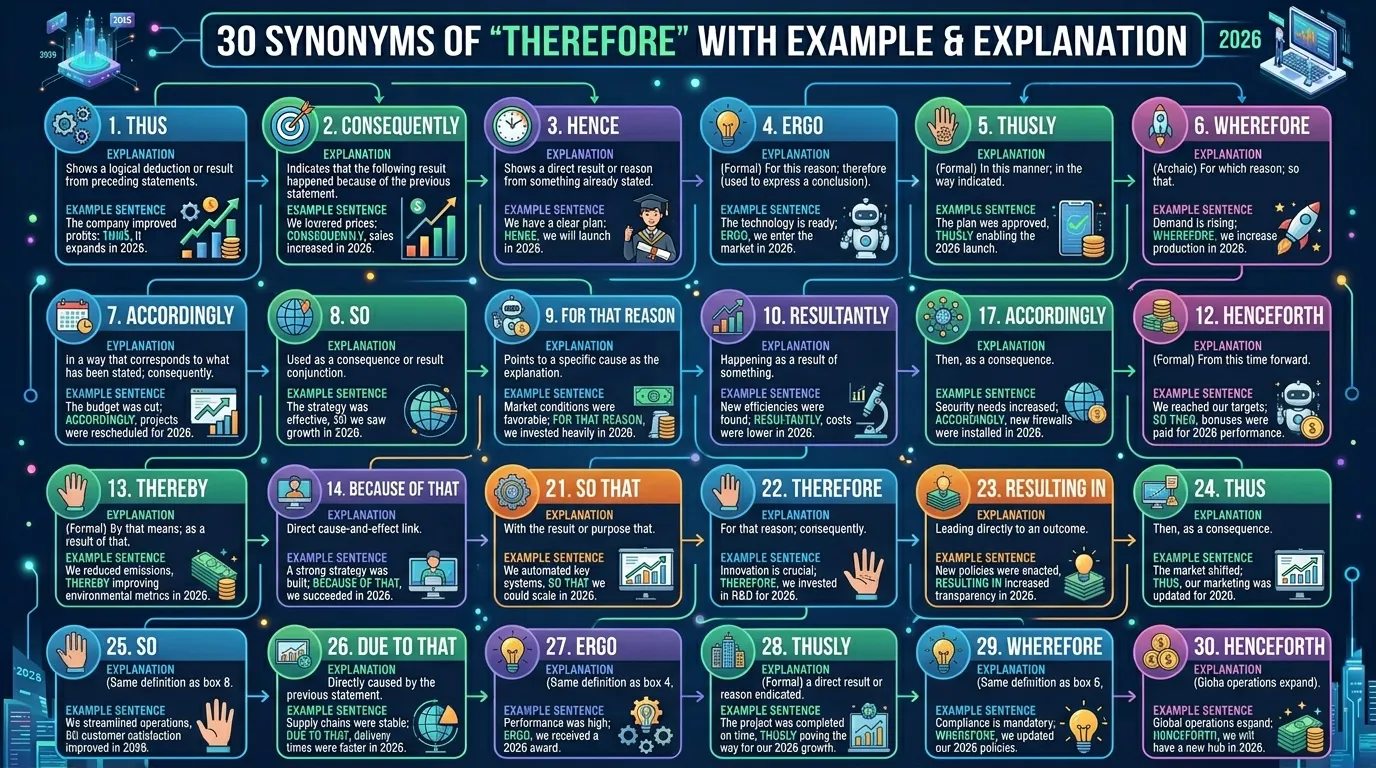
30 Synonyms of Therefore
1. Consequently (Adverb)
US: /ˈkɑːn.səˌkwent.li/ | UK: /ˈkɒn.sɪˌkwent.li/
Meaning: As a result of something.
Examples:
- He missed the train; consequently, he arrived late.
- The company lost money; consequently, several projects stopped.
2. Thus (Adverb)
US: /ðʌs/ | UK: /ðʌs/
Meaning: In this way or as a result.
Examples:
- The weather improved; thus, the event continued.
- She worked hard and thus achieved success.
3. Hence (Adverb)
US: /hens/ | UK: /hens/
Meaning: For this reason.
Examples:
- The shop was closed; hence our disappointment.
- Demand increased; hence the higher prices.
4. Accordingly (Adverb)
US: /əˈkɔːr.dɪŋ.li/ | UK: /əˈkɔː.dɪŋ.li/
Meaning: In a way that matches the situation.
Examples:
- The forecast predicted rain; accordingly, we stayed home.
- He was promoted and acted accordingly.
5. As a Result (Phrase)
US: /æz ə rɪˈzʌlt/ | UK: /æz ə rɪˈzʌlt/
Meaning: Because of something that happened.
Examples:
- Sales increased. As a result, profits grew.
- She trained well. As a result, she won.
6. For That Reason (Phrase)
US: /fɔːr ðæt ˈriːzən/ | UK: /fə ðæt ˈriːzən/
Meaning: Because of a particular cause.
Examples:
- The roads were icy; for that reason, schools closed.
- He was unwell; for that reason, he stayed home.
7. Ergo (Adverb)
US: /ˈɝː.ɡoʊ/ | UK: /ˈɜː.ɡəʊ/
Meaning: Therefore; logically.
Examples:
- You forgot the key; ergo, you cannot enter.
- The evidence is clear; ergo, the answer is obvious.
8. So (Adverb)
US: /soʊ/ | UK: /səʊ/
Meaning: As a result.
Examples:
- I was tired, so I slept early.
- It rained, so we stayed inside.
9. Then (Adverb)
US: /ðen/ | UK: /ðen/
Meaning: As a consequence.
Examples:
- If that is true, then we should proceed.
- He agreed, then the meeting continued.
10. Thereupon (Adverb)
US: /ˌðer.əˈpɑːn/ | UK: /ˌðeər.əˈpɒn/
Meaning: Immediately after that.
Examples:
- The judge spoke; thereupon, silence followed.
- The order arrived; thereupon, work began.
11. Thusly (Adverb)
Meaning: In this manner.
Examples:
- The process works thusly.
- The machine operates thusly.
12. Thereby (Adverb)
US: /ðerˈbaɪ/ | UK: /ðeəˈbaɪ/
Meaning: By that means.
Examples:
- She saved money, thereby reducing debt.
- He improved skills, thereby gaining confidence.
13. Wherefore (Adverb)
US: /ˈwer.fɔːr/ | UK: /ˈweə.fɔː/
Meaning: For what reason.
Examples:
- We wondered wherefore the delay occurred.
- Nobody knew wherefore he left.
14. As Such (Phrase)
US: /æz sʌtʃ/ | UK: /æz sʌtʃ/
Meaning: In that capacity.
Examples:
- He is the manager and, as such, leads the team.
- The law applies and, as such, must be followed.
15. In Consequence (Phrase)
US: /ɪn ˈkɑːn.sə.kwəns/ | UK: /ɪn ˈkɒn.sɪ.kwəns/
Meaning: As a result.
Examples:
- The storm arrived; in consequence, flights stopped.
- Costs rose; in consequence, prices increased.
16. As a Consequence (Phrase)
US: /æz ə ˈkɑːn.sə.kwəns/ | UK: /æz ə ˈkɒn.sɪ.kwəns/
Meaning: Because of a previous action.
Examples:
- He ignored advice; as a consequence, he failed.
- The bridge closed; as a consequence, traffic increased.
17. Resultantly (Adverb)
US: /rɪˈzʌl.tənt.li/ | UK: /rɪˈzʌl.tənt.li/
Meaning: As a result.
Examples:
- Demand fell; resultantly, production slowed.
- Revenue dropped; resultantly, hiring stopped.
18. Subsequently (Adverb)
US: /ˈsʌb.sə.kwənt.li/ | UK: /ˈsʌb.sɪ.kwənt.li/
Meaning: After something happened.
Examples:
- She graduated and subsequently found work.
- The company expanded and subsequently hired more staff.
19. Thereforeforth (Adverb)
US: /ˈðer.fɔːr.fɔːrθ/ | UK: /ˈðeə.fɔː.fɔːθ/
Meaning: From that result onward.
Examples:
- The rule changed and thereforeforth applied.
- The agreement began and thereforeforth remained active.
20. In View of This (Phrase)
US: /ɪn vjuː əv ðɪs/ | UK: /ɪn vjuː əv ðɪs/
Meaning: Considering this fact.
Examples:
- Prices increased. In view of this, budgets changed.
- The risk was high. In view of this, we waited.
21. On That Account (Phrase)
US: /ɑːn ðæt əˈkaʊnt/ | UK: /ɒn ðæt əˈkaʊnt/
Meaning: Because of that.
Examples:
- He apologized on that account.
- We delayed the trip on that account.
22. For This Cause (Phrase)
US: /fɔːr ðɪs kɔːz/ | UK: /fə ðɪs kɔːz/
Meaning: Because of this reason.
Examples:
- The project ended for this cause.
- We changed plans for this cause.
23. Due to This (Phrase)
US: /duː tə ðɪs/ | UK: /djuː tə ðɪs/
Meaning: Because of this situation.
Examples:
- The road flooded. Due to this, travel stopped.
- Sales declined. Due to this, budgets tightened.
24. Because of That (Phrase)
US: /bɪˈkʌz əv ðæt/ | UK: /bɪˈkɒz əv ðæt/
Meaning: For that reason.
Examples:
- He was busy. Because of that, he declined.
- The machine broke. Because of that, work paused.
25. In Light of This (Phrase)
US: /ɪn laɪt əv ðɪs/ | UK: /ɪn laɪt əv ðɪs/
Meaning: Considering the facts.
Examples:
- New evidence appeared. In light of this, the case changed.
- Costs rose. In light of this, prices increased.
26. Accordingly Then (Phrase)
US: /əˈkɔːr.dɪŋ.li ðen/ | UK: /əˈkɔː.dɪŋ.li ðen/
Meaning: Therefore at that time.
Examples:
- The team agreed and accordingly then acted.
- Plans changed and accordingly then continued.
27. In Effect (Phrase)
US: /ɪn ɪˈfekt/ | UK: /ɪn ɪˈfekt/
Meaning: Practically or effectively.
Examples:
- The rule was, in effect, permanent.
- The decision was, in effect, final.
28. By Extension (Phrase)
US: /baɪ ɪkˈsten.ʃən/ | UK: /baɪ ɪkˈsten.ʃən/
Meaning: As a logical result.
Examples:
- The policy helped workers and, by extension, families.
- The change improved quality and, by extension, profits.
29. Consequently Speaking (Phrase)
US: /ˈkɑːn.səˌkwent.li ˈspiː.kɪŋ/ | UK: /ˈkɒn.sɪˌkwent.li ˈspiː.kɪŋ/
Meaning: As a consequence.
Examples:
- Consequently speaking, costs increased.
- Consequently speaking, demand decreased.
30. Therefore Accordingly (Phrase)
US: /ˈðer.fɔːr əˈkɔːr.dɪŋ.li/ | UK: /ˈðeə.fɔː əˈkɔː.dɪŋ.li/
Meaning: As a logical result.
Examples:
- The plan succeeded; therefore accordingly, expansion followed.
- Revenue grew; therefore accordingly, hiring increased.
Prototype Meaning
The most common meaning of therefore is “for that reason” or “as a result.” When people hear this word, they usually think of a logical connection between one event and another. It links a cause to its outcome.
Prototype Categorization
- Formal Writing: Consequently, Hence, Thus, Accordingly, Ergo
- Academic Writing: Therefore, Consequently, Hence, Thus
- Business Communication: Accordingly, As a Result, In Consequence
- Everyday Speech: So, Because of That, Due to This
- Legal and Official Language: Thereupon, Wherefore, On That Account
- Analytical Writing: In Light of This, By Extension, In View of This
Antonyms of Therefore
- Nevertheless (Adverb): Despite that
- However (Adverb): In contrast
- Yet (Adverb): Even so
- Nonetheless (Adverb): In spite of that
- Regardless (Adverb): Without considering the result
- Conversely (Adverb): In an opposite way
- Though (Conjunction): Despite the fact
- Instead (Adverb): As an alternative
Short Questions and Answers
- What does therefore mean?Therefore means “for that reason” or “as a result.”
- When should therefore be used?It should be used when showing a logical result, conclusion, or consequence.
- Is therefore positive or negative?It is usually neutral. The tone depends on the situation being described.
- How is it different from similar words?Therefore is more formal than so and often appears in academic and professional writing.
Conclusion
Learning the Synonyms of Therefore and Synonyms of Therefore can greatly improve your English vocabulary. These alternatives help you express results, conclusions, and logical connections more clearly. Using a variety of synonyms strengthens both writing and speaking by making language more natural and less repetitive. It also helps students, professionals, and content writers choose the right word for different situations, from casual conversations to formal reports. The more synonyms you learn, the easier it becomes to communicate ideas accurately and confidently. Make vocabulary practice a daily habit, and you will notice steady improvement in your English fluency, comprehension, and overall communication skills.

I’m Zahid Abbas, an educator, researcher, and digital publishing strategist with a passion for linguistics, grammar, and clear communication. As a content creator and SEO specialist, I craft research-driven, reader-focused content that empowers learners and makes knowledge accessible worldwide.