The word see means to notice something with your eyes or understand something clearly. Imagine walking outside in the morning and seeing the bright sun rise in the sky. You stop for a moment and enjoy the beautiful view. In daily life, people use the word see when talking about vision, understanding, meeting people, or noticing details.
Because it is such a common English word, many writers and learners repeat it too often. Learning synonyms of see helps improve vocabulary, speaking, and writing skills. It also helps people express ideas more accurately and naturally. In this article, you will learn the meaning of see, its pronunciation, grammar, history, and 30 useful synonyms with meanings and examples. You will also explore semantic categories, antonyms, and simple questions to strengthen your English communication skills.
Meaning of See
Definition
See (verb): to notice something with the eyes or understand something mentally.
Examples
- I can see the mountains from my window.
- She finally saw the truth.
Connotative Meaning
- Positive tone: understanding, awareness, discovery
- Negative tone: witnessing something unpleasant
- Neutral tone: noticing or observing something
Etymology
- From Old English seon meaning “to look at” or “perceive”
- Related to old Germanic language roots connected to vision and understanding
Short History:
- Old English (450–1100): used as seon for vision and understanding
- Middle English (1100–1500): spelling changed to see
- Modern English (1500–Present): became common in daily speech and writing
Pronunciation (US & UK – IPA)
- US: /siː/
- UK: /siː/
Syllables
- see
Affixation Pattern of See
- Root: see
- Prefix: none
- Suffix: none
Word Formation:
- see (verb)
- seeing (verb/adjective/noun)
- seen (verb)
- sight (noun)
- visible (adjective)
- vision (noun)
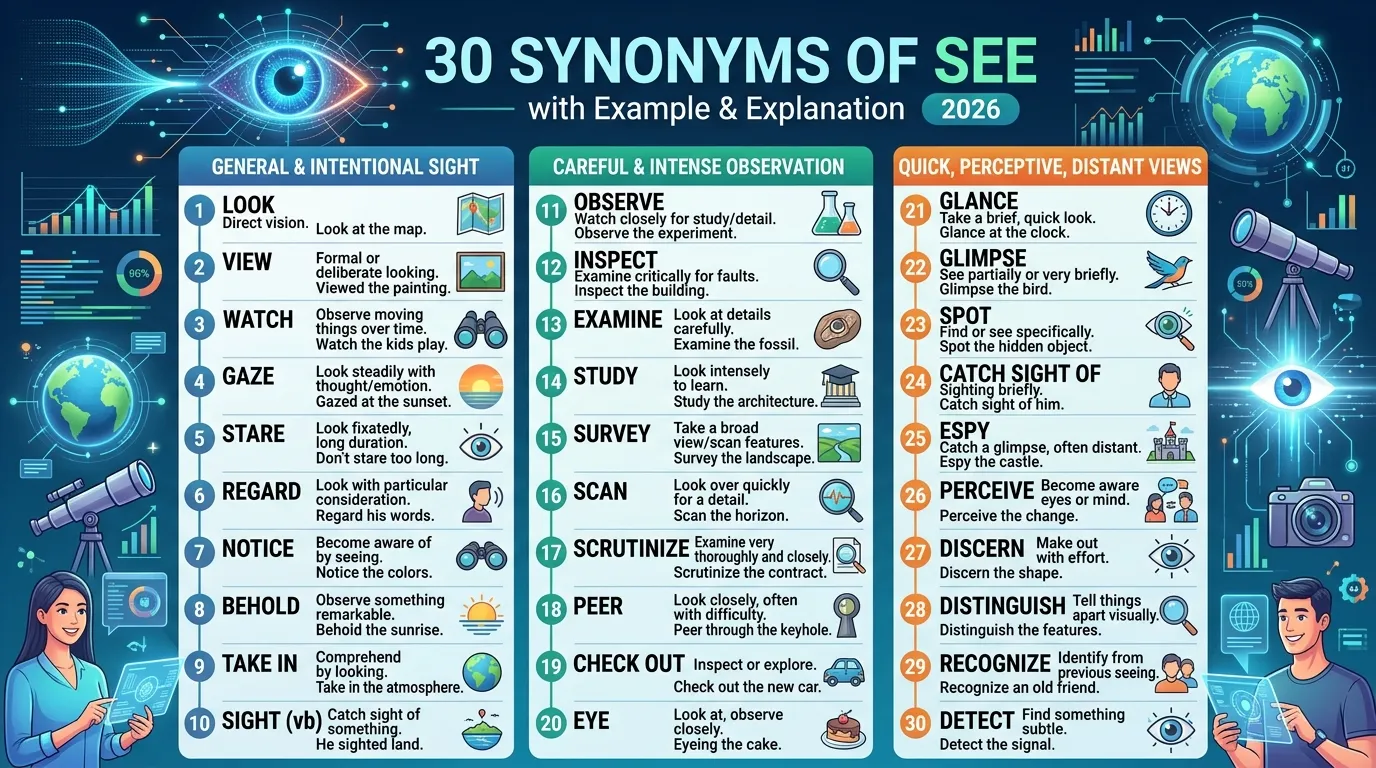
30 Synonyms of See
1. Observe (verb)
US: /əbˈzɜːrv/ | UK: /əbˈzɜːv/
Meaning: to watch carefully
Examples:
- Scientists observe the stars nightly.
- She quietly observed the children.
2. Notice (verb)
US: /ˈnoʊtɪs/ | UK: /ˈnəʊtɪs/
Meaning: to become aware of something
Examples:
- Did you notice the sign?
- He noticed her smile.
3. Watch (verb)
US: /wɑːtʃ/ | UK: /wɒtʃ/
Meaning: to look at something carefully over time
Examples:
- We watched the movie together.
- She likes to watch birds.
4. View (verb)
US: /vjuː/ | UK: /vjuː/
Meaning: to look at something formally
Examples:
- Tourists viewed the castle.
- We viewed the artwork.
5. Glance (verb)
US: /ɡlæns/ | UK: /ɡlɑːns/
Meaning: to look quickly
Examples:
- She glanced at her phone.
- He glanced out the window.
6. Stare (verb)
US: /ster/ | UK: /steə/
Meaning: to look for a long time
Examples:
- The child stared at the toy.
- People stared in surprise.
7. Peek (verb)
US: /piːk/ | UK: /piːk/
Meaning: to look secretly or quickly
Examples:
- He peeked through the door.
- She peeked at the gift.
8. Glimpse (verb)
US: /ɡlɪmps/ | UK: /ɡlɪmps/
Meaning: to see briefly
Examples:
- I glimpsed a rainbow.
- She glimpsed the actor.
9. Witness (verb)
US: /ˈwɪtnəs/ | UK: /ˈwɪtnəs/
Meaning: to see an event happen
Examples:
- Many people witnessed the accident.
- We witnessed history.
10. Spot (verb)
US: /spɑːt/ | UK: /spɒt/
Meaning: to suddenly notice something
Examples:
- She spotted her friend in the crowd.
- I spotted a mistake.
11. Detect (verb)
US: /dɪˈtekt/ | UK: /dɪˈtekt/
Meaning: to discover something hidden
Examples:
- The machine can detect smoke.
- He detected a problem quickly.
12. Perceive (verb)
US: /pərˈsiːv/ | UK: /pəˈsiːv/
Meaning: to understand or notice
Examples:
- She perceived danger nearby.
- People perceive colors differently.
13. Recognize (verb)
US: /ˈrekəɡnaɪz/ | UK: /ˈrekəɡnaɪz/
Meaning: to identify someone or something known
Examples:
- I recognized his voice.
- She quickly recognized the place.
14. Discern (verb)
US: /dɪˈsɜːrn/ | UK: /dɪˈsɜːn/
Meaning: to notice carefully
Examples:
- He could discern the difference.
- She discerned a pattern.
15. Behold (verb)
US: /bɪˈhoʊld/ | UK: /bɪˈhəʊld/
Meaning: to see something impressive
Examples:
- We beheld the mountains.
- She beheld the beautiful view.
16. Examine (verb)
US: /ɪɡˈzæmɪn/ | UK: /ɪɡˈzæmɪn/
Meaning: to inspect carefully
Examples:
- The doctor examined the patient.
- Scientists examined the results.
17. Inspect (verb)
US: /ɪnˈspekt/ | UK: /ɪnˈspekt/
Meaning: to check closely
Examples:
- Workers inspected the building.
- She inspected the package.
18. Scan (verb)
US: /skæn/ | UK: /skæn/
Meaning: to look over quickly
Examples:
- He scanned the newspaper.
- She scanned the crowd.
19. Read (verb)
US: /riːd/ | UK: /riːd/
Meaning: to look at and understand words
Examples:
- I read the article yesterday.
- She loves to read novels.
20. Eye (verb)
US: /aɪ/ | UK: /aɪ/
Meaning: to look at carefully
Examples:
- He eyed the cake hungrily.
- She eyed the painting.
21. Gaze (verb)
US: /ɡeɪz/ | UK: /ɡeɪz/
Meaning: to look steadily
Examples:
- They gazed at the stars.
- She gazed into the distance.
22. Peek At (phrasal verb)
US: /piːk æt/ | UK: /piːk æt/
Meaning: to take a quick look
Examples:
- He peeked at the answers.
- She peeked at the screen.
23. Observe Closely (verb phrase)
US: /əbˈzɜːrv kloʊsli/ | UK: /əbˈzɜːv kləʊsli/
Meaning: to study carefully
Examples:
- Scientists observe closely.
- Teachers observe closely during exams.
24. Look At (phrasal verb)
US: /lʊk æt/ | UK: /lʊk æt/
Meaning: to direct eyes toward something
Examples:
- Please look at the board.
- She looked at the photo.
25. Check Out (phrasal verb)
US: /tʃek aʊt/ | UK: /tʃek aʊt/
Meaning: to look at something interesting
Examples:
- Check out this video.
- We checked out the museum.
26. Sight (verb)
US: /saɪt/ | UK: /saɪt/
Meaning: to suddenly see something
Examples:
- Sailors sighted land.
- We sighted dolphins nearby.
27. Contemplate (verb)
US: /ˈkɑːntəmpleɪt/ | UK: /ˈkɒntəmpleɪt/
Meaning: to look at thoughtfully
Examples:
- She contemplated the painting.
- He contemplated the view.
28. Monitor (verb)
US: /ˈmɑːnɪtər/ | UK: /ˈmɒnɪtə/
Meaning: to watch regularly
Examples:
- Nurses monitor patients closely.
- Police monitor traffic.
29. Survey (verb)
US: /sərˈveɪ/ | UK: /səˈveɪ/
Meaning: to look over an area carefully
Examples:
- The pilot surveyed the land.
- She surveyed the room.
30. Admire (verb)
US: /ədˈmaɪər/ | UK: /ədˈmaɪə/
Meaning: to look at with pleasure or respect
Examples:
- Tourists admired the waterfall.
- I admire her artwork.
Prototype Meaning
The most common meaning of see is using the eyes to notice people, objects, or events. People usually imagine looking at something clearly or understanding an idea or situation.
Prototype Categorization
- Quick looking: glance, peek, glimpse
- Careful observation: observe, inspect, examine
- Emotional looking: admire, gaze, behold
- Mental understanding: perceive, recognize, discern
Antonyms of See
- Ignore (verb): to refuse to notice
- Miss (verb): to fail to notice
- Overlook (verb): to forget or not see
- Neglect (verb): to pay no attention to
- Avoid (verb): to stay away from seeing or noticing
Short Questions and Answers
What does see mean?
- It means to notice something with the eyes or understand something.
When should see be used?
- Use it when talking about vision, noticing, or understanding.
Is see positive or negative?
- It is usually neutral, but meaning depends on context.
How is it different from similar words?
- “See” is general, while words like “observe” or “stare” describe specific ways of looking.
Conclusion
Learning Synonyms of See and Synonyms of See improves vocabulary and communication skills. It helps English learners express ideas more clearly in speaking and writing. Using different synonyms also avoids repetition and makes sentences more natural and engaging. These words are useful in conversations, storytelling, academic writing, and professional communication. They help describe vision, attention, understanding, and observation more accurately. Daily vocabulary practice builds stronger English confidence and fluency over time. Keep learning and using new words regularly to improve your communication skills naturally.

I’m Zahid Abbas, an educator, researcher, and digital publishing strategist with a passion for linguistics, grammar, and clear communication. As a content creator and SEO specialist, I craft research-driven, reader-focused content that empowers learners and makes knowledge accessible worldwide.