The word team means a group of people working together to achieve a common goal. Imagine a football match where players pass the ball, support each other, and try to win together. That group of players is called a team. Teams are important in sports, schools, offices, businesses, and daily life because people often succeed better when they work together.
The word is very common in English communication. Writers, students, and professionals use it often when discussing cooperation and group effort. Learning synonyms of team helps English learners improve vocabulary and avoid repeating the same word again and again. It also helps content writers make their writing more natural and engaging. In this article, you will learn the meaning of team, its pronunciation, history, grammar, and 30 useful synonyms with examples and semantic categories.
Meaning of Team
Definition
Team (noun): a group of people working together toward the same purpose or goal.
Examples
- Our team won the match yesterday.
- She enjoys working with her project team.
Connotative Meaning
- Positive tone: cooperation, unity, support
- Negative tone: pressure from group responsibility
- Neutral tone: a group working together
Etymology
- From Old English team meaning “family line” or “group of animals working together”
- Later used for groups of people working toward one goal
Short History:
- Old English (450–1100): referred to family or working animals
- Middle English (1100–1500): began describing groups working together
- Modern English (1500–Present): commonly used in sports, business, and education
Pronunciation (US & UK – IPA)
- US: /tiːm/
- UK: /tiːm/
Syllables
- team
Affixation Pattern of Team
- Root: team
- Prefix: none
- Suffix: none
Word Formation:
- team (noun)
- teamwork (noun)
- teammate (noun)
- teaming (verb/adjective)
- team-based (adjective)
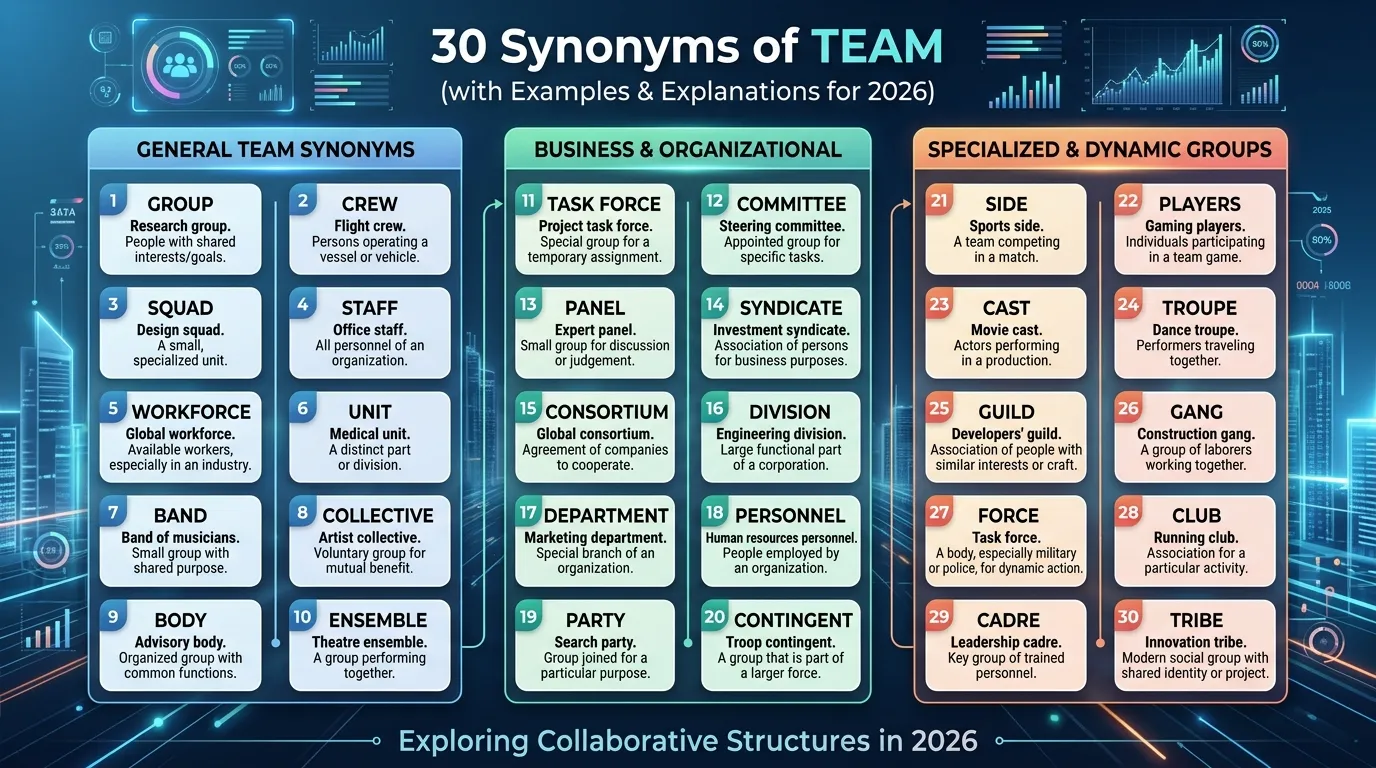
30 Synonyms of Team
1. Group (noun)
US: /ɡruːp/ | UK: /ɡruːp/
Meaning: several people together in one unit
Examples:
- Our group finished the project.
- The study group meets weekly.
2. Squad (noun)
US: /skwɑːd/ | UK: /skwɒd/
Meaning: a small organized team
Examples:
- The rescue squad arrived quickly.
- She joined the dance squad.
3. Crew (noun)
US: /kruː/ | UK: /kruː/
Meaning: people working together on a vehicle or task
Examples:
- The film crew worked hard.
- A ship crew sailed overseas.
4. Unit (noun)
US: /ˈjuːnɪt/ | UK: /ˈjuːnɪt/
Meaning: a group functioning together
Examples:
- The army unit moved forward.
- Our work unit performed well.
5. Staff (noun)
US: /stæf/ | UK: /stɑːf/
Meaning: employees working together
Examples:
- The hospital staff helped patients.
- School staff attended the meeting.
6. Band (noun)
US: /bænd/ | UK: /bænd/
Meaning: a group joined together
Examples:
- A band of volunteers cleaned the park.
- The music band performed live.
7. Company (noun)
US: /ˈkʌmpəni/ | UK: /ˈkʌmpəni/
Meaning: a group of people working together
Examples:
- The theater company traveled widely.
- A military company trained nearby.
8. Party (noun)
US: /ˈpɑːrti/ | UK: /ˈpɑːti/
Meaning: a group involved in an activity
Examples:
- The search party found the hikers.
- Our tour party left early.
9. Gang (noun)
US: /ɡæŋ/ | UK: /ɡæŋ/
Meaning: a close group of people
Examples:
- The old gang met again.
- A work gang repaired the road.
10. League (noun)
US: /liːɡ/ | UK: /liːɡ/
Meaning: groups joined for a purpose
Examples:
- The sports league starts tomorrow.
- Several clubs formed a league.
11. Alliance (noun)
US: /əˈlaɪəns/ | UK: /əˈlaɪəns/
Meaning: a union for mutual benefit
Examples:
- The countries formed an alliance.
- Their business alliance succeeded.
12. Coalition (noun)
US: /ˌkoʊəˈlɪʃən/ | UK: /ˌkəʊəˈlɪʃən/
Meaning: groups joined together temporarily
Examples:
- The parties created a coalition.
- A coalition solved the problem.
13. Partnership (noun)
US: /ˈpɑːrtnərʃɪp/ | UK: /ˈpɑːtnəʃɪp/
Meaning: people working together officially
Examples:
- Their business partnership grew fast.
- The school formed a partnership.
14. Association (noun)
US: /əˌsoʊsiˈeɪʃən/ | UK: /əˌsəʊsiˈeɪʃən/
Meaning: a group organized for a purpose
Examples:
- The teachers’ association met today.
- She joined a sports association.
15. Organization (noun)
US: /ˌɔːrɡənəˈzeɪʃən/ | UK: /ˌɔːɡənaɪˈzeɪʃən/
Meaning: a structured group of people
Examples:
- The charity organization helps children.
- He works for a global organization.
16. Workforce (noun)
US: /ˈwɜːrkfɔːrs/ | UK: /ˈwɜːkfɔːs/
Meaning: all workers in a company
Examples:
- The workforce received training.
- A skilled workforce improves success.
17. Committee (noun)
US: /kəˈmɪti/ | UK: /kəˈmɪti/
Meaning: a group chosen for a task
Examples:
- The committee approved the plan.
- She joined the event committee.
18. Panel (noun)
US: /ˈpænəl/ | UK: /ˈpænəl/
Meaning: a small expert group
Examples:
- The judges formed a panel.
- A discussion panel answered questions.
19. Task Force (noun)
US: /ˈtæsk fɔːrs/ | UK: /ˈtɑːsk fɔːs/
Meaning: a special team for a mission
Examples:
- The task force handled security.
- A medical task force arrived.
20. Lineup (noun)
US: /ˈlaɪnʌp/ | UK: /ˈlaɪnʌp/
Meaning: a selected group of people
Examples:
- The football lineup changed.
- The concert had a strong lineup.
21. Collective (noun)
US: /kəˈlektɪv/ | UK: /kəˈlektɪv/
Meaning: people acting together
Examples:
- The artist collective opened a gallery.
- A worker collective protested.
22. Circle (noun)
US: /ˈsɜːrkəl/ | UK: /ˈsɜːkəl/
Meaning: a close social group
Examples:
- She has a supportive circle.
- Their business circle expanded.
23. Fellowship (noun)
US: /ˈfeləʊʃɪp/ | UK: /ˈfeləʊʃɪp/
Meaning: friendly group connection
Examples:
- The club promoted fellowship.
- They shared strong fellowship.
24. Network (noun)
US: /ˈnetwɜːrk/ | UK: /ˈnetwɜːk/
Meaning: connected group of people
Examples:
- She built a professional network.
- The support network helped families.
25. Battalion (noun)
US: /bəˈtæliən/ | UK: /bəˈtæliən/
Meaning: a large military team
Examples:
- The battalion marched forward.
- A medical battalion arrived.
26. Crewmen (noun)
US: /ˈkruːmən/ | UK: /ˈkruːmən/
Meaning: members of a working crew
Examples:
- The crewmen repaired the ship.
- Skilled crewmen solved the issue.
27. Ensemble (noun)
US: /ɑːnˈsɑːmbəl/ | UK: /ɒnˈsɒmbəl/
Meaning: a coordinated performing group
Examples:
- The musical ensemble practiced daily.
- A jazz ensemble performed tonight.
28. Side (noun)
US: /saɪd/ | UK: /saɪd/
Meaning: one team in a competition
Examples:
- Our side won the game.
- The visiting side played well.
29. Troop (noun)
US: /truːp/ | UK: /truːp/
Meaning: a group working together
Examples:
- The scout troop camped outside.
- A troop of dancers performed.
30. Collaboration (noun)
US: /kəˌlæbəˈreɪʃən/ | UK: /kəˌlæbəˈreɪʃən/
Meaning: people working jointly
Examples:
- Their collaboration improved results.
- A business collaboration started.
Prototype Meaning
The most common meaning of team is a group of people working together toward the same goal. People usually imagine sports players, coworkers, or classmates supporting one another and sharing responsibilities.
Prototype Categorization
- Work and business groups: staff, workforce, committee
- Sports and competition groups: squad, lineup, side
- Military and organized groups: battalion, troop, unit
- Friendly and social groups: circle, fellowship, gang
Antonyms of Team
- Individual (noun): one person acting alone
- Opponent (noun): a competing person or group
- Rival (noun): a competitor
- Enemy (noun): a hostile person or group
- Outsider (noun): someone outside the group
Short Questions and Answers
What does team mean?
- A team is a group of people working together toward a shared goal.
When should team be used?
- Use “team” when discussing cooperation, sports, projects, or group work.
Is team positive or negative?
- The word is usually positive because it suggests unity and support.
How is it different from similar words?
- “Team” focuses on cooperation toward a goal, while “group” can mean any collection of people.
Conclusion
Learning Synonyms of Team and Synonyms of Team improves English vocabulary and communication skills. These words help writers and speakers describe cooperation, unity, and group effort more clearly. Using different synonyms also avoids repetition and makes writing more professional and engaging.
Understanding synonyms of team is useful in school, business, sports, and daily communication. It allows learners to choose the best word for formal, casual, or professional situations. Daily vocabulary practice builds stronger confidence in speaking and writing English naturally and effectively.

I’m Zahid Abbas, an educator, researcher, and digital publishing strategist with a passion for linguistics, grammar, and clear communication. As a content creator and SEO specialist, I craft research-driven, reader-focused content that empowers learners and makes knowledge accessible worldwide.