The word control means having the power to direct, manage, influence, or regulate something. Imagine a teacher managing a classroom during an exam. The teacher keeps order, gives instructions, and ensures everyone follows the rules. In this situation, the teacher has control of the classroom.
Control is one of the most common words in English. People use it in business, education, technology, sports, government, and daily conversations. Because it appears so often, learning its synonyms can greatly improve your English skills.
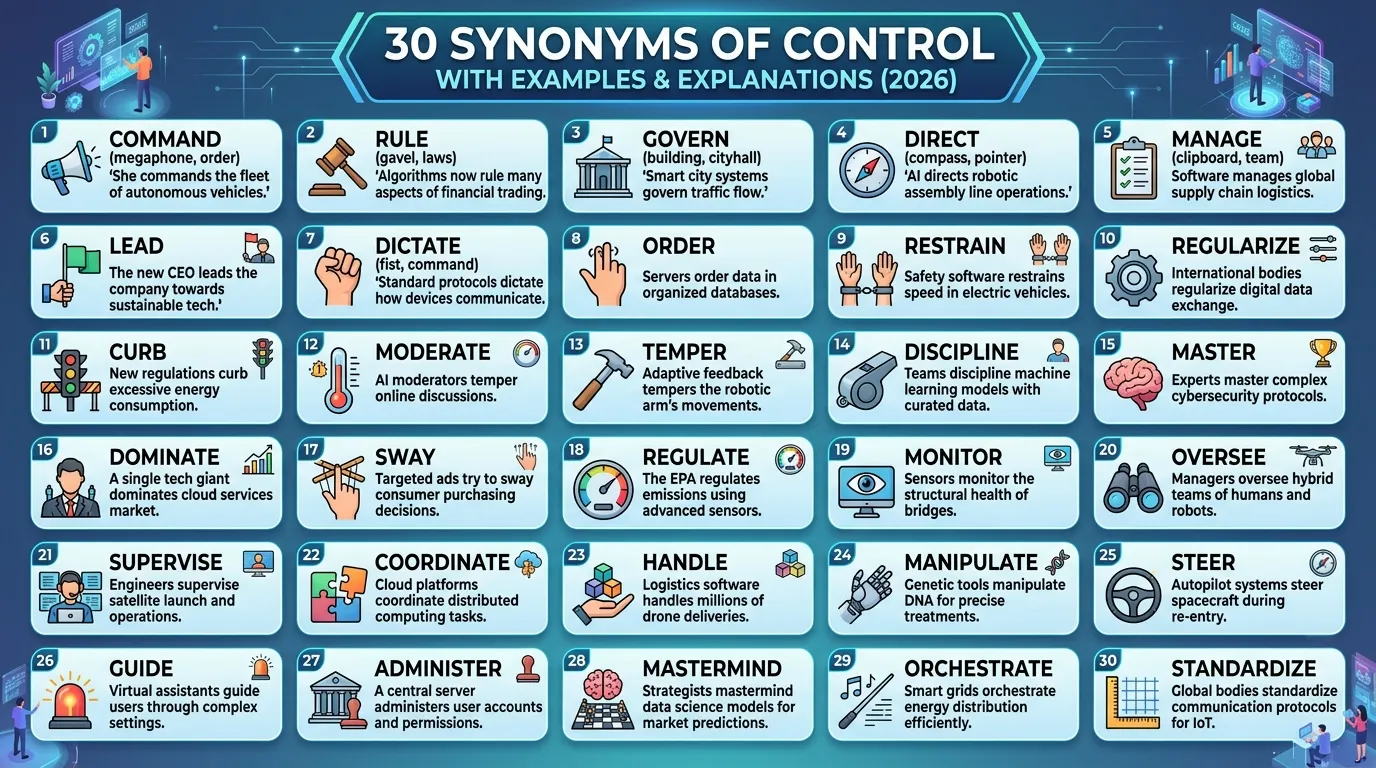
For English learners and content writers, knowing different words for control helps avoid repetition and makes writing more interesting. This article explores the meaning of control, its pronunciation, history, grammar, connotation, and 30 useful synonyms with examples. By the end, you will have a stronger vocabulary and a better understanding of how to use this important word using Synonyms of Control.
Meaning of Control
Definition
Control (Noun, Verb):
The power to direct, manage, influence, regulate, or command people, situations, or things.
Examples
- She has control over the project’s budget.
- The driver controlled the car carefully during the storm.
Connotative Meaning
- Positive tone: Leadership, organization, discipline, responsibility.
- Negative tone: Domination, restriction, manipulation.
- Neutral tone: Management, regulation, supervision.
Etymology
- Origin: Old French controle
- Source Language: Medieval French
- Original Meaning: “A register used to check another record”
Short History of the Keyword
- Old English (450–1100): The word did not exist in Old English.
- Middle English (1100–1500): Borrowed from Old French administrative language.
- Modern English (1500–Present): Expanded to mean regulate, direct, manage, and command.
Pronunciation (US & UK – IPA)
- US: /kənˈtroʊl/
- UK: /kənˈtrəʊl/
Syllables
con-trol
Affixation Pattern of Control
- Root: control
- Prefix: None
- Suffix: None
Word Formation of the Keyword
- Control (noun)
- Control (verb)
- Controlled (adjective)
- Controlled (verb, past tense)
- Controlling (adjective)
- Controlling (verb, present participle)
- Controller (noun)
- Controllable (adjective)
- Uncontrollable (adjective)
- Controlless (adjective)
30 Synonyms of Control
1. Manage (Verb)
US: /ˈmænɪdʒ/ | UK: /ˈmænɪdʒ/
Meaning: To organize and direct people or activities.
Examples:
- She manages a large team.
- He managed the event successfully.
2. Govern (Verb)
US: /ˈɡʌvərn/ | UK: /ˈɡʌvən/
Meaning: To rule or regulate a group or country.
Examples:
- Laws govern society.
- The committee governs the organization.
3. Direct (Verb)
US: /dəˈrɛkt/ | UK: /daɪˈrekt/
Meaning: To guide or lead something.
Examples:
- She directed the project.
- The coach directed the players.
4. Command (Verb)
US: /kəˈmænd/ | UK: /kəˈmɑːnd/
Meaning: To give orders with authority.
Examples:
- The officer commanded the troops.
- She commands respect.
5. Regulate (Verb)
US: /ˈrɛɡjəleɪt/ | UK: /ˈreɡjʊleɪt/
Meaning: To control according to rules.
Examples:
- The agency regulates trade.
- Rules regulate traffic.
6. Supervise (Verb)
US: /ˈsuːpərvaɪz/ | UK: /ˈsuːpəvaɪz/
Meaning: To watch and direct work.
Examples:
- She supervises new employees.
- A teacher supervised the exam.
7. Oversee (Verb)
US: /ˌoʊvərˈsiː/ | UK: /ˌəʊvəˈsiː/
Meaning: To monitor and manage.
Examples:
- He oversees operations.
- She oversees construction work.
8. Administer (Verb)
US: /ədˈmɪnɪstər/ | UK: /ədˈmɪnɪstə/
Meaning: To manage an organization or system.
Examples:
- She administers the program.
- They administer public services.
9. Handle (Verb)
US: /ˈhændl/ | UK: /ˈhændl/
Meaning: To deal with or manage.
Examples:
- He handled the complaint well.
- She can handle pressure.
10. Operate (Verb)
US: /ˈɑːpəreɪt/ | UK: /ˈɒpəreɪt/
Meaning: To control the functioning of something.
Examples:
- He operates the machine.
- She operates a business.
11. Rule (Verb)
US: /ruːl/ | UK: /ruːl/
Meaning: To exercise authority.
Examples:
- The king ruled the nation.
- Rules govern behavior.
12. Lead (Verb)
US: /liːd/ | UK: /liːd/
Meaning: To guide others.
Examples:
- She leads the department.
- He led the discussion.
13. Guide (Verb)
US: /ɡaɪd/ | UK: /ɡaɪd/
Meaning: To show the direction or way.
Examples:
- Teachers guide students.
- The map guided us home.
14. Monitor (Verb)
US: /ˈmɑːnɪtər/ | UK: /ˈmɒnɪtə/
Meaning: To watch carefully.
Examples:
- Nurses monitor patients.
- We monitor performance daily.
15. Restrain (Verb)
US: /rɪˈstreɪn/ | UK: /rɪˈstreɪn/
Meaning: To hold back or limit.
Examples:
- He restrained his anger.
- Police restrained the suspect.
16. Limit (Verb)
US: /ˈlɪmɪt/ | UK: /ˈlɪmɪt/
Meaning: To reduce or restrict.
Examples:
- They limited spending.
- The law limits speed.
17. Restrict (Verb)
US: /rɪˈstrɪkt/ | UK: /rɪˈstrɪkt/
Meaning: To keep within boundaries.
Examples:
- Access is restricted.
- They restricted movement.
18. Check (Verb)
US: /tʃɛk/ | UK: /tʃek/
Meaning: To stop or control growth or action.
Examples:
- The measures checked inflation.
- He checked the spread of fire.
19. Moderate (Verb)
US: /ˈmɑːdəreɪt/ | UK: /ˈmɒdəreɪt/
Meaning: To make less extreme.
Examples:
- She moderated the discussion.
- Policies moderated prices.
20. Influence (Verb)
US: /ˈɪnfluəns/ | UK: /ˈɪnfluəns/
Meaning: To affect decisions or behavior.
Examples:
- Parents influence children.
- Advertising influences buyers.
21. Dominate (Verb)
US: /ˈdɑːməneɪt/ | UK: /ˈdɒmɪneɪt/
Meaning: To have complete power.
Examples:
- The company dominates the market.
- He dominated the game.
22. Master (Verb)
US: /ˈmæstər/ | UK: /ˈmɑːstə/
Meaning: To gain complete control or skill.
Examples:
- She mastered the language.
- He mastered the technique.
23. Discipline (Verb)
US: /ˈdɪsəplɪn/ | UK: /ˈdɪsɪplɪn/
Meaning: To train or control behavior.
Examples:
- Parents discipline children.
- The coach disciplined the team.
24. Coordinate (Verb)
US: /koʊˈɔːrdɪneɪt/ | UK: /kəʊˈɔːdɪneɪt/
Meaning: To organize activities together.
Examples:
- She coordinated the event.
- They coordinated resources.
25. Conduct (Verb)
US: /kənˈdʌkt/ | UK: /kənˈdʌkt/
Meaning: To direct an activity.
Examples:
- He conducted the meeting.
- She conducted research.
26. Steer (Verb)
US: /stɪr/ | UK: /stɪə/
Meaning: To guide in a direction.
Examples:
- She steered the car.
- He steered the company forward.
27. Manipulate (Verb)
US: /məˈnɪpjəleɪt/ | UK: /məˈnɪpjʊleɪt/
Meaning: To control skillfully or unfairly.
Examples:
- He manipulated the data.
- She manipulated the situation.
28. Rein (Verb)
US: /reɪn/ | UK: /reɪn/
Meaning: To control or hold back.
Examples:
- He reined in spending.
- The company reined in costs.
29. Patrol (Verb)
US: /pəˈtroʊl/ | UK: /pəˈtrəʊl/
Meaning: To supervise an area regularly.
Examples:
- Officers patrol the streets.
- Guards patrol the building.
30. Maintain (Verb)
US: /meɪnˈteɪn/ | UK: /meɪnˈteɪn/
Meaning: To keep something under control or in good condition.
Examples:
- She maintained order.
- They maintained discipline.
Prototype Meaning
The most typical meaning of control is having the power to direct, manage, or influence a person, activity, system, or situation. Most people imagine someone guiding events, making decisions, and ensuring things happen as planned.
Prototype Categorization
- Leadership and Authority: command, govern, rule, lead, dominate
- Management and Organization: manage, administer, coordinate, conduct, oversee
- Guidance and Direction: guide, direct, steer, monitor
- Restriction and Limitation: restrain, restrict, limit, check, rein
- Influence and Power: influence, manipulate, master
- Supervision and Observation: supervise, patrol, monitor
Antonyms of Control
- Freedom (Noun): The state of being unrestricted.
- Liberty (Noun): The right to act freely.
- Release (Verb): To set free.
- Chaos (Noun): Complete disorder.
- Disorder (Noun): Lack of organization.
- Neglect (Verb): To fail to manage properly.
- Obey (Verb): To follow another’s control.
- Surrender (Verb): To give up authority.
- Yield (Verb): To give way to another force.
- Abandon (Verb): To stop managing something.
Short Questions and Answers
- What does control mean?
Control means having the power to manage, direct, regulate, or influence something. - When should control be used?
Use control when talking about managing people, systems, situations, emotions, or activities. - Is control positive or negative?
It can be positive, negative, or neutral depending on the situation and intention. - How is it different from similar words?
Control is a broad term. Words like manage, govern, and supervise describe specific types of control.
Conclusion
Learning the Synonyms of Control and Synonyms of Control is an excellent way to strengthen your English vocabulary. These words help you express ideas more clearly in writing and speaking. Using different synonyms prevents repetition and makes communication more engaging. Understanding meanings, pronunciation, connotations, and usage also improves language accuracy. Whether you are a student, English learner, teacher, or content writer, mastering control and its related words can increase your confidence. Practice using one new synonym each day in conversations and writing. Over time, your vocabulary will become richer, more precise, and more professional.

I’m Zahid Abbas, an educator, researcher, and digital publishing strategist with a passion for linguistics, grammar, and clear communication. As a content creator and SEO specialist, I craft research-driven, reader-focused content that empowers learners and makes knowledge accessible worldwide.