Learning means gaining knowledge, skills, or understanding through study, experience, or teaching. Imagine a child learning to ride a bicycle. At first, the child falls many times, but with practice and guidance, the child becomes confident and skilled. This simple situation shows the true meaning of learning.
The word “learning” is commonly used in schools, workplaces, training programs, and everyday life. It is an important word because people learn new things throughout their lives.
For English learners and content writers, knowing synonyms of learning is helpful. It improves vocabulary, makes writing more interesting, and prevents repeated use of the same word. This article explains the meaning of learning, its pronunciation, history, grammar, and thirty useful Synonyms of Learning with examples. By the end, you will have a deeper understanding of this important word and many alternative words that can improve your English skills use Synonyms of Learning.
Meaning of Learning
Learning (Noun):
The process of gaining knowledge, skills, understanding, or experience.
Examples
- Learning a new language takes time and practice.
- Her learning improved after she started reading daily.
Connotative Meaning
- Positive tone: growth, improvement, wisdom, education, development.
- Negative tone: may suggest difficulty, struggle, or a long process in some contexts.
- Neutral tone: acquiring knowledge or skills without emotional judgment.
Etymology
- Origin: Old English leornung.
- Source Language: Old English.
- Original Meaning: instruction, study, or knowledge gained through teaching.
Short History of the Keyword
- Old English (450–1100): Used as leornung, meaning instruction or education.
- Middle English (1100–1500): Developed into forms related to study and knowledge.
- Modern English (1500–Present): Became widely used to describe gaining knowledge and skills through education or experience.
Pronunciation (US & UK – IPA)
US: /ˈlɝː.nɪŋ/
UK: /ˈlɜː.nɪŋ/
Syllables
learn-ing
Affixation Pattern of Learning
Root: learn
Prefix: none
Suffix: -ing
Word Formation of Learning
- Learn (Verb) – to gain knowledge.
- Learning (Noun) – the process of gaining knowledge.
- Learner (Noun) – a person who learns.
- Learned (Adjective) – knowledgeable.
- Learnedly (Adverb) – in a scholarly way.
- Learnable (Adjective) – capable of being learned.
- Unlearn (Verb) – to discard learned knowledge or habits.
- Unlearning (Noun) – the process of forgetting old knowledge.
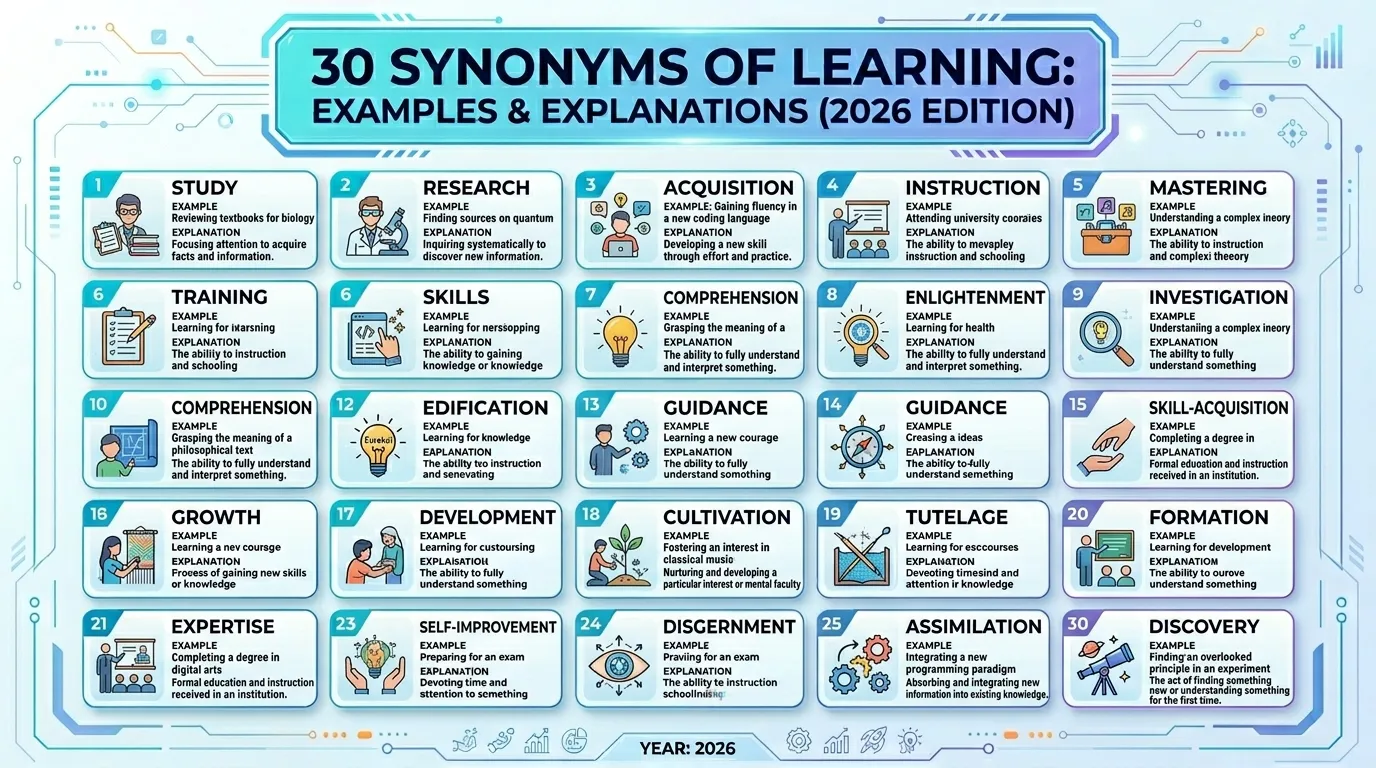
30 Synonyms of Learning
1. Education (Noun)
US /ˌedʒəˈkeɪʃən/ | UK /ˌedʒʊˈkeɪʃən/
Meaning: The process of receiving formal instruction.
Examples:
- Education opens many opportunities.
- She values education highly.
2. Knowledge (Noun)
US /ˈnɑːlɪdʒ/ | UK /ˈnɒlɪdʒ/
Meaning: Information and understanding gained through experience.
Examples:
- His knowledge of history is impressive.
- Reading increases knowledge.
3. Study (Noun)
US /ˈstʌdi/ | UK /ˈstʌdi/
Meaning: The act of learning through reading and practice.
Examples:
- Study improves academic performance.
- She spent the evening in study.
4. Training (Noun)
US /ˈtreɪnɪŋ/ | UK /ˈtreɪnɪŋ/
Meaning: Teaching skills for a specific purpose.
Examples:
- Employees receive training every year.
- Training improved his performance.
5. Instruction (Noun)
US /ɪnˈstrʌkʃən/ | UK /ɪnˈstrʌkʃən/
Meaning: Guidance or teaching provided to someone.
Examples:
- Follow the instructor’s instruction.
- The class received clear instruction.
6. Schooling (Noun)
US /ˈskuːlɪŋ/ | UK /ˈskuːlɪŋ/
Meaning: Formal education at school.
Examples:
- Good schooling benefits children.
- Her schooling began at age five.
7. Scholarship (Noun)
US /ˈskɑːlərʃɪp/ | UK /ˈskɒləʃɪp/
Meaning: Academic achievement and knowledge.
Examples:
- His scholarship is respected.
- Years of scholarship made her an expert.
8. Enlightenment (Noun)
US /ɪnˈlaɪtnmənt/ | UK /ɪnˈlaɪtnmənt/
Meaning: Gaining deeper understanding.
Examples:
- Travel brought enlightenment.
- The book offered enlightenment.
9. Understanding (Noun)
US /ˌʌndərˈstændɪŋ/ | UK /ˌʌndəˈstændɪŋ/
Meaning: Knowledge of how something works.
Examples:
- She has a good understanding of science.
- Understanding grows through practice.
10. Literacy (Noun)
US /ˈlɪtərəsi/ | UK /ˈlɪtərəsi/
Meaning: Ability to read and write.
Examples:
- Literacy is essential today.
- The program improved literacy.
11. Tutelage (Noun)
US /ˈtuːtəlɪdʒ/ | UK /ˈtjuːtəlɪdʒ/
Meaning: Guidance from a teacher.
Examples:
- He improved under her tutelage.
- Tutelage helped him succeed.
12. Coaching (Noun)
US /ˈkoʊtʃɪŋ/ | UK /ˈkəʊtʃɪŋ/
Meaning: Personalized teaching and guidance.
Examples:
- Coaching improved her skills.
- He attends coaching sessions.
13. Development (Noun)
US /dɪˈveləpmənt/ | UK /dɪˈveləpmənt/
Meaning: Growth in knowledge or ability.
Examples:
- Learning supports personal development.
- Child development is important.
14. Improvement (Noun)
US /ɪmˈpruːvmənt/ | UK /ɪmˈpruːvmənt/
Meaning: Becoming better through practice.
Examples:
- Daily reading leads to improvement.
- There was noticeable improvement.
15. Cultivation (Noun)
US /ˌkʌltəˈveɪʃən/ | UK /ˌkʌltɪˈveɪʃən/
Meaning: Development of skills or knowledge.
Examples:
- Cultivation of talent takes time.
- Education encourages cultivation.
16. Erudition (Noun)
US /ˌerjʊˈdɪʃən/ | UK /ˌerjʊˈdɪʃən/
Meaning: Deep scholarly knowledge.
Examples:
- Her erudition impressed everyone.
- The professor showed great erudition.
17. Wisdom (Noun)
US /ˈwɪzdəm/ | UK /ˈwɪzdəm/
Meaning: Good judgment gained from experience.
Examples:
- Wisdom comes with learning.
- His wisdom guided the team.
18. Insight (Noun)
US /ˈɪnsaɪt/ | UK /ˈɪnsaɪt/
Meaning: Deep understanding of a subject.
Examples:
- The article provided insight.
- Experience gives insight.
19. Awareness (Noun)
US /əˈwernəs/ | UK /əˈweənəs/
Meaning: Knowledge of a situation.
Examples:
- Awareness helps decision-making.
- Education increases awareness.
20. Expertise (Noun)
US /ˌekspɜːrˈtiːz/ | UK /ˌekspɜːˈtiːz/
Meaning: High level of skill or knowledge.
Examples:
- She gained expertise through practice.
- His expertise is valuable.
21. Mastery (Noun)
US /ˈmæstəri/ | UK /ˈmɑːstəri/
Meaning: Complete skill or knowledge.
Examples:
- Mastery requires dedication.
- He achieved mastery in music.
22. Apprenticeship (Noun)
US /əˈprentɪsʃɪp/ | UK /əˈprentɪsʃɪp/
Meaning: Learning through practical training.
Examples:
- She completed an apprenticeship.
- Apprenticeship teaches valuable skills.
23. Experience (Noun)
US /ɪkˈspɪriəns/ | UK /ɪkˈspɪəriəns/
Meaning: Knowledge gained through doing.
Examples:
- Experience is a great teacher.
- Learning comes from experience.
24. Discipline (Noun)
US /ˈdɪsəplɪn/ | UK /ˈdɪsəplɪn/
Meaning: A field of study or controlled learning.
Examples:
- Physics is a scientific discipline.
- Discipline supports learning.
25. Research (Noun)
US /rɪˈsɜːrtʃ/ | UK /rɪˈsɜːtʃ/
Meaning: Systematic study to discover facts.
Examples:
- Research expands knowledge.
- Scientists conduct research daily.
26. Cognition (Noun)
US /kɑːɡˈnɪʃən/ | UK /kɒɡˈnɪʃən/
Meaning: Mental process of understanding.
Examples:
- Cognition affects learning.
- Psychology studies cognition.
27. Comprehension (Noun)
US /ˌkɑːmprɪˈhenʃən/ | UK /ˌkɒmprɪˈhenʃən/
Meaning: Ability to understand information.
Examples:
- Reading improves comprehension.
- Students practiced comprehension skills.
28. Absorption (Noun)
US /əbˈzɔːrpʃən/ | UK /əbˈzɔːpʃən/
Meaning: Taking in knowledge or information.
Examples:
- Absorption of ideas takes time.
- The lesson encouraged absorption.
29. Acquisition (Noun)
US /ˌækwɪˈzɪʃən/ | UK /ˌækwɪˈzɪʃən/
Meaning: The process of gaining something.
Examples:
- Language acquisition begins early.
- Knowledge acquisition is important.
30. Self-Education (Noun)
US /ˌself ˌedʒəˈkeɪʃən/ | UK /ˌself ˌedʒʊˈkeɪʃən/
Meaning: Learning without formal teaching.
Examples:
- Self-education helped her career.
- Many skills come from self-education.
Prototype Meaning
The most typical meaning of learning is gaining knowledge or skills through study, practice, teaching, or experience. Most people imagine a student reading books, attending classes, asking questions, and improving understanding over time.
Prototype Categorization
Categorization helps writers choose the most suitable synonym based on context.
- Formal Education: education, schooling, instruction, scholarship.
- Knowledge and Understanding: knowledge, understanding, insight, awareness, wisdom.
- Skill Development: training, coaching, mastery, expertise, apprenticeship.
- Academic Activities: study, research, cognition, comprehension.
- Personal Growth: development, improvement, cultivation, enlightenment.
- Knowledge Acquisition: absorption, acquisition, experience, self-education.
Antonyms of Learning
- Ignorance (Noun) – lack of knowledge.
- Illiteracy (Noun) – inability to read or write.
- Inexperience (Noun) – lack of practical knowledge.
- Unawareness (Noun) – lack of understanding.
- Incompetence (Noun) – lack of skill.
- Forgetfulness (Noun) – tendency to forget information.
- Misunderstanding (Noun) – incorrect understanding.
- Nescience (Noun) – absence of knowledge.
Short Questions and Answers
- What does learning mean?Learning means gaining knowledge, skills, understanding, or experience.
- When should learning be used?Use it when discussing education, training, skill development, or acquiring knowledge.
- Is learning positive or negative?It is usually positive because it suggests growth and improvement, though it can describe a difficult process in some contexts.
- How is it different from similar words?Learning refers to the process of gaining knowledge, while knowledge is the result of that process and education often refers to formal instruction.
Conclusion
Learning is one of the most important concepts in English and in life and use of Synonyms of Learning. Understanding the word and its synonyms helps you express ideas more clearly and accurately. Whether you use words such as education, knowledge, training, insight, expertise, or mastery, each synonym adds variety and precision to your writing and speaking. Expanding your vocabulary reduces repetition, improves communication, and makes your English sound more natural. It also helps students, professionals, writers, and language learners communicate with greater confidence. Make vocabulary learning a daily habit. By studying words, meanings, pronunciations, and synonyms regularly, you can steadily improve your English skills and become a more effective communicator and Synonyms of Learning.

I’m Zahid Abbas, an educator, researcher, and digital publishing strategist with a passion for linguistics, grammar, and clear communication. As a content creator and SEO specialist, I craft research-driven, reader-focused content that empowers learners and makes knowledge accessible worldwide.