A lot means a large amount, a great number, or to a great extent. Imagine a student preparing for exams. They study a lot, read a lot of books, and practice a lot of questions. In daily English, people use this phrase very often because it is simple and easy to understand.
However, using a lot repeatedly can make speaking and writing sound repetitive. Learning synonyms helps English learners express ideas more clearly and naturally. It also helps content writers, students, and professionals improve their vocabulary and communication skills.
In this article, you will learn the meaning of a lot, its pronunciation, history, grammar, and word formation. You will also discover 30 useful Synonyms of A Lot with meanings and examples. Finally, you will learn antonyms, semantic categories, and practical usage tips to strengthen your English vocabulary.
Meaning of A Lot
A lot (Pronoun, Adverb, Determiner Phrase):
A large amount, a great number, or to a great degree.
Examples:
- I learned a lot from that book.
- She travels a lot for work.
Connotative Meaning
- Positive tone: abundance, success, richness, generosity.
- Negative tone: excess, overload, too much.
- Neutral tone: a large quantity without emotional judgment.
Etymology
- Origin: English phrase.
- Derived from the word lot, which originally meant a share, portion, or quantity.
- The phrase a lot gradually developed the meaning of a large amount.
Short History of the Keyword
- Old English (450–1100): Hlot meant share, portion, or fate.
- Middle English (1100–1500): Lot continued to mean portion or allocation.
- Modern English (1500–Present): The phrase a lot became common to mean a large amount or many things.
Pronunciation (US & UK – IPA)
US: /ə ˈlɑːt/
UK: /ə ˈlɒt/
Syllables
a-lot
Affixation Pattern of A Lot
Root: lot
Prefix: None
Suffix: None
Word Formation of the Keyword
- Lot (Noun)
- Lots (Noun)
- Allot (Verb)
- Allotment (Noun)
- Lottery (Noun)
- Lotting (Verb Form)
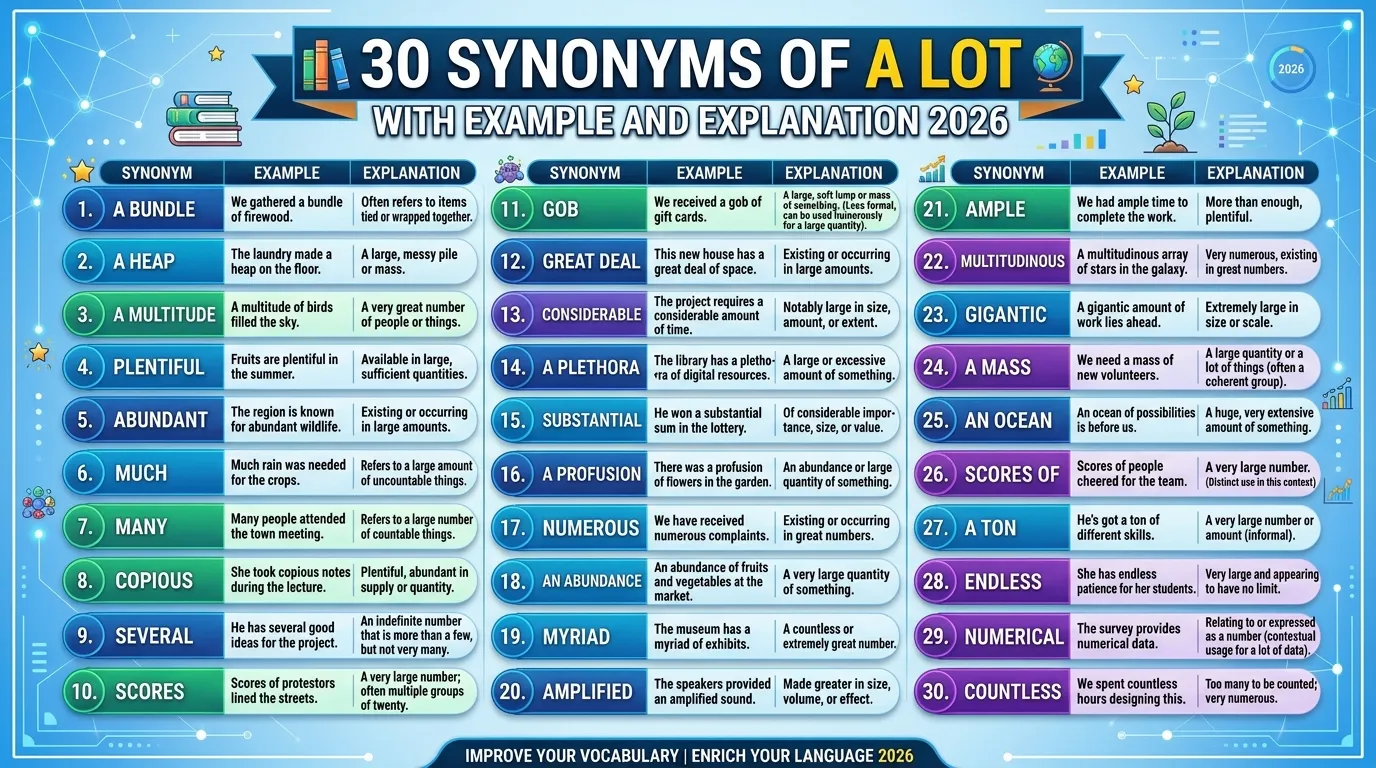
30 Synonyms of A Lot
1. Many (Determiner/Pronoun)
US: /ˈmeni/ | UK: /ˈmeni/
Meaning: A large number of people or things.
Examples:
- Many students attended the class.
- She has many friends.
2. Numerous (Adjective)
US: /ˈnuːmərəs/ | UK: /ˈnjuːmərəs/
Meaning: Existing in large numbers.
Examples:
- Numerous birds filled the sky.
- The company received numerous applications.
3. Plenty (Noun)
US: /ˈplenti/ | UK: /ˈplenti/
Meaning: More than enough.
Examples:
- We have plenty of food.
- There is plenty of time left.
4. Abundant (Adjective)
US: /əˈbʌndənt/ | UK: /əˈbʌndənt/
Meaning: Existing in large quantities.
Examples:
- Water is abundant in this area.
- The garden has abundant flowers.
5. Ample (Adjective)
US: /ˈæmpəl/ | UK: /ˈæmpəl/
Meaning: More than sufficient.
Examples:
- There is ample parking space.
- She had ample opportunity to speak.
6. Countless (Adjective)
US: /ˈkaʊntləs/ | UK: /ˈkaʊntləs/
Meaning: Too many to count.
Examples:
- Countless stars shone above.
- He made countless attempts.
7. Innumerable (Adjective)
US: /ɪˈnuːmərəbəl/ | UK: /ɪˈnjuːmərəbəl/
Meaning: Impossible to count because of quantity.
Examples:
- Innumerable insects lived there.
- She faced innumerable challenges.
8. Multiple (Adjective)
US: /ˈmʌltɪpəl/ | UK: /ˈmʌltɪpəl/
Meaning: More than one; many.
Examples:
- Multiple options are available.
- The issue has multiple causes.
9. Several (Determiner)
US: /ˈsevərəl/ | UK: /ˈsevərəl/
Meaning: More than a few.
Examples:
- Several guests arrived early.
- He visited several countries.
10. Loads of (Phrase)
US: /loʊdz əv/ | UK: /ləʊdz əv/
Meaning: Very many; a great amount.
Examples:
- We have loads of work.
- She owns loads of books.
11. Tons of (Phrase)
US: /tʌnz əv/ | UK: /tʌnz əv/
Meaning: A very large amount.
Examples:
- I have tons of homework.
- They spent tons of money.
12. Masses of (Phrase)
US: /ˈmæsɪz əv/ | UK: /ˈmæsɪz əv/
Meaning: Large quantities.
Examples:
- There were masses of people.
- The store offers masses of products.
13. A Great Deal (Phrase)
US: /ə ɡreɪt diːl/ | UK: /ə ɡreɪt diːl/
Meaning: A large amount.
Examples:
- She learned a great deal.
- It costs a great deal.
14. A Large Amount (Phrase)
US: /ə lɑːrdʒ əˈmaʊnt/ | UK: /ə lɑːdʒ əˈmaʊnt/
Meaning: A significant quantity.
Examples:
- They donated a large amount.
- A large amount of water was used.
15. A Large Number (Phrase)
US: /ə lɑːrdʒ ˈnʌmbər/ | UK: /ə lɑːdʒ ˈnʌmbə/
Meaning: Many people or things.
Examples:
- A large number attended.
- A large number of cars arrived.
16. Copious (Adjective)
US: /ˈkoʊpiəs/ | UK: /ˈkəʊpiəs/
Meaning: Existing in abundance.
Examples:
- The report contains copious details.
- Copious rainfall helped crops.
17. Extensive (Adjective)
US: /ɪkˈstensɪv/ | UK: /ɪkˈstensɪv/
Meaning: Large in amount or scope.
Examples:
- Extensive research was completed.
- The damage was extensive.
18. Vast (Adjective)
US: /væst/ | UK: /vɑːst/
Meaning: Extremely large.
Examples:
- A vast crowd gathered.
- The desert is vast.
19. Huge (Adjective)
US: /hjuːdʒ/ | UK: /hjuːdʒ/
Meaning: Very large.
Examples:
- They made huge profits.
- A huge tree stood nearby.
20. Enormous (Adjective)
US: /ɪˈnɔːrməs/ | UK: /ɪˈnɔːməs/
Meaning: Extremely large.
Examples:
- The project required enormous effort.
- An enormous building was constructed.
21. Significant (Adjective)
US: /sɪɡˈnɪfɪkənt/ | UK: /sɪɡˈnɪfɪkənt/
Meaning: Important and considerable.
Examples:
- Significant progress was made.
- The company earned significant revenue.
22. Substantial (Adjective)
US: /səbˈstænʃəl/ | UK: /səbˈstænʃəl/
Meaning: Large in size or amount.
Examples:
- He received substantial support.
- The repairs required substantial funds.
23. Considerable (Adjective)
US: /kənˈsɪdərəbəl/ | UK: /kənˈsɪdərəbəl/
Meaning: Fairly large.
Examples:
- Considerable effort was needed.
- She has considerable experience.
24. Profuse (Adjective)
US: /prəˈfjuːs/ | UK: /prəˈfjuːs/
Meaning: Produced in large quantities.
Examples:
- Profuse praise followed.
- The plant produced profuse flowers.
25. Overflowing (Adjective)
US: /ˌoʊvərˈfloʊɪŋ/ | UK: /ˌəʊvəˈfləʊɪŋ/
Meaning: Full beyond capacity.
Examples:
- The hall was overflowing with people.
- The basket was overflowing with fruit.
26. Rich (Adjective)
US: /rɪtʃ/ | UK: /rɪtʃ/
Meaning: Having plenty of something.
Examples:
- The soil is rich in nutrients.
- The culture is rich in traditions.
27. Bountiful (Adjective)
US: /ˈbaʊntɪfəl/ | UK: /ˈbaʊntɪfəl/
Meaning: Generous and plentiful.
Examples:
- Farmers enjoyed a bountiful harvest.
- The region has bountiful resources.
28. Generous (Adjective)
US: /ˈdʒenərəs/ | UK: /ˈdʒenərəs/
Meaning: More than enough.
Examples:
- They offered a generous donation.
- Add a generous amount of sugar.
29. Plentiful (Adjective)
US: /ˈplentɪfəl/ | UK: /ˈplentɪfəl/
Meaning: Existing in abundance.
Examples:
- Fish are plentiful here.
- The harvest was plentiful.
30. Excessive (Adjective)
US: /ɪkˈsesɪv/ | UK: /ɪkˈsesɪv/
Meaning: More than necessary.
Examples:
- Excessive spending caused problems.
- Excessive noise disturbed everyone.
Prototype Meaning
The most typical meaning of a lot is a large quantity or a high degree of something. When people hear this phrase, they usually imagine many items, much work, plenty of time, or a strong level of activity using Synonyms of A Lot.
Prototype Categorization
- Large Numbers: many, numerous, countless, innumerable, several
- Large Quantities: plenty, abundant, ample, plentiful, copious
- Informal Expressions: loads of, tons of, masses of
- Academic/Formal Words: considerable, substantial, significant, extensive
- Extreme Amounts: enormous, huge, vast, excessive
- Positive Abundance: bountiful, generous, rich
Antonyms of A Lot
- Little (Adjective/Determiner): a small amount.
- Few (Determiner): a small number.
- Scarce (Adjective): not enough available.
- Limited (Adjective): restricted in amount.
- Minimal (Adjective): very small.
- Insufficient (Adjective): not enough.
- Rare (Adjective): uncommon.
- Meager (Adjective): lacking quantity.
- Sparse (Adjective): thinly distributed.
- Shortage (Noun): lack of supply.
Short Questions and Answers
- What does a lot mean?It means a large amount, many things, or to a great degree.
- When should a lot be used?Use it when talking about large quantities, frequent actions, or strong degrees.
- Is a lot positive or negative?It can be positive, negative, or neutral depending on the context.
- How is it different from similar words?A lot is informal and common, while words like numerous, substantial, and considerable are more formal and precise.
Conclusion
Learning the meaning and Synonyms of A Lot and its is an excellent way to improve English vocabulary. These alternatives help writers and speakers express ideas more accurately and avoid repeating the same phrase. Understanding pronunciation, connotation, history, and usage makes vocabulary learning easier and more effective. Whether you are a student, content writer, professional, or English learner, using a wider range of words can strengthen both writing and speaking skills. Practice these synonyms daily in conversations, essays, emails, and articles. Over time, you will communicate with greater confidence, clarity, and variety, making your English sound more natural and advanced.

I’m Zahid Abbas, an educator, researcher, and digital publishing strategist with a passion for linguistics, grammar, and clear communication. As a content creator and SEO specialist, I craft research-driven, reader-focused content that empowers learners and makes knowledge accessible worldwide.