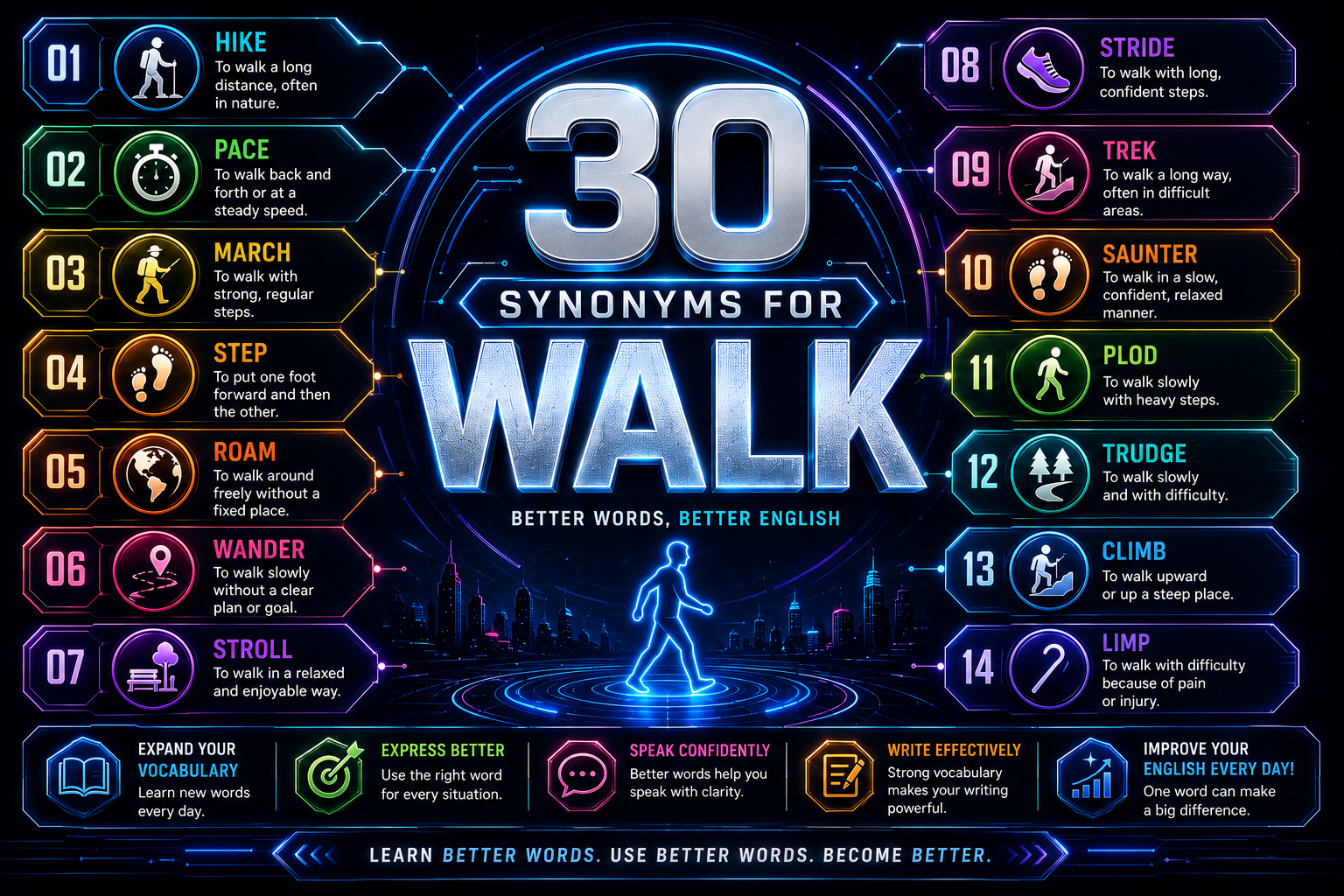
Walk means to move on your feet. You use your legs to move from one place to another. For example, you may walk to school, walk to a shop, or walk in a park. Sara walks to school every day with her brother. The word walk is very common in English because people use it in many daily talks and simple sentences. Learning Synonyms for Walk can help content writers use different words instead of using walk again and again. In this article, you will learn the simple meaning of walk, its grammar, pronunciation, history, word forms, and 30 useful synonyms. You will also learn how these words can have different meanings and tones. This will help you choose the right word for each situation.
Meaning of Walk
Definition
Walk (verb/noun): To move on your feet at a normal speed, or an act of moving this way.
Examples
- I walk to school every morning.
- We went for a walk in the park.
Connotative Meaning.
- Positive tone: stroll, roam, wander can suggest fun, peace, or freedom.
- Negative tone: stagger, limp, trudge can suggest pain, tiredness, or trouble.
- Neutral tone: walk, step, move, pace usually give a simple and direct meaning.
Etymology
- Walk comes from Old English wealcan, which meant “to move” or “to roll.”
- The word later changed in form and meaning as English developed.
- Also read more about https://synonymspot.com/synonyms-of-boring/
Short History of Walk
- Old English (450–1100): Early forms of the word were used for moving or going.
- Middle English (1100–1500): The word became closer to the form walk and was used for moving on foot.
- Modern English (1500–Present): Walk became the common word we use today for moving on foot. It also gained meanings such as taking a walk or walking someone somewhere.
Pronunciation (US & UK – IPA)
- US: /wɔːk/
- UK: /wɔːk/
Syllables
walk
Affixation Pattern of Walk
- Root: walk
- Prefix: None
- Suffix: None
Word Formation of Walk
- walk — verb/noun
- walks — verb/noun
- walked — verb
- walking — verb/noun/adjective
- walker — noun
- walkable — adjective
- walkway — noun
Synonyms of Walk
1. Stroll (Verb/Noun)
US: /stroʊl/ | UK: /strəʊl/
Meaning: To walk slowly and calmly.
Examples:
- We strolled around the park.
- She went for a stroll after dinner.
2. Wander (Verb)
US: /ˈwɑːndər/ | UK: /ˈwɒndə/
Meaning: To walk around without a clear plan.
Examples:
- We wandered around the old town.
- He likes to wander in the park.
3. Roam (Verb)
US: /roʊm/ | UK: /rəʊm/
Meaning: To move around freely.
Examples:
- The children roamed around the garden.
- We roamed the streets all day.
4. Stride (Verb/Noun)
US: /straɪd/ | UK: /straɪd/
Meaning: To walk with long and confident steps.
Examples:
- He strode into the room.
- She walked with a long stride.
5. Step (Verb/Noun)
US: /step/ | UK: /step/
Meaning: To move one foot forward or take one movement with a foot.
Examples:
- Please step inside.
- He took one step forward.
6. March (Verb/Noun)
US: /mɑːrtʃ/ | UK: /mɑːtʃ/
Meaning: To walk with strong, regular steps.
Examples:
- The soldiers marched down the road.
- We marched toward the gate.
7. Pace (Verb/Noun)
US: /peɪs/ | UK: /peɪs/
Meaning: To walk back and forth, often while thinking or waiting.
Examples:
- He paced around the room.
- She walked at a slow pace.
8. Hike (Verb/Noun)
US: /haɪk/ | UK: /haɪk/
Meaning: To take a long walk, often in nature.
Examples:
- We hiked in the mountains.
- They went on a long hike.
9. Trek (Verb/Noun)
US: /trek/ | UK: /trek/
Meaning: To walk a long and hard distance.
Examples:
- We trekked through the hills.
- The trip was a long trek.
10. Amble (Verb)
US: /ˈæmbəl/ | UK: /ˈæmbəl/
Meaning: To walk slowly and easily.
Examples:
- He ambled down the road.
- We ambled through the village.
11. Saunter (Verb)
US: /ˈsɔːntər/ | UK: /ˈsɔːntə/
Meaning: To walk in a slow and relaxed way.
Examples:
- She sauntered into the shop.
- He sauntered along the beach.
12. Meander (Verb)
US: /miˈændər/ | UK: /miˈændə/
Meaning: To walk or move without a clear direction.
Examples:
- We meandered through the streets.
- They meandered around the garden.
13. Trudge (Verb)
US: /trʌdʒ/ | UK: /trʌdʒ/
Meaning: To walk slowly because you are tired.
Examples:
- He trudged home after work.
- We trudged through the snow.
14. Limp (Verb/Noun)
US: /lɪmp/ | UK: /lɪmp/
Meaning: To walk with trouble because one leg or foot hurts.
Examples:
- He limped home after the game.
- She had to limp after hurting her foot.
15. Stagger (Verb)
US: /ˈstæɡər/ | UK: /ˈstæɡə/
Meaning: To walk in an unsteady way.
Examples:
- He staggered after he fell.
- The tired man staggered home.
16. Tiptoe (Verb/Noun)
US: /ˈtɪptoʊ/ | UK: /ˈtɪptəʊ/
Meaning: To walk quietly on your toes.
Examples:
- I tiptoed into the room.
- She tiptoed past the sleeping baby.
17. Shuffle (Verb/Noun)
US: /ˈʃʌfəl/ | UK: /ˈʃʌfəl/
Meaning: To walk without lifting your feet much.
Examples:
- He shuffled across the floor.
- She shuffled toward the door.
18. Sneak (Verb)
US: /sniːk/ | UK: /sniːk/
Meaning: To move quietly so other people do not notice you.
Examples:
- The boy sneaked into the room.
- She sneaked out of the house.
19. Creep (Verb)
US: /kriːp/ | UK: /kriːp/
Meaning: To move very slowly and quietly.
Examples:
- The cat crept into the room.
- He crept toward the door.
20. Clomp (Verb)
US: /klɑːmp/ | UK: /klɒmp/
Meaning: To walk with heavy, loud steps.
Examples:
- He clomped up the stairs.
- The child clomped across the floor.
21. Strut (Verb/Noun)
US: /strʌt/ | UK: /strʌt/
Meaning: To walk in a proud way.
Examples:
- He strutted into the room.
- The peacock strutted across the garden.
22. Sashay (Verb/Noun)
US: /sæˈʃeɪ/ | UK: /sæˈʃeɪ/
Meaning: To walk in a confident or stylish way.
Examples:
- She sashayed across the stage.
- He sashayed into the room.
23. Patrol (Verb/Noun)
US: /pəˈtroʊl/ | UK: /pəˈtrəʊl/
Meaning: To walk around an area to watch it.
Examples:
- The guard patrolled the building.
- Police patrolled the streets.
24. Travel (Verb/Noun)
US: /ˈtrævəl/ | UK: /ˈtrævəl/
Meaning: To move from one place to another.
Examples:
- We traveled across the town.
- They traveled on foot.
25. Proceed (Verb)
US: /prəˈsiːd/ | UK: /prəˈsiːd/
Meaning: To move forward or continue.
Examples:
- Please proceed to the next room.
- We proceeded down the road.
26. Advance (Verb/Noun)
US: /ədˈvæns/ | UK: /ədˈvɑːns/
Meaning: To move forward.
Examples:
- The group advanced toward the town.
- We advanced slowly along the path.
27. Move (Verb/Noun)
US: /muːv/ | UK: /muːv/
Meaning: To go from one place to another.
Examples:
- Please move closer.
- He moved toward the door.
28. Go (Verb/Noun)
US: /ɡoʊ/ | UK: /ɡəʊ/
Meaning: To move from one place to another.
Examples:
- I go to school every day.
- We went home after lunch.
29. Tour (Verb/Noun)
US: /tʊr/ | UK: /tʊə/
Meaning: To travel around a place to see it.
Examples:
- We toured the city on foot.
- They went on a city tour.
30. Ramble (Verb/Noun)
US: /ˈræmbəl/ | UK: /ˈræmbəl/
Meaning: To walk for pleasure, often in the countryside.
Examples:
- We rambled through the woods.
- They went for a long ramble.
Prototype Meaning
The most common meaning of walk is to move on your feet at a normal speed. When people hear the word walk, they usually think of a person moving from one place to another without running. For example, a child may walk to school, or a person may walk in a park.
Prototype Categorization
- Normal movement: walk, step, move, go — good for simple daily actions.
- Slow and relaxed movement: stroll, amble, saunter, ramble — good for calm walks.
- Long walks: hike, trek — good for walks over long or hard paths.
- Fast or strong movement: stride, march, advance — good for strong or planned movement.
- Tired or difficult walking: trudge, limp, stagger — show pain, tiredness, or trouble.
- Quiet movement: tiptoe, sneak, creep — show that someone does not want to make noise.
- Proud or stylish movement: strut, sashay — show confidence or style.
Antonyms of Walk
- Run (verb): To move quickly on your feet.
- Stop (verb): To stop moving.
- Stand (verb): To stay in one place on your feet.
- Sit (verb): To rest on a chair, floor, or other surface.
- Stay (verb): To remain in one place.
- Rest (verb): To stop moving and relax.
Short Questions and Answers
What does walk mean?
- Walk means to move on your feet at a normal speed.
When should walk be used?
- Use walk when someone moves on foot.
- It is the best simple word for normal movement.
Is walk positive or negative?
- Walk is usually neutral.
- Its feeling depends on the situation.
- For example, walk in the park can sound peaceful, while walk away can sound negative in some situations.
How is walk different from similar words?
- Walk is the basic word for moving on foot.
- Stroll means to walk slowly and calmly.
- Hike means to take a long walk, often in nature.
- March means to walk with strong, regular steps.
- Limp means to walk with trouble because of pain.
- Stagger means to walk in an unsteady way.
Conclusion
Synonyms for Walk can make your English stronger. The word walk is simple and useful, but words such as stroll, hike, march, wander, limp, and stride can give more detail. Learning Synonyms for Walk helps you explain how, why, or where a person moves. These words can improve your vocabulary, speaking, and writing. They can also help you avoid using the same word many times. This can make your English clear and natural. Try to learn Synonyms for Walk and a few other new words each day. Use them in short sentences and daily talks. With regular practice, you can build your English skills and feel more confident.

I’m Zahid Abbas, an educator, researcher, and digital publishing strategist with a passion for linguistics, grammar, and clear communication. As a content creator and SEO specialist, I craft research-driven, reader-focused content that empowers learners and makes knowledge accessible worldwide.