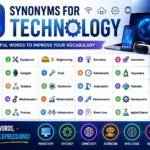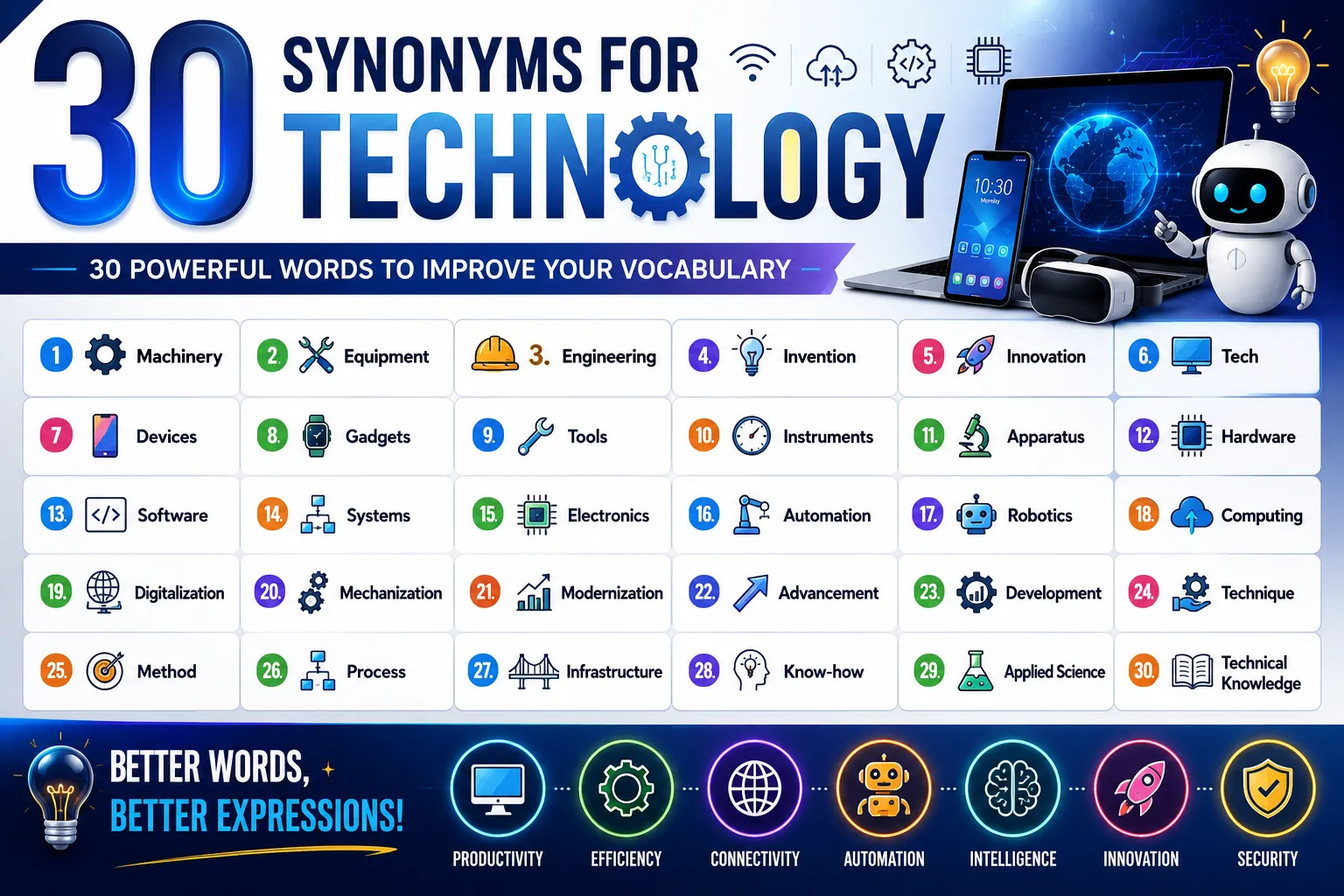
Technology means using tools, machines, and ideas to do things better or faster. Think about your phone. You can use it to call, message, watch videos, or find places. All these things use technology. Learning synonyms for technology can help English learners use more words and speak with ease. It also helps writers avoid repeating the same word. Words like tech, innovation, equipment, machinery, and devices describe different parts of technology. Learning synonyms for technology can also help you choose the right word for each situation. In this guide, you will learn the meaning, examples, grammar, history, pronunciation, and 30 useful related words.
Meaning of Technology
Technology (noun): The use of tools, machines, and science to solve problems or make work easier.
Examples
- Technology helps us talk to people far away.
- We use technology at home, school, and work.
Connotative Meaning
- Positive tone: Progress, speed, comfort, help, and new ideas.
- Negative tone: Too much screen time, loss of jobs, or privacy problems.
- Neutral tone: Tools, machines, systems, and ways of doing work.
Also read more about https://synonymspot.com/synonyms-for-implement/
Etymology
- Source: The word technology comes from Greek.
- Greek root: tekhnē means “skill,” “art,” or “craft.”
- -logy: This part means “study” or “knowledge.”
- The word later came to mean the use of knowledge and skills to make useful things.
Short History of Technology
- Old English (450–1100): The word technology was not used in Old English. People used words for tools, skills, and crafts.
- Middle English (1100–1500): People still used words linked to crafts, tools, and skills. The modern word was not common.
- Modern English (1500–Present): Technology became part of English. Its meaning grew from skills and crafts to machines, science, computers, and digital tools.
Pronunciation (US & UK – IPA)
US: /tekˈnɑːlədʒi/ UK: /tekˈnɒlədʒi/
Syllables
tech-nol-o-gy
Affixation Pattern of Technology
- Root: techn
- Prefix: None
- Suffix: -logy
- Main word: technology — noun
- Related word: technological — adjective
- Related word: technologically — adverb
- Related word: technologist — noun
- Plural: technologies — noun
Word Formation
- Technology — noun
- Technologies — plural noun
- Technological — adjective
- Technologically — adverb
- Technologist — noun
Synonyms of Technology
1. Tech (Noun)
US: /tek/ | UK: /tek/
Meaning: A short word for technology.
Examples:
- I like new tech.
- This tech makes work easier.
2. Innovation (Noun)
US: /ˌɪnəˈveɪʃən/ | UK: /ˌɪnəˈveɪʃən/
Meaning: A new idea or way of doing something.
Examples:
- The phone is a great innovation.
- The company looks for new innovations.
3. Invention (Noun)
US: /ɪnˈvenʃən/ | UK: /ɪnˈvenʃən/
Meaning: Something new that a person creates.
Examples:
- The light bulb was an important invention.
- His new invention saves time.
4. Engineering (Noun)
US: /ˌendʒəˈnɪrɪŋ/ | UK: /ˌendʒɪˈnɪərɪŋ/
Meaning: The work of designing and building machines and systems.
Examples:
- She studies engineering.
- Engineering helps us build safe bridges.
5. Equipment (Noun)
US: /ɪˈkwɪpmənt/ | UK: /ɪˈkwɪpmənt/
Meaning: Tools or machines used for a task.
Examples:
- The lab has new equipment.
- We need better equipment.
6. Machinery (Noun)
US: /məˈʃiːnəri/ | UK: /məˈʃiːnəri/
Meaning: Machines used to do work.
Examples:
- The factory uses large machinery.
- New machinery can save time.
7. Device (Noun)
US: /dɪˈvaɪs/ | UK: /dɪˈvaɪs/
Meaning: A tool or machine made for a special job.
Examples:
- My phone is a useful device.
- This device can measure temperature.
8. Tool (Noun)
US: /tuːl/ | UK: /tuːl/
Meaning: Something used to do a job.
Examples:
- A computer is a useful tool.
- This online tool helps students learn.
9. System (Noun)
US: /ˈsɪstəm/ | UK: /ˈsɪstəm/
Meaning: Parts that work together to do a job.
Examples:
- The computer system is fast.
- The new system saves time.
10. Electronics (Noun)
US: /ɪˌlekˈtrɑːnɪks/ | UK: /ɪˌlekˈtrɒnɪks/
Meaning: Devices and systems that use electricity and electronic parts.
Examples:
- He works with electronics.
- Modern electronics are very small.
11. Automation (Noun)
US: /ˌɔːtəˈmeɪʃən/ | UK: /ˌɔːtəˈmeɪʃən/
Meaning: Using machines or software to do work with little human help.
Examples:
- Automation can save time.
- The factory uses automation.
12. Computing (Noun)
US: /kəmˈpjuːtɪŋ/ | UK: /kəmˈpjuːtɪŋ/
Meaning: The use and study of computers.
Examples:
- He studies computing.
- Computing is useful in many jobs.
13. IT (Noun)
US: /ˌaɪ ˈtiː/ | UK: /ˌaɪ ˈtiː/
Meaning: Short for information technology.
Examples:
- She works in IT.
- Our school needs better IT support.
14. Software (Noun)
US: /ˈsɔːftwer/ | UK: /ˈsɒftweə/
Meaning: Computer programs that help a device work.
Examples:
- I installed new software.
- This software is easy to use.
15. Hardware (Noun)
US: /ˈhɑːrdwer/ | UK: /ˈhɑːdweə/
Meaning: The physical parts of a computer or device.
Examples:
- The computer hardware needs repair.
- New hardware can make a computer faster.
16. Digitalization (Noun)
US: /ˌdɪdʒətəlaɪˈzeɪʃən/ | UK: /ˌdɪdʒɪtəlaɪˈzeɪʃən/
Meaning: The process of using digital tools to change how work is done.
Examples:
- Digitalization has changed banking.
- The school is starting digitalization.
17. Mechanization (Noun)
US: /ˌmekənəˈzeɪʃən/ | UK: /ˌmekənaɪˈzeɪʃən/
Meaning: Using machines to do work.
Examples:
- Mechanization helps farmers.
- Farm mechanization can save time.
18. Development (Noun)
US: /dɪˈveləpmənt/ | UK: /dɪˈveləpmənt/
Meaning: The process of making something new or better.
Examples:
- The development of computers changed life.
- Software development is growing fast.
19. Advancement (Noun)
US: /ədˈvænsmənt/ | UK: /ədˈvɑːnsmənt/
Meaning: An improvement or step forward.
Examples:
- Technology has made many advancements.
- This advancement may help doctors.
20. Modernization (Noun)
US: /ˌmɑːdərnəˈzeɪʃən/ | UK: /ˌmɒdənaɪˈzeɪʃən/
Meaning: The process of making something more modern.
Examples:
- The city needs modernization.
- Modernization can improve public services.
21. Technique (Noun)
US: /tekˈniːk/ | UK: /tekˈniːk/
Meaning: A special way of doing something.
Examples:
- The engineer used a new technique.
- This technique makes the job easier.
22. Method (Noun)
US: /ˈmeθəd/ | UK: /ˈmeθəd/
Meaning: A way of doing something.
Examples:
- We tried a new method.
- This method saves time.
23. Process (Noun)
US: /ˈprɑːses/ | UK: /ˈprəʊses/
Meaning: A set of steps used to do something.
Examples:
- Technology can speed up the process.
- The new process is simple.
24. Know-how (Noun)
US: /ˈnoʊhaʊ/ | UK: /ˈnəʊhaʊ/
Meaning: The practical knowledge needed to do something.
Examples:
- He has the know-how to fix computers.
- You need some technical know-how for this job.
25. Applied Science (Noun Phrase)
US: /əˈplaɪd ˈsaɪəns/ | UK: /əˈplaɪd ˈsaɪəns/
Meaning: Science used to solve real-world problems.
Examples:
- Applied science helps create new tools.
- Medicine uses applied science.
26. Infrastructure (Noun)
US: /ˈɪnfrəˌstrʌktʃər/ | UK: /ˈɪnfrəˌstrʌktʃə/
Meaning: The basic systems and structures needed for a service or place.
Examples:
- Good digital infrastructure helps businesses.
- The country needs better internet infrastructure.
27. Apparatus (Noun)
US: /ˌæpəˈrætəs/ | UK: /ˌæpəˈreɪtəs/
Meaning: A set of tools or equipment used for a special job.
Examples:
- The lab has new apparatus.
- The scientist checked the apparatus.
28. Craft (Noun)
US: /kræft/ | UK: /krɑːft/
Meaning: A skill used to make or do something.
Examples:
- Coding can be a useful craft.
- He learned the craft of computer repair.
29. Digital Transformation (Noun Phrase)
US: /ˈdɪdʒətəl ˌtrænsfərˈmeɪʃən/ | UK: /ˈdɪdʒɪtəl ˌtrænsfəˈmeɪʃən/
Meaning: A big change made by using digital technology.
Examples:
- The company started a digital transformation.
- Digital transformation changed how the team works.
30. Technical Knowledge (Noun Phrase)
US: /ˈteknɪkəl ˈnɑːlɪdʒ/ | UK: /ˈteknɪkəl ˈnɒlɪdʒ/
Meaning: Knowledge about how tools, machines, or systems work.
Examples:
- The job needs technical knowledge.
- His technical knowledge helped fix the machine.
Prototype Meaning
The most common meaning of technology is the use of tools, machines, and science to make life and work easier. When people hear this word, they often think of phones, computers, the internet, robots, and smart devices. But technology also includes simple tools, machines, medical equipment, and ways of doing work.
Prototype Categorization
- General words: tech, technology, know-how, and technical knowledge are broad terms.
- Machines and tools: equipment, machinery, devices, tools, and apparatus describe things we use.
- Digital words: IT, computing, software, hardware, and digitalization relate to computers and digital tools.
- New ideas: innovation, invention, development, and advancement focus on new or better ideas.
- Ways of working: technique, method, process, and craft describe ways to do a task.
- Large systems: systems and infrastructure describe connected parts that support work or services.
- Modern change: automation, mechanization, modernization, and digital transformation describe changes made with technology.
Antonyms of Technology
- Nature (noun): The world that exists without human-made tools.
- Tradition (noun): An old way of doing something passed from one generation to another.
- Simplicity (noun): The use of simple things without complex tools.
- Manual work (noun): Work done mainly by hand.
- Handcraft (noun): Something made mainly by hand.
- Nontechnical (adjective): Not related to technical tools or knowledge.
Short Questions and Answers
What does technology mean?
- Technology means using tools, machines, science, and knowledge to solve problems or make work easier.
When should technology be used?
- Use technology when talking about tools, machines, computers, software, science, or technical systems.
- It works well in both daily and formal English.
Is technology positive or negative?
- Technology is usually neutral.
- It can sound positive when we talk about progress and better tools.
- It can sound negative when we talk about problems such as privacy or too much screen time.
How is technology different from similar words?
- Technology is a broad word.
- Tech is its short and informal form.
- Innovation means a new idea or improvement.
- Equipment means tools or machines used for a job.
- Software means computer programs.
- Machinery means machines used for work.
- IT mainly relates to computers and information systems.
Conclusion
Synonyms for technology and related words can improve your English vocabulary. Words such as tech, innovation, invention, equipment, machinery, devices, software, automation, and computing help you talk about different types of technology. Knowing their meanings also helps you choose the right word when you speak or write. Learning synonyms for technology can make your writing clearer and help you avoid using the same word many times. For English learners, these words are useful at school, at work, and in daily life. Try to learn two or three new synonyms for technology each day. Write a simple sentence with each word and use it in conversation. With daily practice, you can build a stronger vocabulary, speak with more confidence, and express your ideas more clearly.

I’m Zahid Abbas, an educator, researcher, and digital publishing strategist with a passion for linguistics, grammar, and clear communication. As a content creator and SEO specialist, I craft research-driven, reader-focused content that empowers learners and makes knowledge accessible worldwide.